
12. Australia and New Zealand
- 1 Mins to read
- DarkLight
12. Australia and New Zealand
- 1 Mins to read
- DarkLight
Article summary
Did you find this summary helpful?
Thank you for your feedback
PCR Plastic Packaging Regulations
Global
12.1 Regulatory Overview
The standard setting up rules for food contact plastics in Australia and New Zealand is represented by the Australian Standard AS 2070-1999 [1].
Chapter 4.2 “Rework materials” of the Standard provides post-consumer recycled material not deemed to be used in direct contact with food.
Conversely, recycled polymers can be used as part of FCMs if they are not directly in contact with food (i.e., they are separated from the food by a layer that prevents contamination).
This standard, although still valid, is rather old and somehow surpassed by more recent policies in Australia and New Zealand.
In more recent years, namely in 2017, the Food Safety Agency of Australia New Zealand (FSANZ), carried out a project entitled “Chemical Migration from Packaging into Food” (aka Proposal P1034) with the aim of assessing any possible public health and safety risks associated to chemical migration from packaging into food.
Within such project, FSANZ has determined that the estimated dietary exposure to these chemicals is low enough as to not posing concerns to human health and as a consequence, regulatory actions on FCMs have been discontinued. FSANZ referenced to the acceptance of legislation in force in other jurisdictions such as Europe and the USA to ensure safety of food contact materials.
For recycled plastics, compliance with both the EU and US-FDA legislation are accepted in ANZ, and systems based on input stream’s control, along with suitable quality procedures and processes operating under GMP, as in the above-mentioned jurisdictions, can be utilized in ANZ.
This principle has been reaffirmed in a recent WebEx of APCO, the Australian Packaging Covenant Organization, in December 2021, which saw speakers from ANZ authorities, and experts from EU, UK and USA.
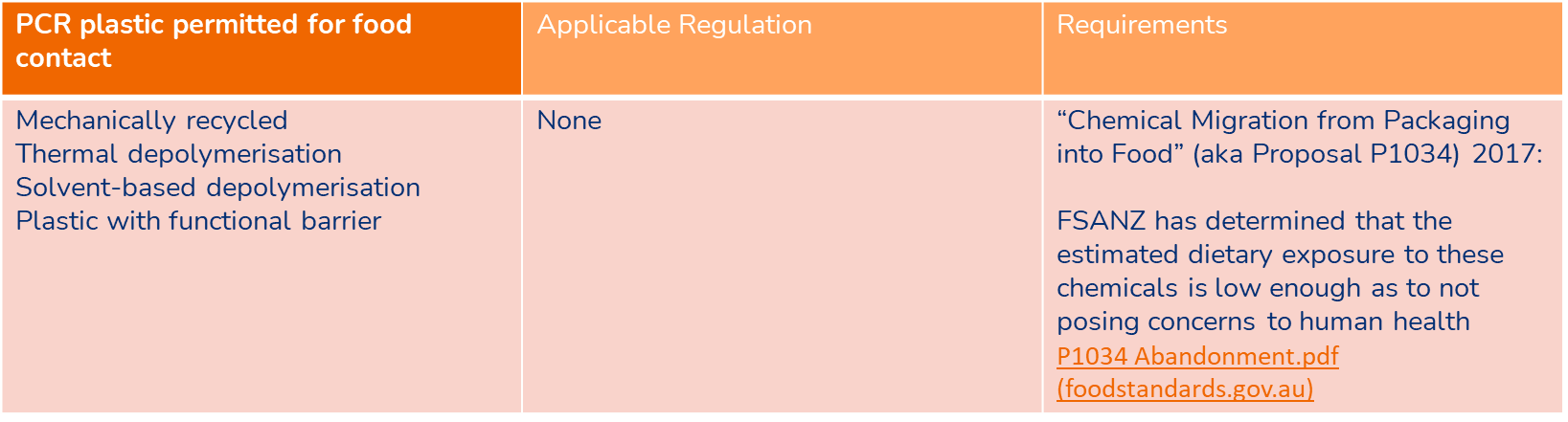
FSNZ - Regulatory Landscape

12.2 References
1. AS 2070-1999 - Plastics materials for food contact use (FOREIGN STANDARD) (ansi.org)
Was this article helpful?