
7. Importation Requirements
- 5 Mins to read
- DarkLight
7. Importation Requirements
- 5 Mins to read
- DarkLight
Article summary
Did you find this summary helpful?
Thank you for your feedback
General Foods Philippines
This section provides information on the importation process (shipment, customs, licenses required, and test requirements).
7.1 Shipment Declaration
There are 2 types of goods declaration (for consumption) [1,2,3]:
- Informal Entry, which covers:
- Goods of a commercial nature with a Free on Board (FOB) or Free Carrier (FCA) value of less than PHP 50,000; and
- Personal and household effects or goods, not in commercial quantity, imported in a passenger’s baggage or mail.
- Formal Entry, which covers goods of a commercial nature with a Free on Board (FOB) or Free Carrier (FCA) value of more than PHP 50,000.
All imported goods shall be subject to the lodgment of a goods declaration which shall be done within 15 days from the date of discharge of the last package from the vessel or aircraft. Documents required include:
- Commercial invoice/pro-forma invoice
- Bill of lading (for sea freight) or air waybill (for air freight)
- Certificate of origin (if requested)
- Packing list
- Import permit
- Applicable special certificates (e.g. Certificate of Product Registration - CPR)
- Commercial invoice of returned Philippine goods and/or supplemental declaration on valuation
Note that food products are considered Regulated Imports which are goods subject to regulations by concerned government agencies such as the Food and Drug Administration (FDA). Regulated goods may be imported only after securing the necessary permits, clearances, licenses, or any other requirements prior to importation and circulation as the case may be.
7.2 Customs Procedure
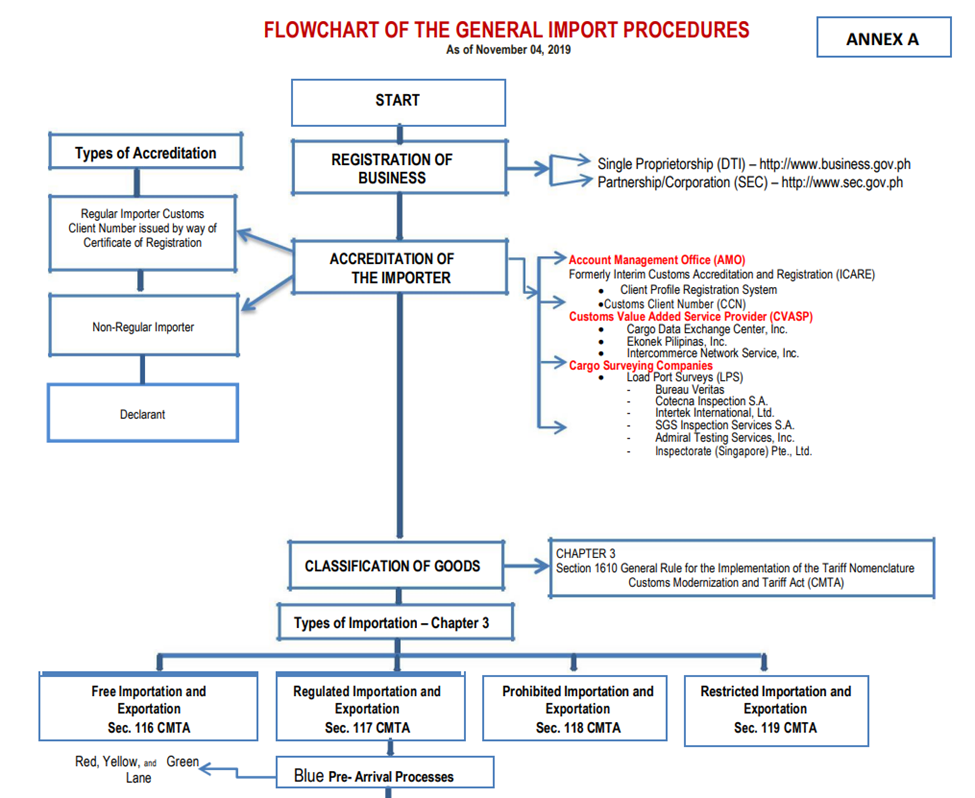
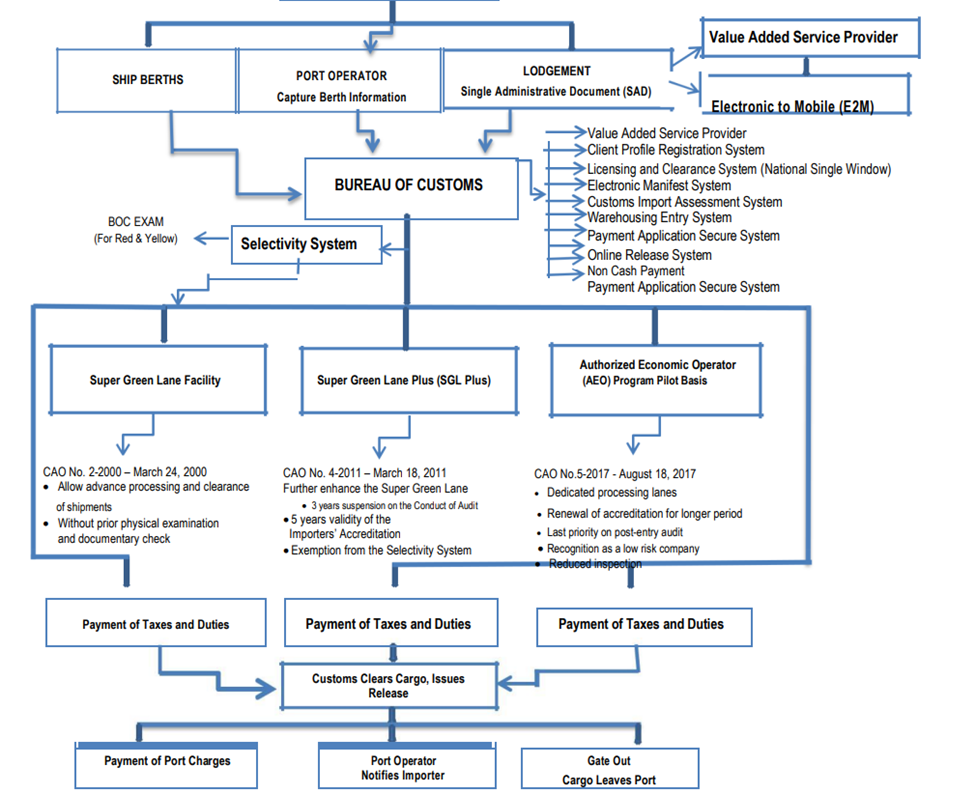
Customs procedure has the following process [1, 3, 4, and 5]
1. Before import:
An importer will need to register and must first secure an Import Clearance Certificate from the BIR (Bureau of Internal Revenue). Registration must then be made with the BOC (Bureau of Customs). From there, an account with the Client Profile Registration System must be created.
- Single Proprietorship (DTI) – http://www.business.gov.ph
- Partnership/Corporation (SEC) – http://www.sec.gov.ph
2. Customs declaration:
Persons Authorized to Lodge Goods Declaration – Declarant: Any person who makes a goods declaration or in whose name a goods declaration is made.
- The importer, being the holder of the bill of lading or airway bill. In case the importer is a juridical person, it may authorize a responsible officer of the company to sign the goods declaration as a declarant on its behalf.
- For a corporation, the responsible officer must be authorized by the Board of Directors to sign as the declarant on its behalf.
- For a partnership, the responsible officer must be authorized by the partners.
- For sole proprietorship, the responsible officer must be authorized by the owner, who shall issue a Special Power of Attorney (SPA).
- A customs broker acting under the authority of the importer or from a holder of the bill; or
- A person duly empowered to act as agent or attorney-in-fact for each holder of the bill.
Guidelines to complete Single Administrative Documents (SAD) are in Reference [4].
3. Selectivity System:
Determines the selection of the examination procedures based on risk criteria established in the Customs Cargo Clearance System. The Customs Cargo Clearance System assigns the declared goods to one of the following control channels:
- Red lane – documentary check and physical examination or non-intrusive inspection, or magna scale weighing, when necessary;
- Yellow lane – documentary check;
- Blue lane – to be considered for post-clearance audit; or
- Green lane – released without documentary check and without examination of the goods.
4. Payment of Taxes and Duties
5. Customs Clears Cargo, Issues Release
6. Payment of Port Charges, Port Operator Notifies Importer, Gate Out Cargo Leaves Port
7.3 Manufacturing License
Not required.
7.4 Test for Importation
Imported foods shall undergo cargo inspection and clearance procedures by the Department of Agriculture (DA) and the Department of Health (DOH) at the first port of entry to determine compliance with national regulations [6,7,8,9].
This inspection by the DA and the DOH shall always take place prior to the assessment for tariffs and other charges by the Bureau of Customs (BOC). The BOC and the Association of International Shipping Lines (AISL) shall provide the DA and the DOH documents such as the Inward Foreign Manifest of Arriving Vessels to enable the DA and the DOH to identify shipments requiring food safety inspection. Shipments not complying with national regulations shall be disposed of according to policies established by the DA and the DOH.
An inspection shall be conducted if the product falls into the red lane, i.e. physical examination by the BOC.
There is no list of the mandatory testing parameters. The applicable testing criteria can be consulted from the current regulations on contaminants in the Philippines or the Codex, as the Philippines adopted Codex guidelines on contaminants in food. The regulations on contaminants that may apply:
- CXS 193-1995 - General standard for contaminants and toxins in food and feed
- FDA Circular No.2022-012 - Guidelines on the Microbiological Requirements and Assessment of Certain Prepackaged Processed Food Products
7.5 Other Notes or Requirements for Importation
Import licenses and permits must be obtained from the relevant regulatory body for the goods to be imported to the Philippines before the products are shipped from the exporting countries [1, 10].
A Sanitary and Phytosanitary Import Clearance (SPSIC) must be obtained from the Philippine Department of Agriculture, Bureau of Animal Industry (BAI), the Bureau of Plant Industry (BPI), or the Bureau of Fisheries and Aquatic Resources (BFAR), as applicable, prior to each and every importation of plant, animal, and fishery products. A Certificate of Product Registration (CPR) must be secured from the Philippines FDA prior to the initial importation of a particular food or beverage.
In addition, all food establishments shall secure a Licence to Operate (LTO) before engaging in food manufacturing, importation, exportation, sale, offer for sale, distribution, transfer, and where applicable the use, testing, promotion, advertisement, and/or sponsorship of food products. Once the FDA-LTO is secured, an initial application for CPR can be submitted.
7.6 Overview Flowchart for Importation Process
7.7 References
1. Import facilitation
https://www1.dti.gov.ph/negosyo/imports/import-facilitation/
2 PH Bureau of Customs - Importation
https://customs.gov.ph/importation/
3. Clearance Procedures for Goods Entered for Consumption Under the Formal Entry Process (CAO 09-2020)
https://customs.gov.ph/wp-content/uploads/2020/06/CAO-09-2020.pdf
5. How to complete the single administrative document (SAD) imports
https://www.customs.gov.sb/files/contents/traders/How%20to%20Complete%20an%20Import%20SAD.pdf
6. SEC. 12b Food Safety Act 2013 (Republic Act No. 10611)
https://faolex.fao.org/docs/pdf/phi128390.pdf
7. FDA Circular No.2010-008 Adoption of Codex standards on food contaminants in processed food.
https://www.fda.gov.ph/wp-content/uploads/2021/08/FDA-Circular-No.2010-008.pdf
8. CXS 193-1995 General standard for contaminants and toxins in food and feed
9. FDA Circular No.2022-012 Guidelines on the Microbiological Requirements and Assessment of Certain Prepackaged Processed Food Products
https://www.fda.gov.ph/wp-content/uploads/2022/12/FDA-Circular-No.2022-12-1.pdf
10. Administrative Order No. 2014-0029 Rules and Regulations on the Licensing of Food Establishments and Registration of Processed Food, and the Other Food Products, and for Other Purposes
https://www.fda.gov.ph/wp-content/uploads/2021/03/Administrative-Order-No.-2014-0029.pdf
Was this article helpful?