
4. USA
- 4 Mins to read
- DarkLight
4. USA
- 4 Mins to read
- DarkLight
Article summary
Did you find this summary helpful?
Thank you for your feedback
PCR Plastic Packaging Regulations
Global
4.1 Regulatory Overview
Overview
Food contact plastics originated from recycling processes do not have to undergo to specific legislation in the USA. The same safety requirements applicable to virgin resins are also applicable to recycled resins, and in particular the provisions set out in Title 21 of the Code of Federal Regulations (CFR), part 177 "Indirect Food Additives- Polymers" [1]. For example, Polyolefins shall fulfil section 177.1520 of CFR [2], PET shall fulfil section 177.1630 [3], etc.
Similarly to Europe, the recycling process shall be demonstrated to possess a cleaning efficiency that makes the polymers in line with the above mentioned requirements.
FDA has published the “Guidance for Industry: Use of Recycled Plastics in Food Packaging (Chemistry Considerations)” [4] (latest version in July 2021) in order to help the recycling operators to assess the cleaning efficiency of their processes. Upon request of the recycling operator, FDA can release a Letter Of No-Objection (LONO) reporting its expert opinion on the capability of the process under examination to deliver polymers in fulfilling the requirements of the relevant section of CFR. It is not mandatory for a recycling operator to obtain al LONO from FDA, however FDA has the power of inspecting plants and seizing products should compliance with safety legislation be missed. As a matter of fact, all businesses that operate polymer recycling processes apply for the LONO.
The Guidelines list three forms of recycling:
- Pre-Consumer Scrap, or Primary Recycling. This form of recycling consists of the recycling of industrial scrap produced during the manufacture of food contact articles and it is acceptable, provided good manufacturing practices are followed. This process is not expected to pose a hazard to the consumer, therefore it is not necessary to obtain a LONO.
- Physical Reprocessing or Secondary Recycling. It consists of physical reprocessing involving grinding, melting, and reforming plastic packaging material, where the basic polymer is not altered during the process. Recyclers should be able to demonstrate that contaminant levels are reduced to sufficiently low levels to ensure that the resulting packaging is of a purity suitable for its intended use, such demonstration usually is made through a surrogate contaminants test (aka “challenge test”); a LONO is usually required for Secondary Recycling.
- Chemical Reprocessing or Tertiary Recycling. This form of recycling consists in the regeneration of purified starting materials (see next paragraph).
Non-mechanical recycling technologies
Chemical Reprocessing, or Tertiary Recycling constitutes a non-mechanical form of recycling. It may involve depolymerization of the used packaging material with subsequent regeneration and purification of resulting monomers (or oligomers), which are then repolymerized, as such or blended with virgin materials. Tertiary recycling was primarily addressed to glycolysis of PET or other polyesters such as PEN (polyethylene naphthalate). A LONO should in principle be requested for these processes, however surrogate contaminant testing is no longer considered necessary to demonstrate that PET or PEN produced by a tertiary recycling process is suitable for food-contact use. Because of the costs associated with this process, some grades available on the market consist of partially depolymerized PET (via glycolysis) mixed with virgin PET (e.g. from Indorama, DAK and other suppliers).
Other chemical recycling processes would however be more properly addressed towards a FDA’s LONO. One examples is the solvent-based PureCycle® [5] technology, which is has been developed to recycle polypropylene via a solvent-based technology, for which a LONO application has been filed in September 2021 (and the resulting polypropylene grade is already in use for packaging of body care detergents).
It is worth being noted that thermal depolymerization is not included in the FDA Guidance: this technology is considered a form of recovery rather than recycling, and the resulting polymers are safe as long as they fulfil the requirements of the relevant section of CFR. Consequently, no applications for LONO are made for thermal depolymerization processes.
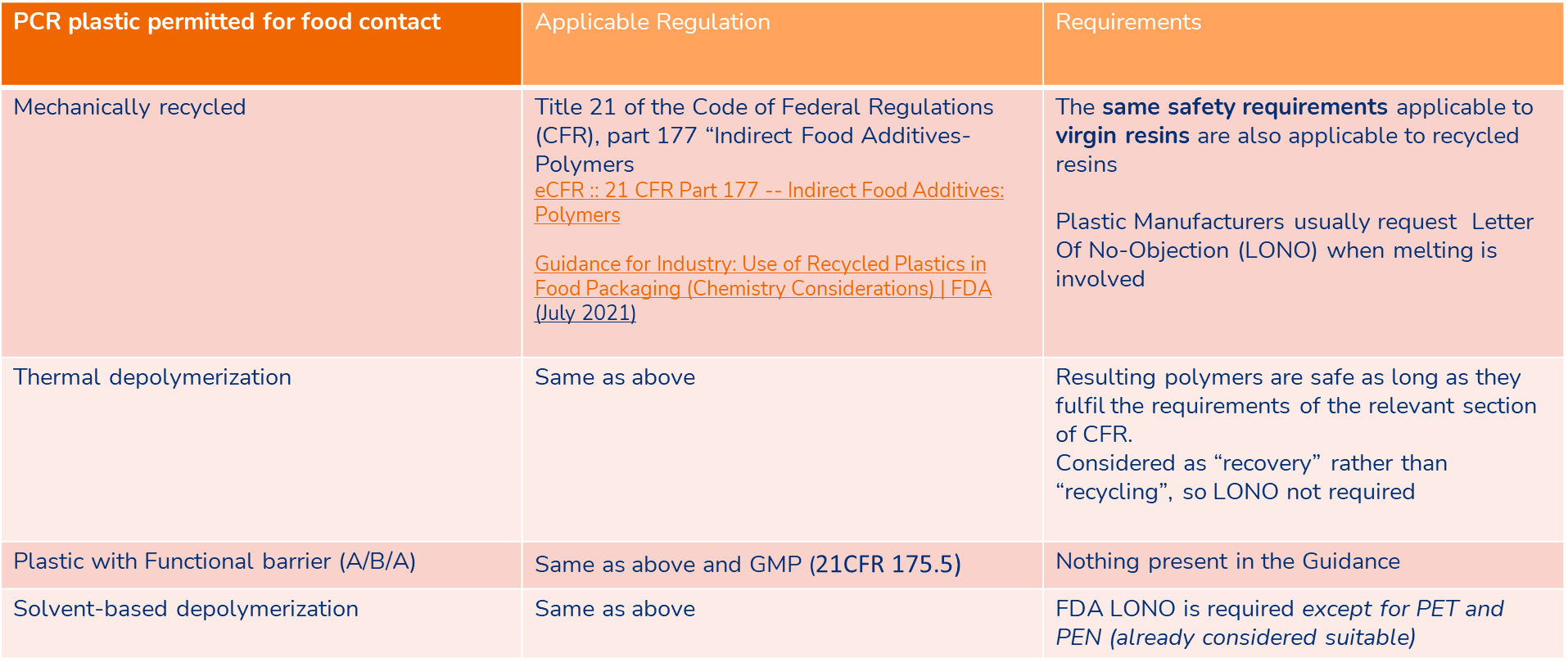 USA - Regulatory Landscape
N.B.: Safety recycled polymers: contamination based on 1.5 micrograms/person/day → back calculation of the residues in polymers.
4.2 Specific Highlights
The surrogate contaminant test in use in the USA to proof the decontamination efficiency of the recycling processes does not differ in principle from those used in Europe but, as such test is not standardized, several approaches may be possible. These approaches may differ in the procedure with which the contaminants are incorporated in the resin which undergoes the decontamination step. Such procedure may have an influence on the decontamination.
For example, for polymers with high diffusion, such as PET, the decontamination is relatively easy, therefore contaminants may be removed more easily during recycling, thus making the decontamination efficiency higher. For polymers with less diffusivity, such as polyolefins, the decontamination is more difficult, surrogate contaminants in the polymer are usually removed with much more difficulty.
A fundamental difference between the US and the EU systems lies in the way FDA assesses safety of recycled polymers. FDA believes that Estimated Daily Intake of contaminants from recycled food-contact articles of 1.5 micrograms/person/day or less are generally of negligible risk; from this value, FDA can calculate the maximum residue amount of contaminants in different polymers that may lead to such exposure’s threshold. Such amounts can be calculated for different polymers, PET, polyolefins, polystyrene etc, and by using such an approach FDA, unlike EFSA, can risk assess recycled polymers in a much easier way.
The risk assessment approach operated by FDA can be applied widely and it is more flexible. For such reason, other jurisdictions have adopted an FDA-like system to assess recycled polymers.
4.3 References
1. eCFR :: 21 CFR Part 177 -- Indirect Food Additives: Polymers
3. eCFR :: 21 CFR 177.1630 -- Polyethylene phthalate polymers.
4. Guidance for Industry: Use of Recycled Plastics in Food Packaging (Chemistry Considerations) | FDA
Was this article helpful?