
4. Labeling Requirements
- 8 Mins to read
- DarkLight
4. Labeling Requirements
- 8 Mins to read
- DarkLight
Article summary
Did you find this summary helpful?
Thank you for your feedback
Foods with Nutrient Function Claims (FNFC)
Japan

This section provides information on labeling requirements and the label approval process.
4.1 Mandatory Labeling Parameters
General Food [1]
A) Processed foods shall bear the following labeling items:
- Product generic name
- List of ingredients (in decreasing order of weight)
- List of additives (in a decreasing order of weight including processing aids unless exempted)
- Net quantity
- Expiry date (use-by date or best-before date)
- Storage conditions
- Country of origin (applicable for imported products)
- Name of food business operator (manufacturer, processor, distributor, or importer)
- Name of the manufacturer (if the product is manufactured in Japan and if different from the food business operator)
- Nutrition declaration table (per 100 g, 100 ml, serving, etc.)
- Other labeling items are required on a case-by-case basis by the Food Labeling Standards
The mandatory labeling information shall be presented in the same table in the following order according to Article 8 and Appended Form 1 of the Food Labeling Standards [1]:
- Product generic name
- List of ingredients (in decreasing order of weight)
- List of additives (in a decreasing order of weight including processing aids unless exempted)
- Net quantity
- Expiry date (use-by date or best-before date)
- Storage conditions
- Country of origin
- Name of the manufacturer (or name of the importer for imported products)
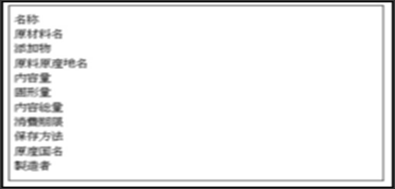
The nutrition declaration table shall be prepared according to Article 8 and Appended Form 2 of the Standards. The nutrition declaration shall include the following mandatory information:
- Unit (100 g, 100 ml, serving, etc.)
- Energy (kcal)
- Protein (g)
- Fat (g)
- Carbohydrates (g)
- Salt equivalent (g)
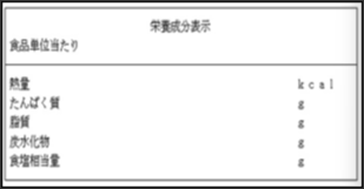
The 5 macronutrients are mandatory for all processed foods, with some exemptions (e.g., the surface area for label indication is 30 cm2 or smaller, alcoholic beverages, foods of which nutritional contribution is very limited such as coffee beans and its extract, herb and its extracts).
Note: The % of RDI is mandatory for FNFC, but not required for the other foods including general foods and FFC/FOSHU.
Declaration of other nutrients described below is optional but when doing so, there is a specific way required by the regulation.
The contents of the following nutrients can be included in the above table (Article 8 and Appended Form 3). When doing so, cholesterol shall be presented after fat and before carbohydrates. Saturated fatty acid, n-3 fatty acid, and n-6 fatty acid shall be presented as a breakdown of fat. The trans fatty acid can be declared after n-6 fatty acid. Similarly, sugar and dietary fiber shall be presented as a breakdown of carbohydrates. Mono- and di-saccharides shall be presented as a breakdown of sugar. The other ‘optional’ nutrients (i.e., vitamins and minerals) shall be presented after the salt equivalent.
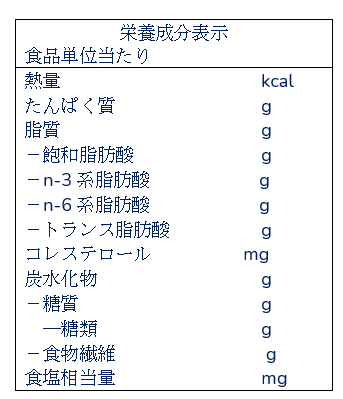
- Unit (100 g, 100 ml, serving, etc.)
- Energy (kcal)
- Protein (g)
- Fat (g)
- Saturated fatty acid (g)
- n-3 fatty acid (g)
- n-6 fatty acid (g)
- Trans fatty acid (g)
- Cholesterol (mg)
- Carbohydrates (g)
- Sugar (g)
- Mono- and di-saccharides (g)
- Dietary fiber (g)
- Salt equivalent (g)
- (vitamins and minerals (mg or µg))
The contents of any other food constituents that are not specified in the Food Labeling Standards (e.g., polyphenol, catechin, beta carotene, DHA) can be declared, but they shall be presented for example outside of the nutritional declaration table so that consumers can easily understand that they are not the nutrients specified by the Standards.
B) Fresh foods (agricultural products, meat products, and seafood) shall bear the following labeling items:
- Product generic name
- Place of origin
- Other labeling items required on a case-by-case basis by the Food Labeling Standards
Category
In addition to the mandatory items listed in "General Food", the following items are required for FNFC products (the words and sentences in brackets are the precise statements that FNFC products must bear on their package):
- Food classification (“栄養機能食品”) followed by the contained nutrient(s) name (e.g. “栄養機能食品(カルシウム)” meaning “FNFC (calcium)”)
- FNFC claim(s) of the contained nutrient(s) (the specified claims presented in Table 4.1-1 below)
- Recommended daily intake
- Nutrition declaration table for the 5 mandatory macronutrients and the contained nutrient(s) (per recommended daily serving)
- Directions for use
- Warnings for use (the specified warnings presented in Table 4.1-1 below)
- Notes for healthy eating (“食生活は、主食、主菜、副菜を基本に、食事のバランスを。”) (in English: “A balanced diet is based on staple foods, main dishes, and side dishes.”)
- Warnings that this product is not evaluated by the CAA (“本品は、特定保健用食品と異なり、消費者庁長官による個別審査を受けたものではありません。”) (in English: “Unlike food for specified health uses, this product has not been individually reviewed by the Commissioner of the Consumer Affairs Agency.”)
- Percentage of the contained nutrient(s) against the Nutrients Labeling Standard Values (Table 4.1-2 below)
- Age group for which the Nutrients Labeling Standard Values are established and the calorie of the Nutrients Labeling Standard Values (“栄養素等標準基準値(18歳以上、基準熱量 2,200kcal)” meaning “Nutrient Labeling Standard Values (18 or older, the standard calorie 2,200 kcal)”)
- Instructions for cooking and/or storage (if applicable)
- Other warnings (if applicable)
Table 4.1-1 Prescribed FNFC Claims and Warning Statement for Use | ||||
Nutrient | Minimum content per daily serving | Maximum content per daily serving | Claim | Warning |
n-3 fatty acid | 0.6 g | 2.0 g |
|
|
Zinc | 2.64 mg | 15 mg | Zinc is a necessary nutrient to maintain normal taste and help to maintain healthy skin and mucous membranes. It is involved in the metabolism of protein and nucleic acids and is helpful in maintaining health. | Increased intake of this product will not result in curing diseases or promoting health. Too much intake of zinc might inhibit the absorption of copper. Please comply with the advisable daily intake. Infants and young children should avoid the use of this product. |
Potassium | 840 mg | 2800 mg | Potassium is necessary for maintaining normal blood pressure. | Increased intake of this product will not result in curing diseases or promoting health. Please comply with the advisable daily intake. People with reduced kidney function should avoid the use of this product. |
Calcium | 204 mg | 600 mg | Calcium is necessary for the development of bone and teeth. | Increased intake of this product will not result in curing diseases or promoting health. Please comply with the advisable daily intake. |
Iron | 2.04 mg | 10 mg | Iron is necessary in the red blood cell formation. | Increased intake of this product will not result in curing diseases or promoting health. Please comply with the advisable daily intake. |
Copper | 0.27 mg | 6.0 mg | Copper helps to form red blood cells and helps the proper function of many body enzymes and bone formation. | Increased intake of this product will not result in curing diseases or promoting health. Please comply with the advisable daily intake. Infants and young children should avoid the use of this product. |
Magnesium | 96 mg | 300 mg | Magnesium is necessary in the development of bone and teeth, maintains proper blood circulation, and helps the proper function of many body enzymes and energy generation. | Increased intake of this product will not result in curing diseases or promoting health. Increased intake might cause diarrhea. Please comply with the advisable daily intake. Infants and young children should avoid the use of this product. |
Niacin | 3.9 mg | 60 mg | Niacin helps to maintain skin and mucosa healthy. | Increased intake of this product will not result in curing diseases or promoting health. Please comply with the advisable daily intake. |
Pantothenic acid | 1.44 mg | 30 mg | Pantothenic acid helps to maintain skin and mucosa health. | Increased intake of this product will not result in curing diseases or promoting health. Please comply with the advisable daily intake. |
Biotin | 15 µg | 500 µg | Biotin helps to maintain skin and mucosa health. | Increased intake of this product will not result in curing diseases or promoting health. Please comply with the advisable daily intake. |
Vitamin A | 231 µg | 600 µg | Vitamin A helps to maintain vision in the dark and helps to maintain skin and mucosa health. | Increased intake of this product will not result in curing diseases or promoting health. Please comply with the advisable daily intake. Women within the third month of pregnancy or women considering to be pregnant should be careful of overconsumption. |
Vitamin B1 | 0.36 mg | 25 mg | Vitamin B1 helps to produce energy from carbohydrates and to maintain skin and mucosa health. | Increased intake of this product will not result in curing diseases or promoting health. Please comply with the advisable daily intake. |
Vitamin B2 | 0.42 mg | 12 mg | Vitamin B2 helps to maintain skin and mucosa healthy. | Increased intake of this product will not result in curing diseases or promoting health. Please comply with the advisable daily intake. |
Vitamin B6 | 0.39 mg | 10 mg | Vitamin B6 helps to produce energy from protein and to maintain skin and mucosa health. | Increased intake of this product will not result in curing diseases or promoting health. Please comply with the advisable daily intake. |
Vitamin B12 | 0.72 µg | 60 µg | Vitamin B12 aids in the red blood cell formation. | Increased intake of this product will not result in curing diseases or promoting health. Please comply with the advisable daily intake. |
Vitamin C | 30 mg | 1000 mg | Vitamin C helps to maintain skin and mucosa healthy and has an anti-oxidizing effect. | Increased intake of this product will not result in curing diseases or promoting health. Please comply with the advisable daily intake. |
Vitamin D | 1.65 µg | 5.0 µg | Vitamin D promotes to absorption of calcium in the gut intestine and aids in the growth of bone. | Increased intake of this product will not result in curing diseases or promoting health. Please comply with the advisable daily intake. |
Vitamin E | 1.89 mg | 150 mg | Vitamin E helps to protect fat in the body from being oxidized and to maintain cell health. | Increased intake of this product will not result in curing diseases or promoting health. Please comply with the advisable daily intake. |
Vitamin K | 45 µg | 150 µg | Vitamin K maintains normal blood coagulation. | Increased intake of this product will not result in curing diseases or promoting health. Please comply with the advisable daily intake. People taking anticoagulants should avoid the use of this product. |
Folic acid | 72 µg | 200 µg | Folic acid aids in red blood cell formation, and contributes to the normal growth of the fetus. | Increased intake of this product will not result in curing diseases or promoting health. Please comply with the advisable daily intake. This product helps the normal development of the fetus, but increased intake of this product will not result in better development of the fetus. |
Table 4.1-2 Nutrition Labeling Standard Values (calculated for the Japanese 18 years old or older) | |
Nutrient | Nutrition Labeling Standard Value |
n-3 fatty acid | 2.0 g |
Zinc | 8.8 mg |
Potassium | 2800 mg |
Calcium | 680 mg |
Iron | 6.8 mg |
Copper | 0.9 mg |
Magnesium | 320 mg |
Niacin | 13 mg |
Pantothenic acid | 4.8 mg |
Biotin | 50 µg |
Vitamin A | 770 µg |
Vitamin B1 | 1.2 mg |
Vitamin B2 | 1.4 mg |
Vitamin B6 | 1.3 mg |
Vitamin B12 | 2.4 µg |
Vitamin C | 100 mg |
Vitamin D | 5.5 µg |
Vitamin E | 6.3 mg |
Vitamin K | 150 µg |
Folic acid | 240 µg |
Calorie | 2200 kcal |
Product
Same as above.
4.2 Languages
Japanese
4.3 Mandatory Information on Stickers
It is acceptable to capture mandatory labeling information on an additional sticker if such a sticker is used to present labeling information required by the Japanese regulations in the Japanese language.
4.4 Product Legal Name
Product
栄養機能食品 (meaning “Food with Nutrient Function Claims”)
4.5 Product-specific Labeling Statements
Category
Please see the "List of all the mandatory labeling parameters".
Product
Same as above.
4.6 Authority Approval of Product Label
N/A
4.7 Additional Notes on Labeling
None.
4.8 References
1. Food Labelling Standards (Cabinet Ordinance No.10 of 2015)
https://elaws.e-gov.go.jp/document?lawid=427M60000002010 (in Japanese)
Was this article helpful?