
3. United Kingdom
- 3 Mins to read
- DarkLight
3. United Kingdom
- 3 Mins to read
- DarkLight
Article summary
Did you find this summary helpful?
Thank you for your feedback
PCR Plastic Packaging Regulations
Global
3.1 Current Regulatory Landscape
Overview
EU legislation which applied directly or indirectly to the UK before 31 December 2020 has been retained in UK law [1] as a form of domestic legislation known as "retained EU legislation". This is set out in sections 2 and 3 of the European Union (Withdrawal) Act 2018 (c. 16). Section 4 of the 2018 Act ensures that any remaining EU rights and obligations, including directly effective rights within EU treaties, continue to be recognized and available in domestic law after exit.
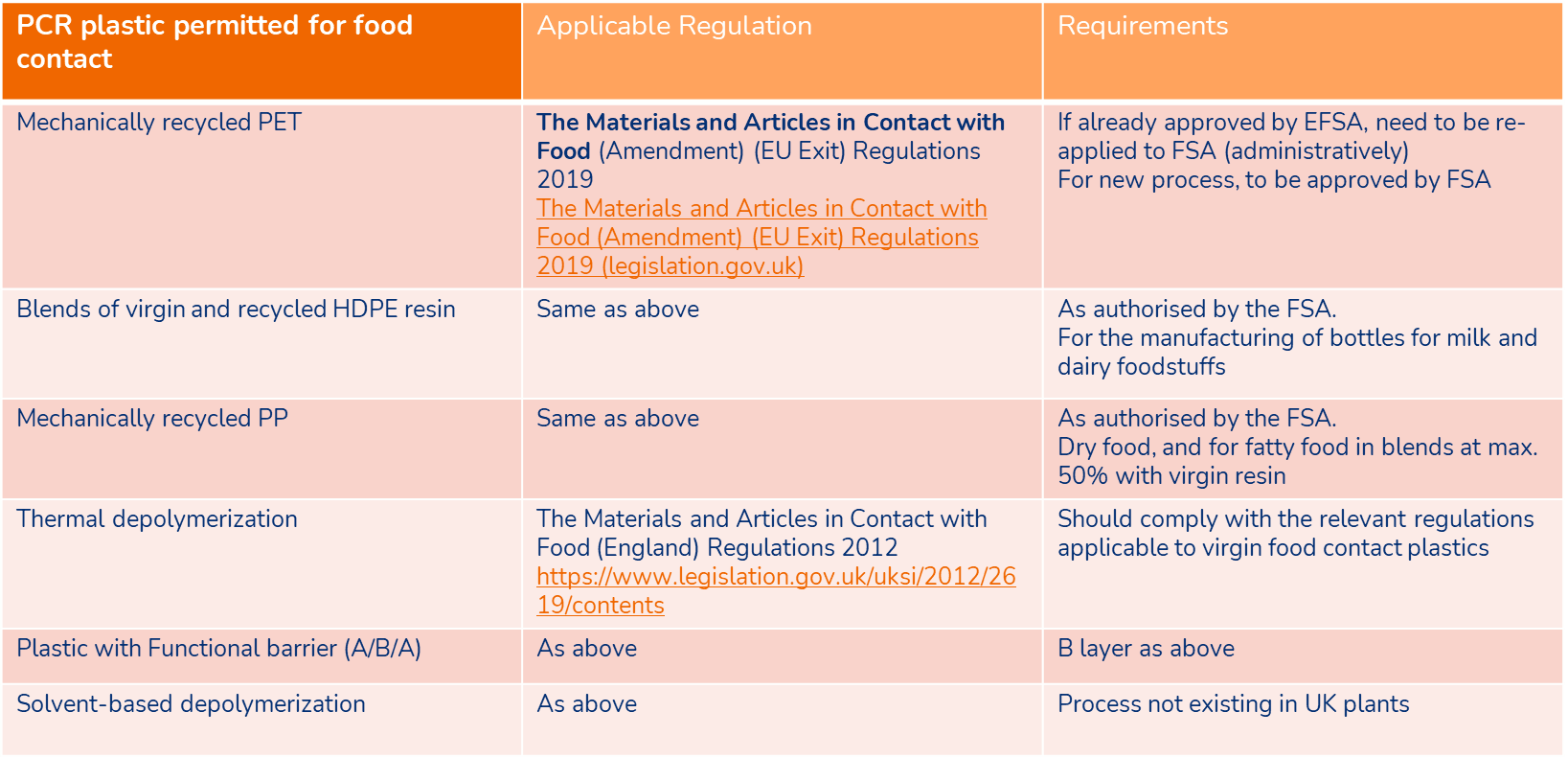
Upon the process of withdrawal of UK from the EU, Regulation 282/2008- previously applicable in the UK- was amended by The Materials and Articles in Contact with Food (Amendment) (EU Exit) Regulations 2019 accounting for the administrative changes originated from the exit of UK from the EU. Such Act, among others, transferred the provisions under the purview of EFSA to the UK Food Safety Agency (FSA). This regulation became applicable on 31 January 2020, date of the entering into force of the European Union (Withdrawal) Act 2018 [2].
However, even before 31 January 2008, the substantial lack of enforcement of Regulation 282/2008, left considerable leeway to the National food safety authorities to locally authorize recycling processes:
- In the UK, blends of virgin and recycled HDPE resin are in use since 2007 for the manufacturing of bottles for milk and dairy foodstuffs [3]. Authorization of such uses was granted by FSA, on a National basis, through no-objection letters. Besides, a capacity of 5k tons/year for recycled PP [4] is also installed in the UK since 2010.
- The PP obtained through this process has been evaluated as safe by the law firm Steptoe (which issued a specific opinion letter), for applications limited to dry food, and for fatty food in blends at max. 50% with virgin resin. The product is used for fruits and mushrooms punnets, and it is also exported to France, Germany and the Netherlands for non-food contact application.
Non-mechanical recycling technologies
The legislation for plastics obtained via non-mechanical recycling technologies does not differ in UK vs. the EU legislation.
In relation to feedstock (thermal) recycling, this is allowed as long as the resulting resins fulfil the requirements of the legislation applicable to virgin plastics, i.e.:
- The Materials and Articles in Contact with Food (England) Regulations 2012
- The Materials and Articles in Contact with Food Regulations (Northern Ireland) 2012
- The Materials and Articles in Contact with Food (Wales) Regulations 2012
- The Materials and Articles in Contact with Food (Scotland) Regulations 2012 (amended in 2019)
Other forms of chemical recycling do not fall within the scope of the current legislation.
Specific highlights
The polyolefin decontamination process consists of sorting bales of plastic bottles into HDPE stream, size reduction to flakes, washing at high temperatures, color sorting, final decontamination at 120°C for over 2 hours (through a Vacurema process) and extrusion under vacuum into pellets. The pellets are subsequently blended with virgin HDPE to manufacture bottles with a concentration of recycled POs of usually 20%.
Two production lines are installed in the UK since 2009 by Veolia (formerly CLR) and two by Biffa Polymers for total of >60,000 ton, corresponding to a production of 30 billion bottles.
 United Kingdom - Regulatory Landscape
3.2 Relationship between EU and UK
Overview
In Europe, two processes were submitted in 2015 by CLR and Biffa Polymers, but EFSA could not reach any decision as the ability of the processes to produce safe recycled HDPE. These applications are de facto still on-hold.
The lack of decision was caused by the use by EFSA of a risk assessment process which applies only to PET. The criteria to establish the ability of the process to decontaminate resins originates in fact from data relevant for PET but not relevant for polyolefins or other polymers.
Conversely, the applicants were able to show the UK FSA that the polyolefins recycling processes were sufficiently kept under control, as to enable a positive scientific opinion by FSA.
The current legislation provides a framework within which recycled resins are subject to risk assessment by EFSA. It is not excluded that (as already demonstrated by the polyolefins case discussed above) the UK FSA would adopt different criteria than EFSA for the assessment of such recycled plastics.
Specific highlights
Although not specifically representing an emerging legislation, it may be worth highlighting the special situation that is created in Northern Ireland by the European Union (Withdrawal Agreement) Act 2020, by virtue of which the legislation of the EU will continue to apply after the Withdrawal Agreement. This would likely result in a conflict should Regulation 282/2008 be repealed after entry into force of the proposed new draft (whether as such or modified).
3.3 References
1. Food contact materials regulations | Food Standards Agency
2. European Union (Withdrawal) Act 2018 (legislation.gov.uk)
3. HDPE plastic bottles | WRAP
4. Food grade recycled polypropylene (rPP) in packaging | WRAP
Was this article helpful?