
3. Compositional Aspects
- 14 Mins to read
- DarkLight
3. Compositional Aspects
- 14 Mins to read
- DarkLight
Article summary
Did you find this summary helpful?
Thank you for your feedback
Beers, RTDs, Whisky
Singapore

This section provides the compositional requirements for the food category and/or food products in scope and information on permitted nutrients, ingredients, and additives.
3.1 Composition Requirements
General Food
Foods shall be safe and suitable for human consumption.
Category
Alcoholic drinks
Flavor restrictions: Where no provisions are laid down for a given alcoholic drink, Regulations 22 and 23 [1] on permitted flavoring agents and flavor enhancers should be followed. Refer to Section 3.6 below on permitted flavors and prohibited substances.
Alcohol content: Regulation 185(1) states that Alcoholic drinks shall contain more than 0.5% (v/v) alcohol at 20oC. It includes “toddy” but does not include denatured spirit.
Product
1) Beer
Alcohol content: Regulation 186 [1] states that “beer shall be a fermented liquid containing not less than 1.0% (v/V) alcohol at 20oC. It shall be brewed from a mash of malted or other grain and sugar or dextrose or both, with hops or other harmless vegetable bitters.”
Flavor restrictions: same as "Category" (alcoholic drinks) above.
2) Ready-to-drink beverages (mainly Chuhai)
Same as "Category" (alcoholic drinks) above.
3) Whisky
Alcohol content: Regulations 204(1) and 204(4) [1] state that “whisky shall be the alcoholic distillate obtained from a mash of cereal grain or cereal grain products matured by storage in wood to develop its characteristics, with or without the addition of caramel. Whisky shall contain not less than 37% (v/v) alcohol at 20oC.”
Flavor restrictions: Flavored whisky shall be whisky with the addition of a permitted flavoring agent per Regulation 22 [1]. Refer to below Section 3.6 on permitted flavors and prohibited substances contained within.
3.2 Raw Material Requirements
General Food
Under the Sale of Food Act, Section 2A defines food as [2]:
- any substance or thing of a kind used, capable of being used, or represented as being for use, for human consumption (whether it is live, raw, prepared, or partly prepared);
- any substance or thing of a kind used, capable of being used, or represented as being for use, as an ingredient or additive in a substance or thing mentioned in paragraph (a);
- any substance used in preparing a substance or thing mentioned in paragraph (a) (other than a substance used in preparing a living thing);
- chewing gum or an ingredient or additive in chewing gum, or any substance used in preparing chewing gum;
- and any substance or thing declared by the Minister by order in the Gazette to be food.
Raw materials used are regulated under the Sale of Food Act and Food Regulations. Refer to the Food Regulations for individual product standards (if any).
Regulation 36A of the Food Regulations [1] also states that partially hydrogenated oil shall not be used as an ingredient or in the manufacture of any prepacked food.
* The Food Safety and Security Act (FSSA) [4], with its implementation done in phases and full transition by 2028, shares the same scope in terms of the definition of “food” as the Sale of Food Act (SOFA), though being more encompassing (e.g. food to include fresh fruits and vegetables (FSSA) instead of unprocessed and raw fruits and vegetables that are intended for human consumption (SOFA) only).
Category
Alcoholic drinks
Same as "General Food" above.
Product
1) Beer
Same as "Category" (alcoholic drinks) above.
2) Ready-to-drink beverages (mainly Chuhai)
Same as "Category" (alcoholic drinks) above.
3) Whisky
Same as "Category" (alcoholic drinks) above.
3.3 Fortification
General Food
Based on Regulation 25(2) of the Food Regulations, nutrient supplements (i.e. vitamins, minerals, and amino acids specified in the Seventh Schedule below) are permitted [1].
According to Regulation 11(4), when vitamin A, vitamin D, or a mineral is added to a food, the addition must not
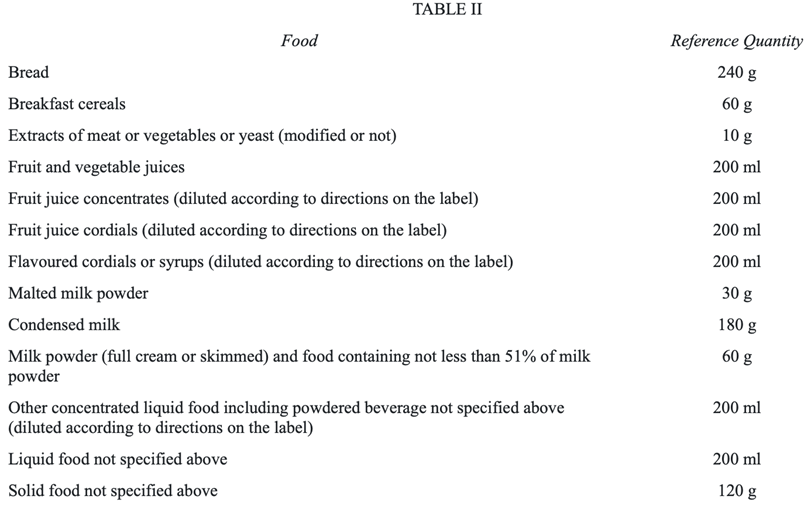
- increase the vitamin A content to more than 750 mcg of retinol activity per reference quantity for that food as specified in Regulation 11 Table II,
- nor increase the content of vitamin D to more than 10 mcg of cholecalciferol or of any mineral to more than 3 times the daily allowance (as specified in Table 1 for that mineral) per reference quantity for that food as specified in Regulation 11 Table II.
Nutrients that can be added to food are listed in the Seventh Schedule [1].
No label shall claim that any article of food is enriched, fortified, ennobled, vitaminized or in any way imply that the article is an excellent source of one or more vitamins or minerals unless the reference quantity for that food as laid down in Table II contains not less than 50% of the daily allowance as laid down in Table I for the relevant vitamin and mineral.
Category
Alcoholic drinks
While regulations do not specifically prohibit the fortification of alcoholic products, in practice alcoholic beverages are not fortified. However, if nutrients are added, it should comply with the requirements described under “General Food” above.
Product
1) Beer
Same as "Category" (alcoholic drinks) above.
2) Ready-to-drink beverages (mainly Chuhai)
Same as "Category" (alcoholic drinks) above.
3) Whisky
Same as "Category" (alcoholic drinks) above.
3.4 Other Permitted Ingredients
None.
3.5 Permitted Additives
General Food [1]
General-purpose food additives
Based on Regulation 28(2), no person shall use any general-purpose food additive other than those specified in the Eighth Schedule or permitted for use under this regulation.
Specific to acetone
Regulation 28(4) states that no person shall import, sell, advertise, manufacture, consign, or deliver any food containing residue of acetone unless, in the case of any food or any food containing flavoring, where acetone is used as a processing aid in the production of the food or in the production of one or more of its ingredients, the residue of acetone does not exceed 0.1 mg/kg of the food.
Specific to methanol
Regulation 28(5) states that methanol may be used as an extraction solvent in food, provided that the residue of methanol in the food does not exceed 5 ppm.
Permitted general-purpose food additives per Part I of the Eighth Schedule:
- Acetic acid
- Acetone
- Adipic acid
- Ammonium bicarbonate
- Ammonium carbonate
- Ammonium hydroxide
- Ammonium phosphate (mono- and di-basic)
- Ammonium sulfate
- Aspartame
- Beeswax
- Calcium carbonate
- Calcium chloride
- Calcium Citrate
- Calcium gluconate
- Calcium hydroxide
- Calcium lactate
- Calcium phosphate (mono-, di-and tri-basic)
- Calcium sulfate
- Candelilla wax
- Carbon dioxide
- Carnauba wax
- Citric acid
- Cyclotetraglucose
- Cyclotetraglucose syrup
- Erythritol
- Fumaric acid
- Glucono delta-lactone
- Glycerin or Glycerol
- Glycerol esters of citric, lactic, and tartaric acids
- Helium
- High fructose syrup
- Hydrochloric acid
- Hydrogen peroxide
- Hydrogenated starch hydrolysate (polyglycitol syrup)
- Isomalt
- Lactic acid
- Lactitol
- Magnesium carbonate
- Magnesium chloride
- Magnesium oxide
- Magnesium hydroxide
- Magnesium hydroxide carbonate
- Magnesium lactate
- Magnesium stearate
- Magnesium sulfate
- Malic acid
- Maltitol
- Maltitol syrup (hydrogenated glucose syrup)
- Mannitol
- Nitrogen
- Nitrous oxide
- Oligofructose (from chicory root)
- Peracetic acid
- Phosphoric acid
- Polydextrose
- Polyethylene glycol
- Polyvinylpyrrolidone, insoluble (polyvinylpolypyrrolidone)
- Potassium acid tartrate
- Potassium bicarbonate
- Potassium carbonate
- Potassium chloride
- Potassium citrate
- Potassium hydroxide
- Potassium sulfate
- Propylene glycol
- Pullulan
- Shellac
- Silica aerogel
- Sodium acetate
- Sodium acid sulfate (sodium hydrogen sulfate)
- Sodium chloride
- Sodium aluminum phosphate
- Sodium bicarbonate
- Sodium carbonate
- Sodium citrate
- Sodium fumarate
- Sodium hydroxide
- Sodium phosphate (mono-, di-and tri-basic)
- Sodium potassium tartrate
- Sodium pyrophosphate
- Sodium sesquicarbonate
- Sodium sulfate
- Sodium tartrate
- Sorbitol
- Sorbitol syrup
- Succinic acid
- Sucrose esters of fatty acids
- Sucrose oligoesters, type I and type II
- Sulphuric acid
- Sulfurous acid
- Tartaric acid
- Thaumatin
- Trehalose
- Triammonium citrate
- Xylitol
Permitted enzymes are also listed in Part II of the Eighth Schedule.
Sweetening agents
Based on Regulation 18(2), a person must not import, sell, advertise, manufacture, consign, or deliver any sweetening agent for use in food or any food containing any sweetening agent other than the sweetening agents up to the proportions specified in the Thirteenth Schedule.
Regulation 18(3A) states that Advantame may be added to any food in accordance with good manufacturing practices for food additives as described in section 3.3 of the preamble of the Codex General Standard for Food Additives (CODEX STAN 192-1995).
Regulation 18(3B) states that monk fruit extract may be added to any food in accordance with good manufacturing practices for food additives as described in section 3.3 of the preamble of the Codex General Standard for Food Additives (CODEX STAN 192‑1995) if the monk fruit extract contains:
- Mogroside V of not less than 20% (w/w) and not more than 90% (w/w);
- not more than 1 mg/kg lead;
- not more than 1 mg/kg arsenic;
- not more than 5% (w/w) ash; and
- not more than 6% (w/w) moisture.
Chemical preservatives
Regulation 19(3)(a-c) states the following:
(a) The addition of any Class I chemical preservatives in any food in any proportion is not restricted.
(b) No person shall import, sell, advertise, manufacture, consign, or deliver any article of food that contains a Class II chemical preservative, except that —
(i) any specified food may contain one of the Class II chemical preservatives in the proportion specified in Part I of the Fourth Schedule except as provided in subparagraph (ii); and
(ii) any specified food in relation to which 2 or more Class II chemical preservatives are specified in the Fourth Schedule may contain an admixture of those chemical preservatives if, when the quantity of each such chemical preservative present in that food is expressed as a percentage of the maximum quantity of that chemical preservative appropriate to that food in accordance with Part I of that Schedule, the sum of those percentages does not exceed 100.
(c) No person shall import, sell, advertise, manufacture, consign, or deliver any article of food to which a Class III chemical preservative has been added, except that a Class III chemical preservative may be added to any food, and in such proportion, specified in Part II of the Fourth Schedule.
Anti-foaming agents
Regulation 16A(1) states that an “anti-foaming agent” means any substance that prevents or reduces food foaming. Regulation 16A(2) and 16A(3) states that no person shall (a) import, sell, advertise, manufacture, consign, or deliver any article of food that contains an anti-foaming agent; or (b) sell or advertise for sale, with a view to its use in the preparation of food for human consumption any anti-foaming agent, except the specific food products (alcoholic drinks not included) which may contain dimethyl polysiloxane not exceeding 10ppm in amount.
Anti-oxidants
Regulation 17(1) states that “anti-oxidant” means any substance that delays, retards, or prevents the development in food of rancidity or other flavor deterioration due to oxidation. Regulation 17(2) states that subject to Regulation 17(3), no person shall import, sell, advertise, manufacture, consign, or deliver any article of food containing any added anti-oxidant other than ascorbic acid, erythorbic acid, citric acid, phosphoric acid, lecithin, and tocopherols. Regulation 17(2) does not apply to:
(a) any food which contains other anti-oxidants of a description and in the proportions specified in the Third Schedule; and
(b) any mixed food containing one or more of the foods in which specific anti-oxidants are expressly provided as indicated in the Third Schedule and which contains an admixture of these anti-oxidants in not greater amount than is specifically allowed in the quantity of food or foods containing the anti-oxidants used in the preparation of the mixed food.
Emulsifiers and stabilizers
Regulation 21(1) states that “emulsifier” or “stabilizer” means any substance that is capable, in the case of an emulsifier, of aiding the formation of, and in the case of a stabilizer, of maintaining, the uniform dispersion of 2 or more immiscible substances. Regulation 21(2) states that unless as otherwise indicated, no person shall import or manufacture for sale or sell any article of food which contains any emulsifier or any stabilizer which is not a permitted emulsifier or a permitted stabilizer, as specified in the Sixth Schedule. Regulation 21(3A)(b) states that quillaia extracts (Type I, II, or both) may be used only in alcoholic beverages, at a level not exceeding 40 ppm (calculated as saponins).
Gaseous packaging agents
Regulation 27(1) states that “gaseous packaging agent” means any substance used as an aerating agent or propellant in the storage or packaging of any fluid food; or to displace air in a sealed package or in a place of storage, in the storage or packaging of any food. Regulation 27(2) states that no person shall use in the storage or packaging of any food any gaseous packaging agent other than carbon dioxide, nitrogen, and helium.
Category
Alcoholic drinks
Same as "General Food" above.
Product
1) Beer
Same as "Category" (alcoholic drinks) above except for sweetening agents.
Sweetening agents are not allowed in beer alone or in whisky alone, but are allowed in a mixture of beer or whisky and non-alcoholic drinks with the following maximum limits to be complied with:
- Acesulfame-K – 350 ppm
- Saccharin – 80 ppm
- Cyclamates (as cyclamic acid) – 250 ppm
- Neotame – 20 ppm
- Steviol Glycosides (as steviol) – 200 ppm
- Sucralose – 250 ppm
2) Ready-to-drink beverages (mainly Chuhai)
Same as "Category" (alcoholic drinks) above.
3) Whisky
Same as "Beer" above.
3.6 Permitted Flavors and Colors
General Food [1]
Flavoring agents
Regulation 22(1) of the Food Regulations defines a Flavouring agent as “any wholesome substance that when added or applied to food is capable of imparting taste or odor, or both, to a food.”
Regulation 22(2) states that no person shall import, sell, advertise, manufacture, consign or deliver any natural or synthetic flavoring essence or extract that is contained in a solvent other than a permitted solvent, namely, 1,3‑propanediol, benzyl alcohol, beta-cyclodextrin, diacetin, diethyl ether, ethyl acetate, ethyl alcohol, glycerol, isopropyl alcohol, propylene glycol, triacetin and water. As stated in Regulation 22(3), the permitted solvent, except water, shall confirm with the British Pharmacopoeia standard.
Regulation 22(4) states that permitted flavoring compounds may also be carried in an emulsion of a permitted emulsifier as provided under regulation 21 with any of the permitted solvents mentioned in this regulation.
Regulation 22(5) defines that natural flavoring agents shall include natural flavoring essences, spices, and condiments; Regulation 22(6) states that natural flavoring essences or extracts shall be preparations in any permitted solvent or any combination of permitted solvents, with or without sweeteners other than sweetening agents, permitted coloring matter or chemical preservatives, of sapid or odoriferous principles, or both, derived from a plant after which the flavoring extract or essence is named. Additionally, Regulation 22(9) defines synthetic flavoring essences or extracts.
Based on Regulation 22(7), the use of coumarin, tonka bean, safrole, sassafras oil, dihydrosafrole, isosafrole, agaric acid, nitrobenzene, dulcamara, pennyroyal oil, oil of tansy, rue oil, birch tar oil, cade oil, volatile bitter almond oil containing hydrocyanic acid and male fern as flavoring agents is prohibited.
Notwithstanding Regulation 22(7), Regulations 22(8) and (9) permit the use of natural flavoring agents and synthetic flavoring essences or extracts in articles of food.
In general, the Singapore Food Agency has no objection to the use of flavoring substances that have been evaluated and endorsed by recognized international bodies such as the Joint FAO/WHO Expert Committee on Food Additives (JECFA), the Flavour and Extract Manufacturers Association (FEMA), or the European Food Safety Authority (EFSA) as a flavoring agent in food, provided that the flavoring preparations do not contain any of the prohibited substances listed in Regulation 22(7) [5].
Flavor Enhancers
Regulation 23(1) defines a flavor enhancer as “any substance which is capable of enhancing or improving the flavor of food, but does not include any sauce, gravy, gravy mix, soup mix, spice or condiment.”
Regulation 23(2) lists the permitted flavor enhancers for use in food intended for human consumption:
- ethyl maltol;
- L-glutamic acid, mono-sodium L-glutamate, monopotassium L-glutamate, calcium di‑L‑glutamate, monoammonium L-glutamate and magnesium di-L-glutamate;
- Inosinic acid, guanylic acid, di-sodium 5’‑inosinate, di-potassium 5’-inosinate, calcium 5’-inosinate, disodium 5’-guanylate, di‑potassium 5’-guanylate and calcium 5’‑guanylate;
- L-cysteine
Coloring matter
Regulation 20(1) of the Food Regulation defines coloring matter as “any substance that, when added or applied to food, is capable of imparting color to that food.”
Refer to the Fifth Schedule for the list of permitted coloring matters. Regulation 20(2) states that no person shall import, sell, advertise, manufacture, consign, or deliver:
- any article of food intended for human consumption that contains any added coloring matter other than a permitted coloring matter as listed in the Fifth Schedule;
- any coloring matter for use in food intended for human consumption other than a permitted coloring matter, as listed in the Fifth Schedule; or
- any permitted synthetic organic color, as listed in Part I of the Fifth Schedule which contains alpha naphthylamine, beta-naphthylamine, benzidine, paraaminodiphenyl (xenylamine) or their derivatives, and the polycyclic aromatic hydrocarbons.
Category
Alcoholic drinks
Same as "General Food" above.
Product
1) Beer
Same as "Category" (alcoholic drinks) above.
2) Ready-to-drink beverages (mainly Chuhai)
Same as "Category" (alcoholic drinks) above.
3) Whisky
Same as "Category" (alcoholic drinks) above.
3.7 Permitted Processing Aids
General Food [1]
Processing aid is considered a general-purpose food additive in Singapore. Regulation 28(1) defines that a general-purpose food additive is any substance that serves a useful and specific purpose during either the processing or packing of a food and shall include processing aid*.
*The Food (Amendment) Regulations 2025 [6], which will come into operation on 30 Jan 2026, amends Regulation 5 where the definition for “processing aid” is added. [Note: Singapore currently follows Codex’s definition for processing aid].
In the Food (Amendment) Regulations 2025, “Processing aid” means any substance or material used to perform a technological function in the treatment or processing of any food that may result in the non-intentional but unavoidable presence of residue or derivative of the substance or material in the final products, other than a) an apparatus or utensil, b) an ingredient consumed on its own, and c) a food or an ingredient that is known to cause hypersensitivity.
Regulation 28(2) states that no person shall use any general-purpose food additive other than those specified in the Eighth Schedule or permitted for use under this regulation. Refer to Part I of the Eighth Schedule for the list of permitted general-purpose food additives.
Specific to acetone: Regulation 28(4) also states that no person shall import, sell, advertise, manufacture, consign, or deliver any food containing residue of acetone unless —
- in the case of flavoring, where acetone is used as a processing aid in the production of the flavoring, the residue of acetone does not exceed 5 mg/kg of the flavoring; or
- in the case of any food or any food containing flavoring, where acetone is used as a processing aid in the production of the food or in the production of one or more of its ingredients, the residue of acetone does not exceed 0.1 mg/kg of the food.
Category
Alcoholic drinks
Same as "General Food" above.
Product
1) Beer
Same as "Category" (alcoholic drinks) above.
2) Ready-to-drink beverages (mainly Chuhai)
Same as "Category" (alcoholic drinks) above.
3) Whisky
Same as "Category" (alcoholic drinks) above.
3.8 Additional Notes
General Food
Nutri-grade requirements for beverages [3]
Based on Regulation 184B(1), 184C, 184D(3), 184F(1), beverages sold in Singapore in pre-packaged form, from customizable automated beverage dispensers, and freshly prepared beverages intended for sale at specified settings are required to have nutrition labels and advertising is prohibited for nutri-grade beverages graded “D”.
Category
Alcoholic drinks
Based on Regulation 184A, beverage that contains more than 0.5% (v/v) alcohol is exempted from the nutri-grade requirements.
Product
1) Beer
Same as "Category" (alcoholic drinks) above.
2) Ready-to-drink beverages (mainly Chuhai)
Same as "Category" (alcoholic drinks) above.
3) Whisky
Same as "Category" (alcoholic drinks) above.
3.9 References
1. Food Regulations
https://sso.agc.gov.sg/SL/SFA1973-RG1?DocDate=20230904&ProvIds=P1IV-P4_184A-P4_185-#pr198-
2. Sale of Food Act (SOFA)
https://sso.agc.gov.sg/Act/SFA1973#pr2A-
3. Health Promotion Board’s website on “Measures for Nutri-Grade Beverages"
https://hpb.gov.sg/healthy-living/food-beverage/nutri-grade
4. Food Safety and Security Act 2025
https://sso.agc.gov.sg/Act/FSSA2025/Uncommenced/20250502161636?DocDate=20250206&WholeDoc=1#
5. Singapore Food Agency’s website on “FAQs"
https://www.sfa.gov.sg/faqs#regulatory-standards-frameworks-guidelines-food-additives-and-ingredients-do-you-have-a-list-of-flavouring-agents-allowed-for-use-in-food
6. Food (Amendment) Regulations 2025
https://sso.agc.gov.sg/SL-Supp/S92-2025/Published/20250131?DocDate=20250131&WholeDoc=1
Was this article helpful?