
3. Compositional Aspects
- 5 Mins to read
- DarkLight
3. Compositional Aspects
- 5 Mins to read
- DarkLight
Article summary
Did you find this summary helpful?
Thank you for your feedback
Quick-frozen Foodstuffs
France

This section provides the compositional requirements for the food category and/or food products in scope and information on permitted nutrients, ingredients, and additives.
3.1 Composition Requirements
Category
Quick-frozen foodstuffs
There is no compositional standard at the French level. Please refer to Section 3.1 - Composition Requirements - of the "Frozen Foodstuffs" guidebook for the EU.
Product
Frozen Potatoes
There is no compositional standard at the French level. Please refer to Section 3.1 - Composition Requirements - of the "Frozen Foodstuffs" guidebook for the EU.
Frozen Cheese Snack
In addition to the requirements outlined in Section 3.1 - Composition Requirements - of the "Frozen Foodstuffs" guidebook for the EU, frozen cheese snacks must contain, as a main ingredient, cheese and not a cheese analog (e.g. from a plant-based source).
The term ‘fromage’ (cheese) is legally defined (see Section 3.2 below). When the product name provides a specific cheese name, such as camembert, please refer to Section 4.4 of this guidebook. When flavorings that mimic the taste of cheese are added, see Section 4.4.
3.2 Raw Material Requirements
Category
Quick-frozen foodstuffs
Please refer to Section 3.2 - Raw Material Requirements - of the "Frozen Foodstuffs" guidebook for the EU.
Product
Frozen Potatoes
Same as "Category" above.
Frozen Cheese Snack
In addition to the requirements outlined in Section 3.2 - Raw Material Requirements - of the "Frozen Foodstuffs" guidebook for the EU, the below applies to France:
Decree nº2007-628 of 27 April 2007 relating to cheese and cheese specialties [1] defines the category ‘fromage’ (= cheese), ‘fromage fondu (= processed cheese), ‘spécialité fromagère’ (= cheese specialty), and ‘spécialité fromagère fondu (= processed cheese specialty).
Translated in English:
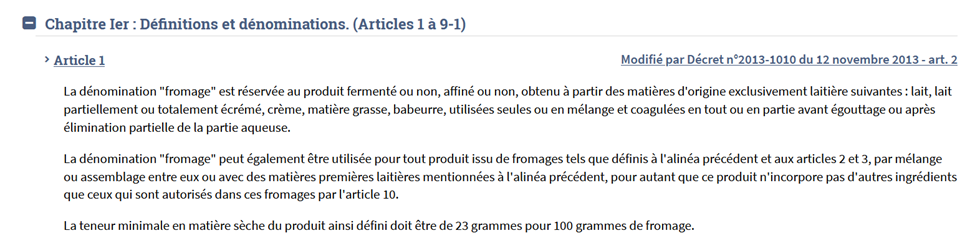
The term "cheese" is reserved for a product, fermented or not, ripened or not, obtained from the following materials of exclusively dairy origin: milk, partially or totally skimmed milk, cream, fat, buttermilk, used alone or in a mixture and coagulated in whole or in part before draining or after partial removal of the aqueous part.
The name "cheese" can also be used for any product made from cheeses as defined in the previous paragraph and in Articles 2 and 3, by mixing or assembling them or with dairy raw materials mentioned in the previous paragraph, provided that this product does not incorporate other ingredients than those which are authorized in these cheeses by article 10.
The minimum dry matter content of the product thus defined must be 23 grams per 100 grams of cheese.
 Translated in English:
Article 4
The name "processed cheese" is reserved for the product obtained by melting and emulsifying, using heat (at a temperature of at least 70° C for 30 seconds or any other equivalent combination), cheese or a mixture of cheeses, possibly with the addition of other dairy products. Processed cheese has a minimum dry matter content of 40 grams per 100 grams of finished product.
By way of derogation from the provisions of the first paragraph, a processed cheese reduced in fat and whose name "processed cheese" is supplemented on the labeling with a statement indicating this reduction in fat has a minimum dry matter content of 30 grams per 100 grams of finished product.
Translated in English:
Article 8
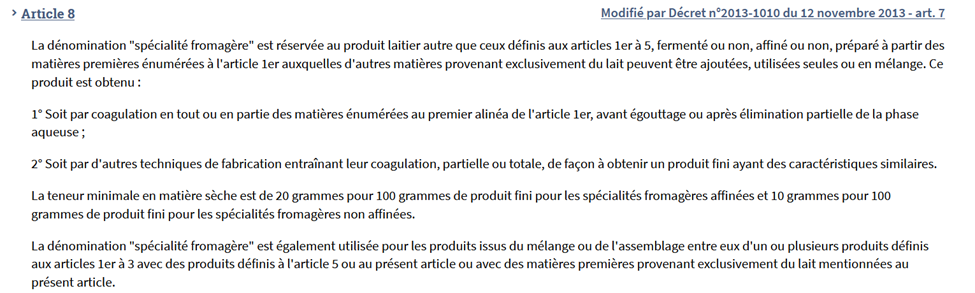
The name "cheese specialty" is reserved for dairy products other than those defined in Articles 1 to 5, fermented or not, refined or not, prepared from the raw materials listed in Article 1 to which other materials originating exclusively from milk can be added, used alone or in mixture. This product is obtained:
1° Either by coagulation in whole or in part of the materials listed in the first paragraph of Article 1, before draining or after partial elimination of the aqueous phase;
2° Or by other manufacturing techniques resulting in their partial or total coagulation, so as to obtain a finished product with similar characteristics.
The minimum dry matter content is 20 grams per 100 grams of finished product for matured specialty cheeses and 10 grams per 100 grams of finished product for unripened specialty cheeses.
The denomination "cheese specialty" is also used for products resulting from the mixture or assembly between them of one or more products defined in articles 1 to 3 with products defined in article 5 or in this article or with raw materials exclusively from milk mentioned in this article.

Translated in English:
Article 9
The name "processed cheese specialty" is reserved for dairy products other than those defined in Article 4, the minimum dry matter content of which is 25 grams per 100 grams of product, prepared from cheese and other dairy products. This product is obtained by processing techniques which include melting and lead to the emulsification of the raw materials and must have undergone, during its manufacture, a temperature of at least 70°C for 30 seconds or any other combination of duration and temperature of equivalent effect.
By way of derogation from the provisions of the first paragraph, a processed cheese specialty reduced in fat and whose name "processed cheese specialty" is supplemented on the labeling with a statement mentioning this reduction in fat has a minimum dry matter content of 20 grams per 100 grams of finished product.
In addition, specific cheese denominations have their mandatory characteristics defined in the Annex, such as Camembert, Brie, and Emmental [1]. They are defined in terms of milk origin (cow, goat…), description, shape, % of minimum fat/dry matter, and % of minimum dry matter.
3.3 Fortification
Category
Quick-frozen foodstuffs
Please refer to Section 3.3 - Fortification - of the "Frozen Foodstuffs" guidebook for the EU.
Product
Frozen Potatoes
Same as "Category" above.
Frozen Cheese Snack
Same as "Category" above.
3.4 Other Permitted Ingredients
Category
Quick-frozen foodstuffs
Please refer to Section 3.4 - Other Permitted Ingredients - of the "Frozen Foodstuffs" guidebook for the EU.
Product
Frozen Potatoes
Same as "Category" above.
Frozen Cheese Snack
Same as "Category" above.
3.5 Permitted Additives
Category
Quick-frozen foodstuffs
Please refer to Section 3.5 - Permitted Additives - of the "Frozen Foodstuffs" guidebook for the EU.
Product
Frozen Potatoes
Same as "Category" above.
Frozen Cheese Snack
Same as "Category" above.
3.6 Permitted Flavors and Colors
Category
Quick-frozen foodstuffs
Please refer to Section 3.6 - Permitted Flavors and Colors - of the "General Foods" guidebook for France.
Product
Frozen Potatoes
Same as "Category" above.
Frozen Cheese Snack
Same as "Category" above.
3.7 Permitted Processing Aids
Category
Quick-frozen foodstuffs
Please refer to Section 3.7 - Permitted Processing Aids - of the "General Foods" guidebook for France.
Product
Frozen Potatoes
Same as "Category" above.
Frozen Cheese Snack
Same as "Category" above.
3.8 Additional Notes
Category
Quick-frozen foodstuffs
Please refer to Section 3.8 - Additional Notes - of the "General Foods" guidebook for France.
Product
Frozen Potatoes
Same as "Category" above.
Frozen Cheese Snack
Same as "Category" above.
3.9 References
1. Decree nº2007-628 of 27 April 2007 relating to cheese and cheese specialties
https://www.legifrance.gouv.fr/loda/id/LEGITEXT000006056036/2023-06-27/
Was this article helpful?