
2. European Union
- 5 Mins to read
- DarkLight
2. European Union
- 5 Mins to read
- DarkLight
Article summary
Did you find this summary helpful?
Thank you for your feedback
PCR Plastic Packaging Regulations
Global
2.1 Current Regulatory Landscape
Overview
Regulation 282/2008 [1] on recycled plastic materials and articles intended to come into contact with foods requires that any Business Operator who intends to operate a technology for the production of recycled plastics shall file an application and obtain a Scientific Opinion from EFSA relative to the safety of the recycling process used in the production of such recycled plastic. The Opinion should subsequently be adopted by the European Commission, through Authorization Decisions, in order to authorize or reject the process, through an implementing Commission Decision that shall be published in the Official Journal of the European Union (OJEU). Guidelines are available concerning the contents and the format of the dossier used for the application.
All types of plastics are in scope, however the way EFSA makes risk assessment of recycled plastics applies almost entirely to PET. It is important to outline that this Regulation has not been fully implemented. In facts, although EFSA has delivered about 240 assessments (mostly for recycling of PET), the EU Commission failed to adopt Authorization Decisions, which would have rendered these processes legally authorized across the EU.
The existing recycling processes operate still under the National legislations of the Member Countries (where existing). The actual situation sees Member States accepting the presence on the market of products containing plastics:
- from processes assessed by EFSA,
- as well as recycled plastics out of the scope of Regulation 282/2008, i.e. originated from a chemical (feedstock) recycling, or used in A/B/A structures (where B is a recycled plastic and A is a layer exerting as a barrier to migrating substances), subject to industry risk assessment.
Non-mechanical recycling technologies
Recycling processes based on thermal depolymerization of plastics do not fall under the scope of Reg. (EC) 282/2008. Polymers (mainly polyolefines) obtained by reusing monomers or oligomers obtained by thermal decomposition of post-consumer or post-industrial plastics (aka feedstock recycling) are accepted as long as they comply with the relevant regulations applicable to virgin food contact plastics (namely Reg. (EC) 1935/2004 [2], Reg. (EC) 2023/2006 [3] and Reg. (EU) 10/2011 [4]).
PET originated from solvent-based depolymerization can be used if it complies with the regulations applicable to virgin PET in above paragraph.
Solvent- based technologies for non-PET (e.g. APK AG Newcycling® [5]) exist, e.g. for LDPE and Polyamide, but the polymers originated from these technologies are (at least for the moment) not used in food contact applications.
Specific highlights
Despite EFSA has assessed more than 200 recycling processes [6], no Authorization Decisions have been published by the EU Commission so far. The reasons for such lack of implementation are not clear, in any case the bottom line is that the EU regulatory system for recycled plastics in Europe relies currently in the National legislation of the single Member Countries (where these legislations exist). In practice, since almost the totality of the Member States does not have specific legislation on food contact recycled plastics, they simply rely on the presence of positive opinions issued by EFSA.
Recycled plastics that are separated from food by a functional barrier (e.g., in A/B/A structures) do not fall in the scope of Reg. (EC) 282/2008. A functional barrier is defined in accordance with Art. 11 of Reg. (EU) 10/2011, as a layer that is capable to reduce the migration of a substance in food to a non-detectable level (usually identified as 0.01 mg/kg).
EFSA carries the safety assessment of recycled plastics by comparing the residue contaminants concentration to a modeled concentration [7] calculated starting from the threshold of toxicology concern for carcinogenic, mutagenic and reprotoxic substances, corresponding to 0.15 microgram/ person/day. Such residue contaminants concentration is calculated by applying a decontamination efficiency factor, obtained from analytical challenge tests to a maximum concentration of contaminants set at 3 mg/kg of post-consumer PET, derived from a survey carried out in the late '90s. Since this maximum concentration of contaminants is known only for PET, the system is unapplicable to other polymers, and that is the reason why EFSA is unable to take decisions for recycling processes other than PET.
The challenge test has also been put in discussion when it is applied to polymers other than PET, as it has been designed considering the diffusion coefficient of this polymer. This however has not prevented recyclers to use the same test to assess non-PET materials (e.g. for their use behind a functional barrier); such an assessment is by its own nature unprecise.
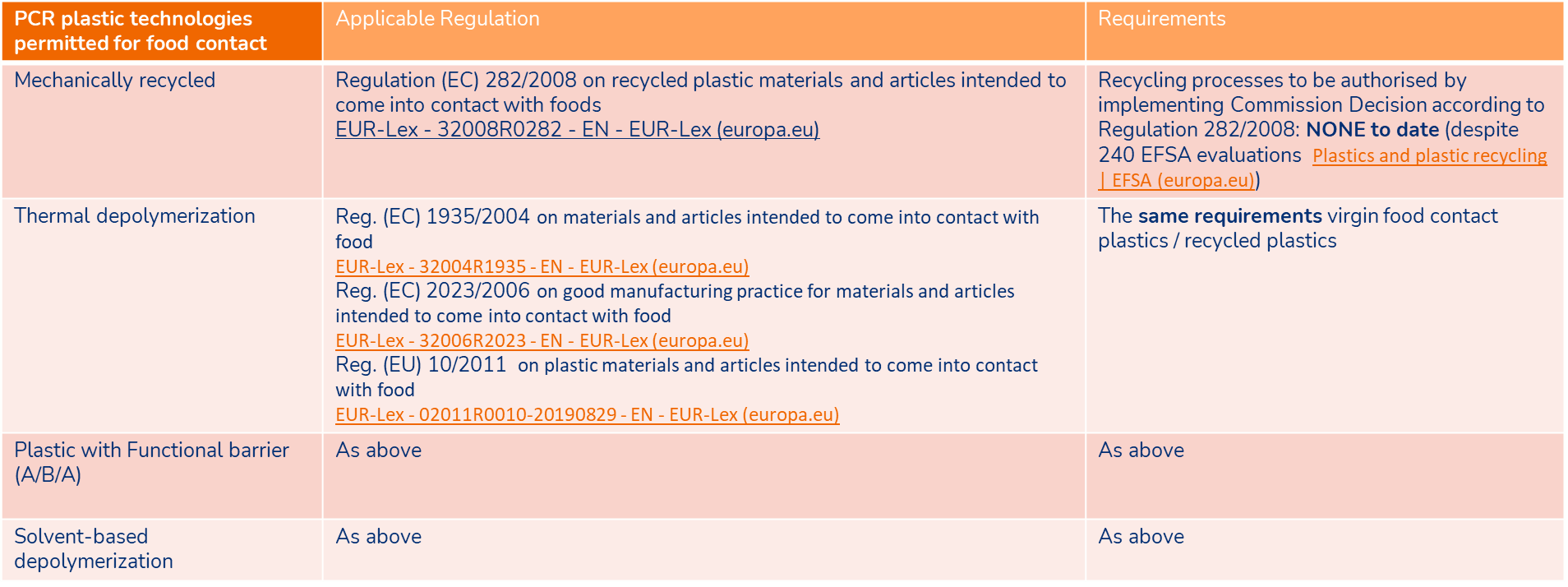 European Union - Regulatory Landscape
N.B.: Safety recycled polymers (only available for PET): contamination based on 0.15 micrograms/person/day → max residues at 3 mg/kg of post-consumer PET.
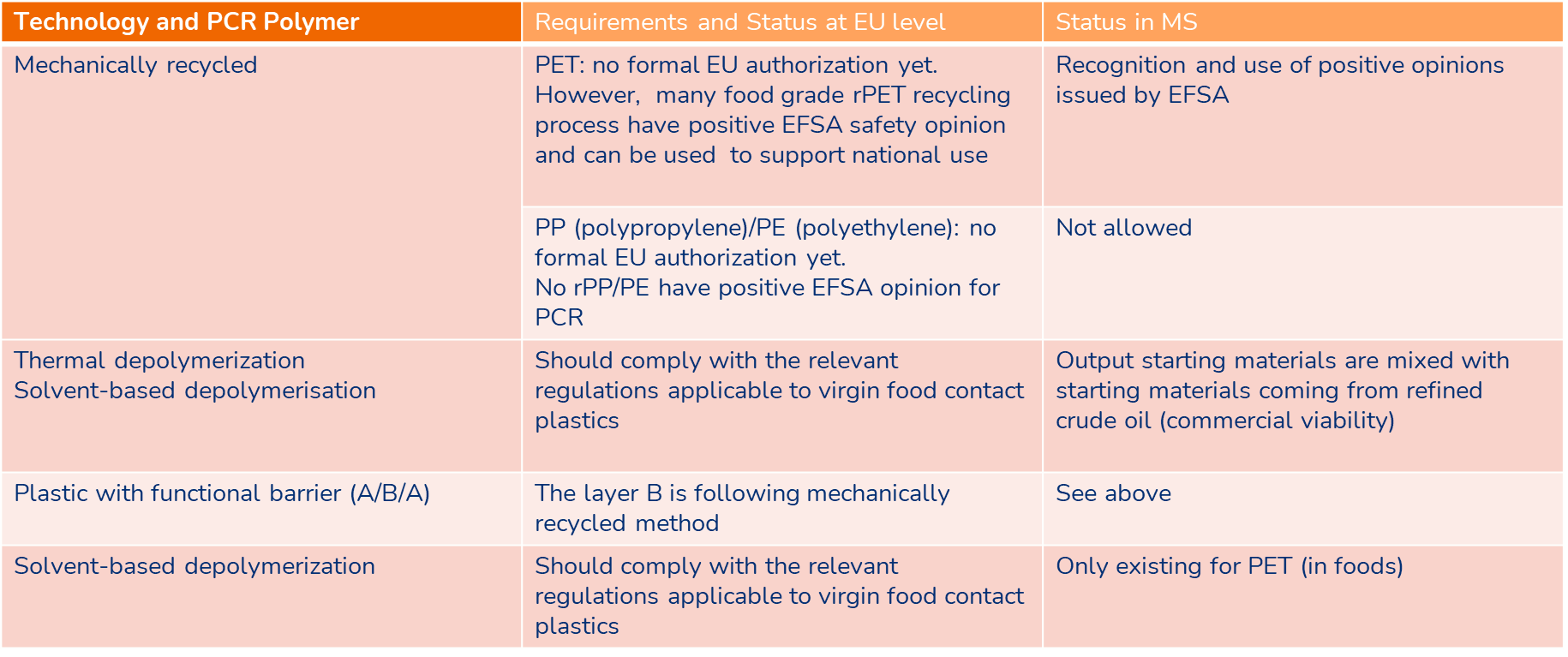 European Union - Status at EU and MS Levels
2.2 Emerging Regulations
Overview
The new draft [8], repealing 282/2008, introduces strong changes to the current legislation, the most relevant being:
- authorization of recycling technologies instead of single processes;
- phase-in period for new technologies without authorization;
- extension of the scope to technologies other than mechanical recycling of PET;
- extension of the scope to recycled plastics not in direct contact with food;
- obligations of disclosing information to the public;
- labelling and testing obligations for recycled polymers;
- register of recycling technologies, processes and installations.
Whether these changes will be maintained in the final text cannot be predicted at the moment (announced date of adoption is mid-2022).
Non-mechanical recycling technologies
The new draft, explicitly allows "novel technologies", besides mechanical recycling of PET. The draft enables such new technologies to be introduced in the market without authorization, for a limited period of time and under strict control to collect data and assess the technology. The timing for introducing these technologies in the market ranges from 2 to 7 years.
Specific highlights
- The draft is not clear on whether A/B/A structures that are currently excluded from the scope of the legislation, would be considered "novel technologies", thus subject to authorization, affecting hundreds of products already on the market.
- The draft also mandates public disclosure of confidential information, such as results of testing recycled plastics originated from novel technologies, which would create a target for NGO's.
- Finally, the draft includes an increased testing and administrative burden for the recycling industries as well as converters, with an expected effect of cost increase on the final products.
2.3 References
1. EUR-Lex - 32008R0282 - EN - EUR-Lex (europa.eu)
2. EUR-Lex - 32004R1935 - EN - EUR-Lex (europa.eu)
3. EUR-Lex - 32006R2023 - EN - EUR-Lex (europa.eu)
4. EUR-Lex - 02011R0010-20190829 - EN - EUR-Lex (europa.eu)
5. New cycling - APK AG (apk-ag.de)
6. Plastics and plastic recycling | EFSA (europa.eu)
7. Guidance_and_Criteria_for_Safe_Recycling.pdf (fraunhofer.de)
8. Food safety – recycled plastic in food packaging (updated rules) (europa.eu)
Was this article helpful?