
Requirements for Confectionary & Soluble Coffee
- 7 Mins to read
- DarkLight
Requirements for Confectionary & Soluble Coffee
- 7 Mins to read
- DarkLight
Article summary
Did you find this summary helpful?
Thank you for your feedback
Duty-free Requirements for Confectionary & Soluble Coffee
India

The below version control table serves to document all updates made to the report. The purpose is to ensure the information is always accurate and up-to-date.
| Version Number | Content Creation Date | Publishing Date | Section(s) Updated & Reason(s) for Update |
|---|---|---|---|
| V0 | 13 April 2023 | 07 May 2024 | N/A (new report) |
Disclaimers
A) At RegASK, we are committed to providing our clients with the most up-to-date and accurate information on regulatory requirements and compliance. To ensure the highest level of accuracy and relevance, we regularly review and update our e-guidebooks at least twice per year to reflect the latest regulatory developments in the market. (Please contact us if you wish to activate this feature.) In the meantime, our RegAlerts service is designed to keep our clients notified of any regulatory updates that may impact their business.
B) The contents on this platform are exclusively intended for the use of RegASK and its authorized representatives. All materials herein are confidential and the sole property of RegASK. Any reproduction, distribution, or display of this content to others is strictly prohibited without the express written consent of RegASK.
1. Applicable Legislation to Duty-free Food Products in India
1.1 Overview of duty-free legislation
In India, Duty-free shops (DFS) located at Airports and Seaports are licensed retail outlets. These shops sell a wide range of products including alcohol, tobacco, perfumes, cosmetics, premium food products, and other luxury items to international travelers who are leaving India. DFS is overseen by the Airport Authority of India (AAI) which comes under the purview of the Ministry of Civil Aviation and is regulated by the Central Government through The Customs Act, 1962 [1] and the Customs Tariff Act, 1975 [2].
"Duty-free shops" are defined as shops or outlets located within the designated areas of international airports or seaports, where imported goods can be sold to international travelers who are leaving India.
Based on this definition, goods sold in DFS are considered as equivalent to “export” under Customs law, and hence GST (Goods and Service Tax) is not applicable to products being displayed at duty-free shops [3].
Rules and regulations governing DFS are generally harmonized across the country having the same set of regulations applicable to all DFS operating in India.
At the state level, there might be state government-specific additional regulations applicable to these DFS. These rules/ regulations are mostly related to restrictions on the type of products that can’t be sold, state-specific labor law, licensing requirements for DFS, etc. It is recommended to obtain specific information from the respective state authority in which the DFS is to be operated.
1.2 Should confectionary and soluble coffee sold in India duty-free be compliant with Indian regulations?
In India, Food businesses are regulated by the Food Safety and Standards Authority of India (FSSAI). It is the body constituted under the Ministry of Health and Family Welfare that plays a major role in the import of food products alongside the Directorate General of Foreign Trade (DGFT). The purpose of FSSAI is to ensure the import of safe and quality food products in India.
Until 2016, food products displayed in DFS were regulated by FSSAI in terms of composition, quality, safety, labeling, etc. However, in 2017, The Food Safety and Standards (Import) Regulations [4] came into force, and food products sold at DFS were exempted from the FSSAI regulatory overview, considering it as an “Export” as confirmed in the FAQ on Food Imports [5]:


Food products sold at DFS are beyond the scope of FSSAI, hence, the quality standards, safety and labeling standards and norms as laid down by FSSAI are not applicable to these products, including coffee and confectionery products at DFS.
2. If products sold in the duty-free do not need to comply with specific Indian requirements, does the legislation of the Country of Origin apply?
Since the products sold in DFS do not need to comply with Indian requirements, it is generally understood that they shall meet the regulatory requirements of the country of origin.
Note: When products are imported to India, for the Indian market, FSSAI norms apply. Products exported to a specific country shall meet the requirements of the Importing country. Since duty-free products come under “export” but are sold in retail shops to individuals not from identified countries, they must follow the regulatory norms of the country the duty-free products come from.
3. If products sold in duty-free need to comply with specific Indian requirements, what are they?
Not applicable, confectionery and coffee products sold in duty-free shops are not required to meet the FSSAI norms.
4. What is the registration/notification process(s), if any?
There is no specific registration required for duty-free products. However, the DFS owner must follow prescribed procedures for the import and movement of duty-free products from the warehouse to the retail store inside the airport [6].
In addition, the DFS owner shall comply with all the regulations and guidelines set by the airport authorities of the relevant state.
5. What are the importation requirements?
Importation requirements for duty-free products are similar to regular imports of food products except for some additional documentation requirements relating to DFS. At the custom level, duty-free products are to be declared separately to avail the benefits of “Duty free” under various government schemes. More information can be obtained from the Customs Manual 2023 [7].
General Importation process for chocolates and coffee products
List of documents that may be required for importing food into India:
- Ingredient list
- Specimen copy of label in English
- End-use declaration
- Bill of Entry
- Country of origin certificate
- FSSAI import license (required from the DFS owner, not the product supplier)
- Certificate of analysis from the country of origin
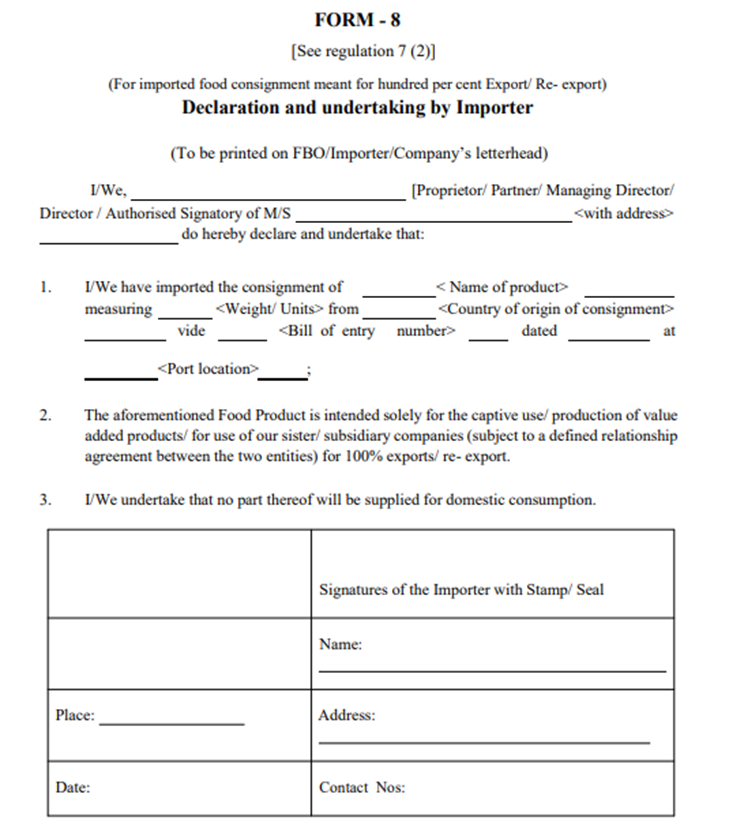
- Declaration and undertaking from the importers for imported food consignment meant for Duty-free shops
General process
- Bill of Entry (BOE) is filed at customs ICE GATE (https://icegate.gov.in) on a single window Interface for Facilitating Trade (SWIFT). Risk-based sampling called Risk Management System (RMS) is in operation at Customs single window interface for facilitating Trade (SWIFT).
- If RMS determines FSSAI clearance is required, the BOE is referred to the FSSAI online Food Import Clearance System (FICS).
- CHA (Clearing and Handling Agents)/ importer needs to be registered on FICS (www.ics.fssai.gov.in).
- If all the relevant information is provided, the Authorized Officer (A.O.) sets an appointment for the inspection of the consignment (only two opportunities are provided to the CHA/Importer to confirm the appointment).
- On inspection, if everything is found satisfactory including labeling and packaging requirements of the consignments, the samples are drawn (2 samples from each batch) and if not, the Authorized Officer rejects the consignment and issues a Non-Conforming Report.
- Samples are then sent to FSSAI Notified NABL accredited Laboratory. If the sample is found conforming then a No Objection Certificate (NOC) is generated and if not conforming, then a Non-Conforming Report (NCR) is generated, rejecting the clearance of food consignment/items.
- In the following cases, FSSAI NOC is exempted [5]:
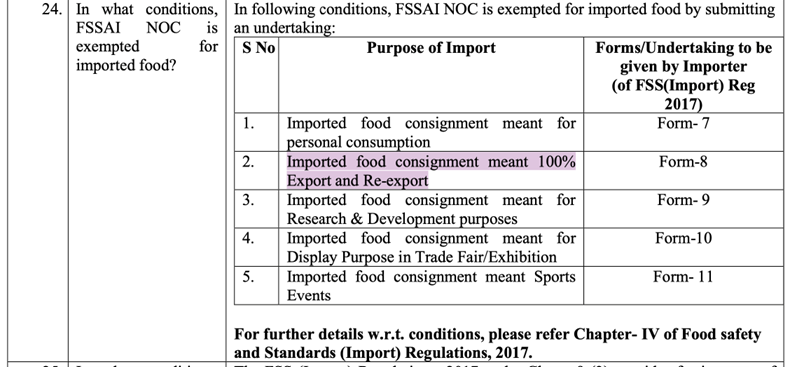
Form 8 can be found as an appendix to the Food Safety and Standards (Import) Regulations, 2017 [4]:
- If the importer does not agree with the findings of the laboratory report, he may apply for retesting of a second sample at the referral laboratory. The outcome of the test result will determine the fate of the consignment. The importer may present the review application in Form 6 of FSS(Import) Regulations, 2017 to the Review Officer along with the required documents at the FSSAI Headquarters.
- The order passed by the Review Officer can be challenged before the CEO of FSSAI within 15 days whose decision thereon will be final.
Conclusion
- Under Customs law, goods sold in duty-free stores (DFS) are considered equivalent to “export”.
- Food products sold at DFS are beyond the scope of the Food Safety and Standards Authority (FSSAI), hence, the quality standards, safety, and labeling standards and norms as laid down by FSSAI are not applicable to these products, including coffee and confectionery products.
- Products sold in DFS do not need to comply with Indian requirements but must meet the regulatory requirements of the country of origin.
- There is no specific registration required for duty-free products however, the DFS owner must follow prescribed procedures for the import and movement of duty-free products from the warehouse to the retail store inside the airport.
- Importation requirements for duty-free products are similar to regular imports of food products except for some additional documentation requirements relating to DFS. At the custom level, duty-free products are to be declared separately to avail the benefits of “Duty-free” under various government schemes.
6. References
https://www.indiacode.nic.in/bitstream/123456789/2475/1/a1962-52.pdf
https://www.indiacode.nic.in/bitstream/123456789/8774/1/A197551.pdf
3. “Goods sold to and from the Duty-free Shops are exempt from GST: HC”. A2Z Taxcorp LLP
https://www.a2ztaxcorp.com/goods-sold-to-and-from-the-duty-free-shops-are-exempt-from-gst-hc/)
4. Food Safety and Standards (Import) Regulations, 2017
https://www.fssai.gov.in/upload/uploadfiles/files/Compendium_Food_Import_Regulations_12_11_2021.pdf
5. Frequently Asked Questions (FAQs) on Food Import
https://fssai.gov.in/upload/uploadfiles/files/FAQs_Food_Import_15_01_2020.pdf )
6. Central Board of Indirect Taxes & Customs. Circular No. 32 /2016-CustomsF.No: 473 / 05 / 2015 –LC Govt. of India Ministry of Finance Dept. of Revenue Central Board of Excise and Customs North Block, New Delhi Dated 13th July 2016
https://taxinformation.cbic.gov.in/view-pdf/1000490/ENG/Circulars
https://old.cbic.gov.in/resources//htdocs-cbec/deptt_offcr/Customs_Manual_2023.pdf
Was this article helpful?