
Duty-free Requirements for Food Supplements
- 6 Mins to read
- DarkLight
Duty-free Requirements for Food Supplements
- 6 Mins to read
- DarkLight
Article summary
Did you find this summary helpful?
Thank you for your feedback
Duty-free Requirements for Food Supplements
India

The below version control table serves to document all updates made to the report. The purpose is to ensure the information is always accurate and up-to-date.
| Version Number | Content Creation Date | Publishing Date | Section(s) Updated & Reason(s) for Update |
|---|---|---|---|
| V0 | 17 Jan 2024 | 10 Oct 2024 | N/A (new report) |
Disclaimers
A) At RegASK, we are committed to providing our clients with the most up-to-date and accurate information on regulatory requirements and compliance. To ensure the highest level of accuracy and relevance, we regularly review and update our e-guidebooks at least twice per year to reflect the latest regulatory developments in the market. (Please contact us if you wish to activate this feature.) In the meantime, our RegAlerts service is designed to keep our clients notified of any regulatory updates that may impact their business.
B) The contents on this platform are exclusively intended for the use of RegASK and its authorized representatives. All materials herein are confidential and the sole property of RegASK. Any reproduction, distribution, or display of this content to others is strictly prohibited without the express written consent of RegASK.
1. Duty-free Legislation
1.1 Are “food supplements” sold in duty-free stores exempt from FFSAI scope and considered equivalent to “export” under customs law?
In India, Duty-free shops (DFS) located at Airports and Seaports are licensed retail outlets. These shops sell a wide range of products including alcohol, tobacco, perfumes, cosmetics, premium food products, and other luxury items to international travelers who are leaving India. DFS are overseen by the Airport Authority of India (AAI) which comes under the purview of the Ministry of Civil Aviation and are regulated by the Central Government through The Customs Act, 1962 [1] and the Customs Tariff Act, 1975 [2].
"Duty-free shops" are defined as shops or outlets located within the designated areas of international airports or seaports, where imported goods can be sold to international travelers who are leaving India.
Based on this definition, goods sold in DFS are considered equivalent to “export” under Customs law and GST (Goods and Service Tax) is not applicable to products being displayed at duty-free shops [3]. In addition, as shown in question 3 of this report, Indian Food legislation does not apply to Food products (this includes food/health supplements) manufactured outside India and intended for export outside India, from duty-free shops).
Goods are defined as follows in the Customs Act [1]:
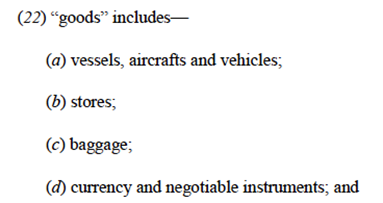

“Any kind of movable property” includes food supplements.
1.2 Are there specific Duty-free requirements applying at the state level or are they harmonized?
Rules and regulations governing DFS are generally harmonized across the country having the same set of regulations applicable to all DFS operating in India.
The DFS owner must follow prescribed procedures for the import and movement of duty-free products from the warehouse to the retail store inside the airport [4].
In addition, the DFS owner shall comply with all the regulations and guidelines set by the airport authorities of the relevant state.
At the state level, there might be state government-specific additional regulations applicable to these DFS. However, these rules/ regulations are mostly related to restrictions on the type of products that can’t be sold, state-specific labor law, licensing requirements for DFS, etc.
2. What are the importation requirements?
Please refer to section 6 of the RegASK report “Duty-free requirements for confectionary and soluble coffee – India” dated 11 April 2023.
3. Can a product classified in the EU as a “food supplement” and in the USA as a “dietary supplement” keep its regulatory classification in duty-free?
In India, Food businesses are regulated by the Food Safety and Standards Authority of India (FSSAI). It is the body constituted under the Ministry of Health and Family Welfare that plays a major role in the import of food products alongside the Directorate General of Foreign Trade (DGFT). The purpose of FSSAI is to ensure the import of safe and quality food products in India.
In India, food supplements are called “Health supplements”. When sold in the regular sales channel in India, they must comply with the requirements laid down in the Food Safety and Standards (Health Supplements, Nutraceuticals, Food for Special Dietary Use, Food for Special Medical Purposes, Functional Food, and Novel Food) Regulations, 2016 [5].
Until 2016, food products displayed in DFS were regulated by FSSAI in terms of composition, quality, safety, labeling, etc. However, in 2017, The Food Safety and Standards (Import) Regulations [6] came into force, and food products sold at DFS were exempted from the FSSAI regulatory oversight, considering it as an “Export” as confirmed in the FAQ on Food Imports [7]:


Figure 1: Question #33 from the Frequently Asked Questions (FAQs) on Food Import [5]
Food products, including health supplements, sold at DFS are beyond the scope of FSSAI, hence, the quality standards, safety, and labeling standards and norms as laid down by FSSAI are not applicable to these products. Health supplements are considered food and, as such, when health supplements are sold at DFS they do not fall under the scope of FSSAI and therefore do not fall under the scope of the “Nutraceuticals Regulation”.
Products exported to a specific country shall meet the requirements of the Importing country (importing from India). Since duty-free products come under “export” but are sold in retail shops to individuals not from identified countries (i.e. the “importing” country is not known), it is understood that they must follow the regulatory norms of the country the duty-free products come from.
As a consequence, a product classified in the EU as a “food supplement” and in the USA as a “dietary supplement” may keep its name when sold in duty-free stores.
As health supplements not manufactured in India and sold in DFS do not fall under the scope of FSSAI, their classification under Indian legislation is not relevant. As shown above, such products must follow the legislation of the country where they were manufactured, therefore, one can consider they “keep” their regulatory classification when sold in DFS in India.
For information, in India, there is a Duty-Free Import Authorization System [8] (a variant of the Advance Authorization Scheme [9] which is a duty exemption program offered to manufacturers who process products in SEZ (Special Economic Zone) so that they can import inputs and raw materials duty-free in order to produce export-oriented products. By definition, this Duty-Free Import Authorization system does not apply to finished health supplements imported from Europe or USA.
Conclusion
- Under Customs law, goods sold in duty-free stores (DFS) are considered equivalent to “export”.
- Food products sold at DFS are beyond the scope of the Food Safety and Standards Authority (FSSAI), hence, the quality standards, safety, and labeling standards and norms as laid down by FSSAI are not applicable to these products, including Food Supplements (called Health Supplements in India).
- Products sold in DFS do not need to comply with Indian requirements but must meet the regulatory requirements of the country of origin.
- As a consequence, products classified in the EU as “food supplements” and in the USA as “dietary supplements” may keep their name and classification when sold in duty-free stores.
4. References
https://www.indiacode.nic.in/bitstream/123456789/2475/1/a1962-52.pdf
https://www.indiacode.nic.in/bitstream/123456789/8774/1/A197551.pdf
3. Supreme Court recalls its verdict upholding no indirect taxes can be levied from duty free shops at airports
https://economictimes.indiatimes.com/news/india/supreme-court-recalls-its-verdict-upholding-no-indirect-taxes-can-be-levied-from-duty-free-shops-at-airports/articleshow/102837579.cms
4. Central Board of Indirect Taxes & Customs. Circular No. 32 /2016-CustomsF.No: 473 / 05 / 2015 –LC Govt. of India Ministry of Finance Dept. of Revenue Central Board of Excise and Customs North Block, New Delhi Dated 13th July 2016
https://taxinformation.cbic.gov.in/view-pdf/1000490/ENG/Circulars
5. Food Safety and Standards (Health Supplements, Nutraceuticals, Food for Special Dietary Use, Food for Special Medical Purpose, Functional Food and Novel Food) Regulations, 2016
https://www.fssai.gov.in/upload/uploadfiles/files/Nutraceuticals_Regulations.pdf
6. Food Safety and Standards (Import) Regulations, 2017
https://www.fssai.gov.in/upload/uploadfiles/files/Compendium_Food_Import_Regulations_12_11_2021.pdf
7. Frequently Asked Questions (FAQs) on Food Import
https://fssai.gov.in/upload/uploadfiles/files/FAQs_Food_Import_15_01_2020.pdf )
8. Foreign Trade Policy – CHAPTER 04 - DUTY EXEMPTION REMISSION SCHEMES. Ministry of Commerce and Industry - Directorate General of Foreign Trade
https://www.dgft.gov.in/CP/?opt=ft-policy
Was this article helpful?