
4. Labeling Requirements
- 9 Mins to read
- DarkLight
4. Labeling Requirements
- 9 Mins to read
- DarkLight
Article summary
Did you find this summary helpful?
Thank you for your feedback
Infant, Follow-up, Young Child Formula
Singapore

This section provides information on labeling requirements and the label approval process.
4.1 Mandatory Labeling Parameters
Product
1) Infant Formula and Follow-up Formula [1,2]
- Product legal name: Infant formula
- Indication of the sources of protein printed immediately after the common name “infant formula” or any appropriate designation (not applicable to infant milk formula or infant milk preparation prepared from cow’s milk. It may have part or whole of its butterfat replaced by vegetable oils).
- Ingredients list: A specific name or description or a generic name or description of every ingredient contained in the infant formula. The appropriate designation of each ingredient in the case of food consisting of two or more ingredients and unless the quantity or proportion of each ingredient is specified, the ingredients shall be specified in descending order of the proportions by weight in which they are present. Where a food contains an ingredient that is made from two or more constituents, the appropriate designations of those constituents shall be so specified and it shall not be necessary to specify the appropriate designation of that ingredient. It is not necessary to state that the food contains water.
- Foods and ingredients known to cause hypersensitivity:
- cereals containing gluten, i.e. wheat, rye, barley, oats, spelt, or their hybridized strains and their products;
- crustacea and crustacean products;
- eggs and egg products;
- fish and fish products;
- peanuts, soybeans, and their products;
- milk and milk products (including lactose);
- tree nuts and nut products; and
- sulfites in concentrations of 10 mg/kg or more
- Date marking of validity of prepacked food: The date mark shall be shown clearly and the size of the letters shall not be less than 3 mm in height. The expiry dates of prepacked food products may be declared in one of the following ways:
- “USE BY (here insert the day, month, and year)”;
- “SELL BY (here insert the day, month, and year)”;
- “EXPIRY DATE (here insert the day, month, and year)”; or
- “BEST BEFORE (here insert the day, month, and year)”.
- Net quantity
- Directions as to the method of preparing the food
- A warning statement about the health hazards of improper use, preparation, or storage of infant formula
- The amount of energy and the number of grams of protein, fat, and carbohydrate per 100 ml or other equivalents of formula prepared in accordance with the directions on the label
- The total quantity of each vitamin and mineral per 100 ml or other equivalents of formula prepared in accordance with the directions on the label
- A statement suggesting the amount of the prepared food to be given each time, and the number of times such amount is to be given per day; such statement shall be given for each month of the infants’ age up to 6 months
- Directions for storage and information regarding its keeping qualities before and after the container has been opened
- Information that infants above the age of 6 months should start to receive supplemental foods in addition to the formula, where the infant formula is intended for infants above the age of 6 months
- Manufacturer or Importer name and address and Country of Origin: The name and address of the manufacturer, packer, or local vendor in the case of a food of local origin; and the name and address of the local importer, distributor or agent and the name of the country of origin of the food in the case of an imported food. A telegraphic or code address or an address at a post office shall not be sufficient.
- Prominently displayed statements, starting with the words “IMPORTANT NOTICE” or words of similar import, to ensure that a consumer understands that breast milk is best for infants such as “Breast milk is the best food for your baby”; and the infant formula should be used on the advice of a doctor or healthcare practitioner such as “Before you decide to use this product, consult your doctor or healthcare professional for advice."
2) Young Child Formula [3]
- Product name: The common name, or a description sufficient to indicate the true nature of the food (e.g. Growing-up Milk, Growing-up Formula).
- Ingredients list: A specific name or description or a generic name or description of every ingredient contained in the infant formula. The appropriate designation of each ingredient in the case of food consisting of two or more ingredients and unless the quantity or proportion of each ingredient is specified, the ingredients shall be specified in descending order of the proportions by weight in which they are present. Where a food contains an ingredient that is made from two or more constituents, the appropriate designations of those constituents shall be so specified and it shall not be necessary to specify the appropriate designation of that ingredient. It is not necessary to state that the food contains water. In the case of food that contains the synthetic coloring tartrazine, declare (i) tartrazine or (ii) color (102) or (iii) color (FD&C Yellow #5) or other equivalent terms in the ingredients list.
- The following words or any other words to the same effect in the case of any food containing aspartame: “PHENYLKETONURICS: CONTAINS PHENYLALANINE.”
- Foods and ingredients known to cause hypersensitivity:
- cereals containing gluten, i.e. wheat, rye, barley, oats, spelt, or their hybridized strains and their products;
- crustacea and crustacean products;
- eggs and egg products;
- fish and fish products;
- peanuts, soybeans, and their products;
- milk and milk products (including lactose);
- tree nuts and nut products; and
- sulfites in concentrations of 10 mg/kg or more
- Date marking of validity of prepacked food: The date mark shall be shown clearly and the size of the letters shall not be less than 3 mm in height. The expiry dates of prepacked food products may be declared in one of the following ways:
- “USE BY (here insert the day, month, and year)”;
- “SELL BY (here insert the day, month, and year)”;
- “EXPIRY DATE (here insert the day, month, and year)”; or
- “BEST BEFORE (here insert the day, month, and year)”.
- Storage direction of the food where the validity of the date mark of any prepacked food is dependent on its storage
- Net quantity
- In the case of nutrition claim(s) made, a nutrition information panel in the form specified in the Twelfth Schedule or in such other similar form as may be acceptable to the Director-General, specifying the energy value, the amounts of protein, carbohydrate, fat and the amount of any other nutrients for which a nutrition claim is made in respect of the food. Refer to the format of the nutrition information panel in the Twelfth Schedule.
- Manufacturer or Importer name and address and Country of Origin: The name and address of the manufacturer, packer, or local vendor in the case of a food of local origin; and the name and address of the local importer, distributor or agent and the name of the country of origin of the food in the case of an imported food. A telegraphic or code address or an address at a post office shall not be sufficient.
4.2 Languages
Category
Special Purpose Foods
English [4].
Product
Infant Formula, Follow-on Formula, Young Child Formula
English [4].
4.3 Mandatory Information on Stickers
Category
Special Purpose foods
The use of sticker labels to incorporate the mandatory labeling information in English on the labels of your food product is acceptable as long as the sticker label used is firmly attached to the product at all times, and does not cover other essential information required under the Food Regulations.
The information made available on the sticker labels should not contradict those declared on the original label. Please note that tampering of date marking (i.e. expiry date) declared on the original label, is prohibited under the Food Regulations [5].
Product
Infant Formula, Follow-on Formula, Young Child Formula
There are no requirements specific to these products. It should comply with the "Category" (Special Purpose Foods) above.
4.4 Product Legal Name
Product
1) Infant Formula
Infant formula [6]
2) Follow-up Formula
The common name, or a description (in the case where a suitable common name is not available) sufficient to indicate the true nature of the food (e.g. Follow-on Formula). Given that there is no specific legislation for this category, the common practice in the market is to indicate the Stage (Stage 2) with the target age (6 months onwards) and indicate "Follow-on Formula" [7].
3) Young Child Formula
The common name, or a description (in the case where a suitable common name is not available) sufficient to indicate the true nature of the food. (e.g. Growing-up Milk) [7].
4.5 Product-specific Labeling Statements
Product
1) Infant Formula and Follow-up Formula [6]
There shall be printed on the label of infant formula prominently displayed statements, starting with the words “IMPORTANT NOTICE” or words of similar import, to ensure that a consumer understands that breast milk is best for infants; and the infant formula should be used on the advice of a doctor or healthcare practitioner.
The label on a package of any infant formula that is sold or to be sold as lactose-free or low-lactose must include:
- the words “lactose-free” or “low lactose”, or words of similar import;
- a statement within the nutrition information panel on the label, specifying the exact amount of lactose in the infant formula; and
- the words “Not suitable for infants with galactosemia” in the same font and size as, and in close proximity to, the words “lactose-free” or “low lactose”, or words of similar import, if the infant formula is manufactured from protein sources other than soya protein isolate.
2) Young Child Formula [8]
A product that is intended for consumption by children between the ages of 12 to 36 months is not considered a “Nutri-Grade beverage” and is thus not subject to the Nutri-Grade labeling requirements.
A product that is intended for consumption by children beyond 36 months would be considered a “Nutri-Grade beverage” (assuming it does not fulfill any of the other criteria within Regulation 184A). This includes:
- A product intended for consumption by children above 12 months (without an upper age limit), and
- A product intended for consumption by children between the ages of 1 to 10 years.
According to the requirements set out in Regulation 184B [9], Nutri-Grade beverages sold in Singapore shall be graded (“A”, “B”, “C” or “D”) based on the sugar and saturated fat content according to the grading system shown in the table below. Note that the grade of a Nutri-Grade beverage is the poorer of the sugar content grade and the saturated fat content grade. In addition, the sugar content of a beverage is determined by its total sugar content, minus the amount of lactose and/or galactose that is declared on the Nutrition Information Panel (NIP).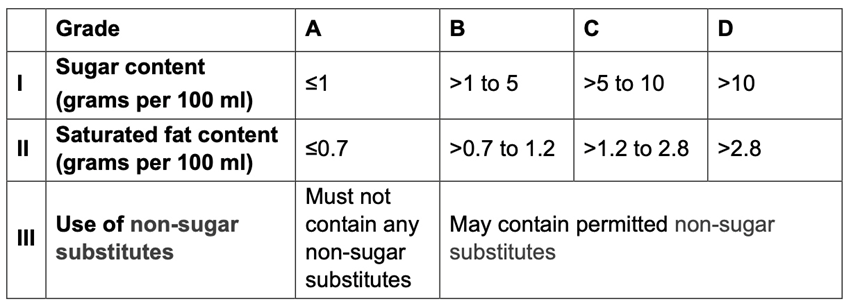
The Nutri-Grade Mark must be applied on the Front-of-Pack (FOP) surface of pre-packaged beverages if they are graded “C” or “D”. The Nutri-Grade mark consists of two key pieces of information about the beverage (i.e. its grade and its percentage of sugar content per 100ml rounded to the nearest whole number (see below figure)).
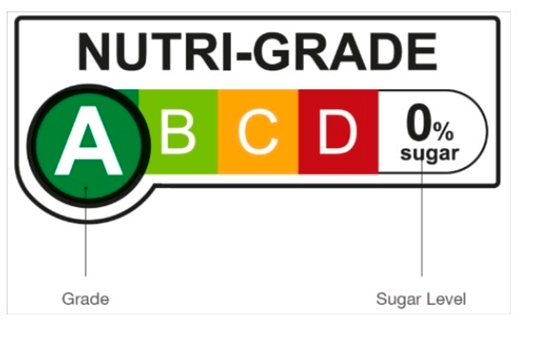 According to Regulation 184C of the Food Regulations, a nutrition information panel is mandatory for Nutri-grade beverages in the form specified in the Twelfth Schedule and, additionally, to declare the amount of total sugar and saturated fat, unless the product contains no carbohydrate or no fat, respectively. Refer to Industry Guidance in [10] for more details.
4.6 Authority Approval of Product Label
Product
Infant Formula, Follow-up Formula, Young Child Formula
No authority approval is required [5].
4.7 Additional Notes on Labeling
Product
Infant Formula, Follow-up Formula, Young Child Formula [1,3]
Labeling information appears conspicuously and in a prominent position on the label and shall be clearly legible.
The common name of the product (e.g., infant formula), the statement of ingredients, and the net quantity must be printed with letters not less than 1.5 mm in height.
4.8 References
1. Regulation 5, 6, 10 and 254 Singapore Food Regulation
https://sso.agc.gov.sg/SL/SFA1973-RG1?DocDate=20211230&WholeDoc=1#pr5-
2. The Sale of Infant Foods Ethics Committee Singapore
(SIFECS) Code of Ethics, 5th Edition (1 December 2020)
3. Regulation 5, 6, 8A, 10, 248 and TWELFTH Schedule Singapore Food Regulation
https://sso.agc.gov.sg/SL/SFA1973-RG1?DocDate=20211230&WholeDoc=1#pr5-
4. Regulation 5(2) Singapore Food Regulation
5. Singapore Food Agency Frequently Asked Questions on Food Labelling and Advertisements
https://www.sfa.gov.sg/faqs#food-information--food-labelling-advertisement
6. Regulation 254 Singapore Food Regulation
7. Regulation 5(4)a Singapore Food Regulation
8. Measures for Nutri-Grade Beverages
https://hpb.gov.sg/healthy-living/food-beverage/nutri-grade
9. Regulation 184B, Singapore Food Regulation
https://sso.agc.gov.sg/SL/SFA1973-RG1?DocDate=20240520&ProvIds=P1IV-#pr184B-
10. Guideline for implementation of the labeling and advertising requirements for Nutri-Grade beverages
https://go.gov.sg/industryguidance
Was this article helpful?