
5. Claim Requirements
- 4 Mins to read
- DarkLight
5. Claim Requirements
- 4 Mins to read
- DarkLight
Article summary
Did you find this summary helpful?
Thank you for your feedback
General Foods
Taiwan

This section provides information on the definition of different types of claims and any restrictions or allowance of claims as well as claim registration processes.
5.1 Overview of Claims
5.1.1 Types & Definitions
According to the Regulations on Nutrition Claim for Prepackaged Food Products [1], Nutrition claims refer to any representation that states, suggests, or implies that a food product has or does not have particular calorie or nutrition properties.
The Regulations [1] do not provide definitions of the specific type of nutrition claims such as nutrient content or nutrient comparative claims.
There is also no specific definition of Nutrient Function claims in the Regulations [1]. These are referred to as “claims on physiological functions of the nutrients” and are listed in Table 4 in Section 5.2.1 below.
5.1.2 List of Prohibited Claims
According to Article 28 of the Act Governing Food Safety and Sanitation, food products should not be false, exaggerated, or misleading [2]. They should also not be labeled, promoted, or advertised as having medical properties.
5.2 Nutritional Claims
5.2.1 Permitted Claims
According to Regulations on Nutrition Claim for Prepackaged Food Products [1], Nutrient content claims (as defined in Codex guidelines) such as ‘low in’, ‘free’, ‘high’, and ‘source’ and comparative claims such as ‘higher than’ are permitted for selected nutrients:
- Nutrients for moderate intake: calories, fat, saturated fat, trans fat, cholesterol, sodium, sugar, and lactose.
- Nutrients for supplementary intake: protein, dietary fiber, vitamin A, vitamin B1, vitamin B2, vitamin B6, vitamin B12, vitamin C, vitamin D, vitamin E, vitamin K, niacin, folic acid, pantothenic acid, biotin, choline, calcium, iron, iodine, magnesium, zinc, fluorine, and selenium.
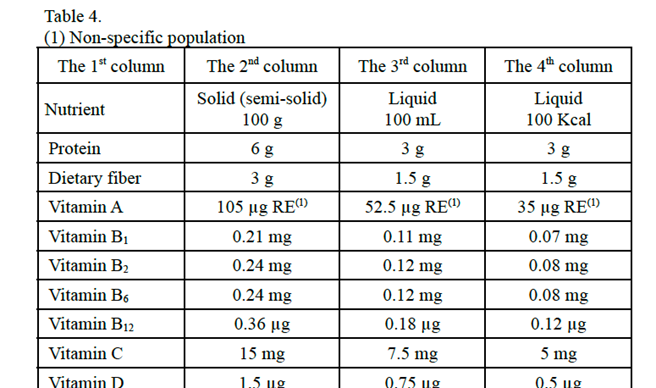
The nutrient content must meet the conditions set in the regulation in order to make nutrient claims. For example, see Table 4 below to make a ‘source of claims’:
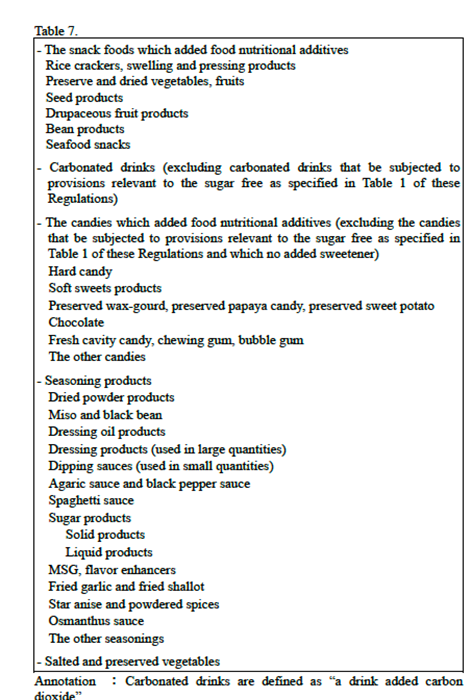
Food products in Table 7 (below) of the Regulations are not allowed to make nutrition claims and claims on the physiological functions of the food. These foods are generally considered unhealthy and their excessive intake is not encouraged.
5.2.2 Nutritional Claim Registration
(a) For nutritional claims that are already permitted for use:
It is not necessary to seek approval for nutritional claims. The responsibility is on the companies to ensure claims are truthful.
(b) For nutritional claims that are not currently permitted for use:
There is no formal process for companies to apply for new nutritional claims, for example, to add other vitamins or minerals to the list of Nutrients for supplementary intake. Companies may consult the Taiwan FDA on the possibility of amending the regulation. Information such as how the absence of this nutrient will affect national health and recommendations for intake should be provided.
5.3 Health Claims
5.3.1 Permitted Claims
Food products can only make permitted nutritional function claims (Claims on physiological functions of the Nutrients) as stated in Regulations Governing Criteria for the Label, Promotion, and Advertisement of Foods and Food Products Identified as False, Exaggerated, Misleading or Having Medical Efficacy [3].
An example of the permitted claim is “Pantothenic acid helps in promoting healthy skin and mucosa”.
To make these permitted claims, they must meet the “source of “ claim requirements in Table 4 of the Regulations of Nutrition Labeling (see Section 5.2.1 above).
Companies that wish to make new claims or product-specific claims (for example combination of vitamin D, calcium, and some other minerals for bone health) may register the General Food, Food Tablet, or Capsule form as Health Food.
According to the Health Food Act [4], Health food is defined as “food with health care effects, having been labeled or advertised with such effects". Currently, the Taiwan FDA has a list of 13 recognized health claims. Taiwan FDA also published approved test methods to substantiate these claims.
- Regulating blood lipids
- Regulating the gastrointestinal tract
- Protecting the liver
- Adjuvant Modulating Allergic Constitution
- Protecting Bone Health
- Regulating the immune system
- Reducing Body Fat Formation
- Regulating blood pressure
- Promoting Iron Absorption
- Anti-weariness
- Regulating blood sugar
- Postponing aging
- Protecting Teeth Health
Besides the 13 claims, the Taiwan FDA has also established 2 standardized claims that qualify for fast-track registration. The product will only need to meet the ingredient permitted levels specifications in order to make the claim.
- Fish Oil: “This product may help to reduce triglycerides in blood. This is based on theory. The effectiveness has not been confirmed through experimental studies”.
- Red Yeast Rice: “This product may help to reduce blood cholesterol. This is based on theory. The effectiveness has not been confirmed through experimental studies."
5.3.2 Health Claim Registration
(a) For health claims that are already permitted for use:
Premarketing approval is not required for the use of permitted Nutrient functional claims.
(b) For health claims that are not currently permitted for use:
Companies can also register products with claims that are not on the list as long as they meet the general provision set out in the Health Food Control Act. However, the test methods used for substantiation of the claims must be approved by the Taiwan FDA. Normally, companies will engage Taiwan academic bodies (universities) to develop assessment methods for the new health food claims.
There is no formal process for companies to apply for new Nutritional function claims. Companies may consult the Taiwan FDA on the possibility to amend the regulation.
5.4 Other Notes or Requirements for Claims
None.
5.5 References
1. Revised Regulations on Nutrition Labelling
http://www.foodlabel.org.tw/FdaFrontEndApp/Law/Edit?SystemId=25230d37-a119-4321-b274-51494044f9bb&clPublishStatus=1
2. Act Governing Food Safety and Sanitation
https://law.moj.gov.tw/ENG/LawClass/LawAll.aspx?pcode=L0040001
3. Regulations Governing of Criteria for the Label, Promotion and Advertisement of Foods and Food Products Identified as False, Exaggerated, Misleading or Having Medical Efficacy
4. Health Food Regulations
https://law.moj.gov.tw/ENG/LawClass/LawAll.aspx?pcode=L0040012
Was this article helpful?