
9.0 Importation Requirements
- 12 Mins to read
- DarkLight
9.0 Importation Requirements
- 12 Mins to read
- DarkLight
Article summary
Did you find this summary helpful?
Thank you for your feedback
Infant, Follow-up, and Young Child Formula
Singapore

This section provides information on the importation process (shipment, customs, licenses required, test requirements).
9.1 Shipment Declaration
Infant, Follow-up, and Young Child Formula [1]
Documents Required for Containerized Cargo:
For containerized cargo, the container number and shipper seal number must be declared when applying for the customs permit.
(i) Importing by sea: NOT required to present the customs permit and supporting documents to the checkpoint officers at the entry points.
(ii) Importing by air or land: required to produce the printed copy of the customs permit, and supporting documents such as invoice, packing list, and Air Waybill/consignment note, to the checkpoint officers at the time of cargo clearance for verification. Ensure the validity of the customs permit presented for clearance of imports.
Depending on the checkpoint, conditions in the customs permit could be:
- A1 The goods and this permit with invoices, BL/AWB, etc must be produced for Customs clearance/ endorsement at a Free Trade Zone “In” Gate.
- A3 The goods must be produced with this permit, invoices, BL/AWB, etc for Customs endorsement at an Airport Customs checkpoint or designated Customs office or station as required.
- H1 The goods and this permit with invoices, BL/AWB, etc must be produced for Customs clearance/endorsement at Woodlands Checkpoint / Tuas Checkpoint.
Documents Required for Conventional Cargo & Hand-Carried Goods:
For conventional cargo and hand-carried goods, present the goods, printed copy of the customs permit, and supporting documents such as invoice, packing list, and Bill of Lading/Air Waybill, to the checkpoint officers at the entry points for verification.
An example of conditions in the customs permit indicating this requirement:
- A1 The goods and this permit with invoices, BL/AWB, etc must be produced for Customs clearance/ endorsement at a Free Trade Zone “In” Gate.
- A3 The goods must be produced with this permit, invoices, BL/AWB, etc for Customs endorsement at an Airport Customs checkpoint or designated Customs office or station as required.
- H1 The goods and this permit with invoices, BL/AWB, etc must be produced for Customs clearance/endorsement at Woodlands Checkpoint / Tuas Checkpoint.
For a consignment that requires partial clearance, the same customs permit should be presented each time for endorsement till the whole consignment is completely cleared.
Please note partial clearance is NOT allowed for goods brought in via Woodlands and Tuas checkpoints.
Documents Required for Cargo Clearance of Air Imports Granted GST Relief at Changi Airfreight Centre Checkpoint:
GST relief and permit waiver are granted on non-controlled and non-dutiable air imports imported by post or air with a total Cost, Insurance, and Freight (CIF) value not exceeding S$400.00. To facilitate the cargo clearance of such air courier parcels/consignments at the Changi Airfreight Centre (CAC) Checkpoint, freight forwarders/handling agents are allowed to use a summary list, together with the invoice and House Airway Bill (HAWB)/consignment note for each parcel/consignment with a CIF value not exceeding S$400.00 containing only non-controlled and non-dutiable items.
There is no GST relief for goods originally imported by land, sea, or truck flights and subsequently presented for clearance at the CAC Checkpoint, even if the CIF value of the goods does not exceed S$400. See Circular No. 01/2021 for details. For more information on how to determine the total CIF value of a parcel/consignment, please refer to Circular No: 04/2016 for more information.
The summary list is to be printed on A4-sized paper in a minimum font size of 12 and shall contain the following information stated below in English:
- Company’s letterhead and indicated with the page number and total number of pages of the summary list.
- All items are serialized and ordered alphabetically with the following information:
- corresponding parcel tracking number/ HAWB/ reference number;
- outer packing number (i.e. mailbag no);
- consignee name;
- consignee address;
- item CIF provided in S$; and
- total CIF value of all items under the same parcel tracking number/ reference number.
- An undertaking by your company (endorsed by a staff holding a managerial position or above) that:
- the parcels/consignments imported using the summary list are non-controlled, non-dutiable, and valued at S$400.00 or less;
- the parcels/consignments imported did not originally enter Singapore via land or sea;
- the staff’s name, designation, signature, and email contact are clearly indicated on the Letter of Undertaking; and
- the company will pay any duty/GST not paid for the goods where GST relief is not granted, including goods that were first imported via land or sea.
- Your company is to ensure that the individual parcels imported are labeled with their invoice and HAWB/consignment note.
For clearance of dutiable and controlled goods as well as goods originally imported by land, sea, or truck flights (regardless of CIF value) and other goods with CIF exceeding S$400.00, a Customs In-Payment (GST) permit is required to account for each consignment, and the individual HAWB, commercial invoices, together with the Customs permit, are to be presented to the checkpoint officer for verification.
9.2 Customs Procedure
Infant, Follow-up and Young Child Formula [2][3][4]
Step 1: Register for UEN and Activate Customs Account
An entity that intends to:
- Engage in import or export activities in Singapore, or
- Obtain import, export, and transshipment permits or certificates
will need to:
- Register with the Accounting and Corporate Regulatory Authority (ACRA) or the relevant Unique Entity Number (UEN) issuance agency to obtain a UEN; and
- Activate its Customs Account
Step 2: Check if Your Goods are Controlled
Importers of infant formula, follow-up formula, and young children formula require importer registration with the Singapore Food Agency (SFA) (see Other Notes or Requirements for Importation) and importers of infant formula shall submit regulated source documents to Singapore Food Agency, and/or register with Ministry of Health Malaysia for Malaysian establishments (see Section 8. Registration processes).
Step 3: Apply for Inter-Bank GIRO
The importer or its Declaring Agent must maintain an Inter-Bank GIRO (IBG) with Singapore Customs to make payment of duties, taxes, fees, penalties, and other charges on services offered by Singapore Customs from your bank account to Singapore Customs directly.
Mail the completed Application for Inter-Bank GIRO form to Singapore Customs’ address as indicated in the form.
The importer may authorize their Declaring Agent to use your IBG for the payment of duties and GST for your customs permit one day after the approval of your IBG application. If you do not maintain an IBG with Singapore Customs, the duties, and GST will be deducted from your Declaring Agent’s IBG.
Step 4: Furnish Security
Importers are required to furnish security for transactions involving dutiable goods, temporary import of goods for approved purposes, and for the operation of licensed premises such as licensed warehouses and excise factories. The security furnished should be in the form of a Banker’s Guarantee, Finance Company Guarantee, or an Insurance Bond. Please see security lodgement for more information.
Step 5: Obtain Customs Import Permit
Appoint a Declaring Agent to obtain a customs permit on your behalf; or obtain customs permits for your own or on behalf of your clients. To do so, you will need to register as a Declaring Agent and apply for a TradeNet user ID.
Obtain customs permits through TradeNet, which is accessible through TradeNet front-end software from an approved software vendor; or Government Front-End Application.
Each permit application typically costs S$2.88. This does not include service fees charged by service providers such as freight forwarders, Declaring Agents, etc. If the trader is engaging a Declaring Agent for assistance in submitting the permit application, please check the amount of service fees that they charge.
Below is a summary of the application procedure for import permits for infant formula, follow-up formula, and young child formula:
STEP A: Prepare registration number, and product / HS codes. Refer to the respective lists of establishment codes to identify the relevant code for the relevant exporting country or region (https://www.sfa.gov.sg/docs/default-source/tools-and-resources/casc-code-1/listofestablishmentcodesinaothercountriesexcludejap; https://www.sfa.gov.sg/docs/default-source/tools-and-resources/casc-code-1/listofjapanprefecturalcodes1). See SFA’s Product Codes for permit declaration for Processed Food Products and food Appliances.
STEP B: Apply for an import permit via TradeNet. You will be assigned a Unique Reference Number.
STEP C: Submit additional documents online as attachments through TradeNet, if required - see Other Notes or Requirements for Importation (Section 9.5 below). Submit TradeNet applications and all supporting documents before 5:30 pm on Mondays to Thursdays and before 5:00 pm on Fridays. This is to facilitate permit approval within one working day. Applications made on Saturdays, Sundays, and Public Holidays will only be processed the next working day.
STEP D: After approval by the Singapore Customs and SFA, you will be issued a Cargo Clearance Permit (CCP) which also serves as an SFA import permit.
STEP E: Print out your CCP and make the required number of copies of the CCP, which will be used for the clearance of goods at the border checkpoint, inspection, etc. There is no import fee for every consignment of infant formula, follow-up formula, and young child formula imported into Singapore, unlike other specific food categories. See "Other Notes or Requirements for Importation" (Section 9.5 below) for specific import permit requirements for infant formula and follow-up formula.
Step 6: Prepare Documents for Cargo Clearance
Approved permit applications are issued with a validity period. The importer should ensure the validity of the permit presented for goods clearance. For imports of containerized cargo, the container number and shipper seal number are required when applying for a permit. Besides the import permit, other supporting documents are required such as an invoice, packing list, and Bill of Lading/Air Waybill (see Shipment Declaration details).
Step 7: Retain your Trade Documents
Generally, the Importer is required to retain the relevant supporting documents relating to the purchase, import, sale, or export of the goods for a period of 5 years from the date of the permit application approval.
These documents can be stored as physical hardcopies or as images. Importers are required to produce these supporting documents to Singapore Customs upon request.
9.3 Manufacturing License
Infant, Follow-up, and Young Child Formula [5]
Not required. For infant formula and follow-up formula (which falls under the classification of infant formula), regulated source documentation including factory license is submitted as documentary proof one time via the SFA Online Feedback Form or TradeNet unless there are changes in sources of supply (see Section 8. Registration Processes).
9.4 Test for Importation
Infant, Follow-up, and Young Child Formula [6]
In general, SFA tests food products for the following test parameters. The specific parameters to be tested for each food product will be dependent on the risks and hazards associated with the food. This list is not exhaustive and SFA may test for additional parameters that are not stated.
Infant Formula [6]
Submission of manufacturer’s quality control (QC) reports on chemical and microbiological tests once every 6 months. As part of the import requirements, importers may be required to test for the following parameters if requested by the Singapore Food Agency:
- Chemical: Heavy metals, Melamine, Pesticide residues, Polychlorinated biphenyls (PCBs)
- Microbiological: Clostridium botulinum, Campylobacter, Listeria monocytogenes, Bacillus enterotoxins.
9.5 Other Notes or Requirements for Importation
Infant, Follow-up and Young Child Formula [5][6][7]
- Importers of infant formula, follow-up formula, and young child formula have to apply with the Singapore Food Agency for "Registration to Import Processed Food Products and Food Appliances" through submission of an application through the GoBusiness Licensing website. Registration is free and it takes 1 working day to process.
- All food consignments are subject to inspection. Some samples may also be taken by SFA for laboratory analysis.
- In some cases, consignments may be placed on “hold and test”, i.e. the consignment cannot be sold or distributed until the laboratory results have been released and the sample found compliant with Singapore food laws.
- Importers are advised to make an online booking through the Singapore Food Agency Inspection & Laboratory e-Services https://ifast.sfa.gov.sg/eserviceweb for the inspection of imported processed food. Importers will not receive the results of ad hoc inspections done without bookings. Importers need to check with SFA for the results of ad hoc inspections.
- Guidelines for online booking for inspections can be found at:
- Documents required for the inspection:
- Cargo Clearance Permit (CPP issued by SFA)
- Any relevant documents, e.g. invoices and health certificates, and
- The consignment of food for inspection
In case consignments that fail to meet SFA’s requirements will not be allowed to be sold or distributed in Singapore. Importers of such consignments will have to return or dispose of them. For consignments found to be contaminated with radioactive materials, importers are required to either return or re-export the products. Local disposal of the consignments is not allowed.
Depending on the nature of the non-compliance, the source and/or exporter may be suspended from exporting to Singapore. Importers of non-compliant products may also be suspended from importing from these sources/exporters.
China milk, milk products, and products containing milk from China produced on or after 18 Dec 2008 will be allowed to be imported into Singapore subject to compliance with the following import conditions:
- the products must be produced by establishments approved for export by the Chinese authorities,
- the manufacturers are required to test each batch of their raw materials and end products to ensure that they are not contaminated with melamine, and
- the Chinese authorities must inspect and test each batch of the products and issue health certificates with the results of melamine tests to accompany consignments exported to Singapore.
A template of the health certificate and laboratory test report can be found here.
To facilitate the approval of import permits, please ensure that the following information is provided during the application for import permits:
- Brand
- Product Description
- Batch No., Production Date or Date of Expiry
- Name and address of the manufacturer
Infant Formula [6]
The import requirements for infant formula, and follow-on formula (age 0-12 months) are as follows, to be submitted to Singapore Food Agency:
1. Submission of documentary proof (one-time submission) that the imported infant formulas are manufactured in a premise regulated by the competent authority (e.g. certified true copy of the manufacturer's license). This requirement coincides with the submitted documentary proof requirement for the manufacturing site mentioned in Section 8. Registration Processes. The importer only needs to do it once via SFA's online feedback form or TradeNet.
2. Product from Foot-and-Mouth Disease (FMD) free countries:
Submission of health certificate (every consignment) during import permit application that must contain the following attestation by the relevant competent authority of the exporting country:
- Products are produced using milk ingredients originating from FMD-free countries
- Liquid milk used is pasteurized by heating at a min 72oC for a minimum of 15 seconds or an equivalent process
3. Product from FMD-affected countries:
Submission of health certificate (every consignment) during import permit application that must contain the following attestation by the relevant competent authority of the exporting country:
- a sterilization process applying a minimum temperature of 132°C for at least one second (ultra-high temperature [UHT]), or
- if the milk has a pH less than 7.0, a sterilization process applying a minimum temperature of 72°C for at least 15 seconds (high temperature - short time pasteurization [HTST]), or
- if the milk has a pH of 7.0 or over, the HTST process is applied twice.
4. The health certificate should include the following information:
- Description of the products including brand name and nature of product
- Quantity in the appropriate units
- Lot identifier and date of production
- Name and address of the manufacturer or the processing establishment
- Name and address of the importer or consignee
- Name and address of the exporter or consignor
- Country of dispatch
- Country of destination
5. Submission of health certificate or manufacturer’s quality control (QC) reports on chemical and microbiological tests once every 6 months:
- Chemical: Aflatoxin M1
- Microbiological:
- Powdered formulas:
- Total colony count
- *Total coliform
- *Faecal coliform
- *Escherichia coli
- *Enterobacter sakazakii (Cronobacter spp)
- Salmonella spp.
- Staphylococcus enterotoxin (or Staphylococcus aureus)
- Liquid formulas in hermetically sealed containers: Sterility test
*The Enterobacteriaceae test can be accepted as a test method for total coliform, fecal coliform, Escherichia coli, and Enterobacter sakazakii (Cronobacter spp).
Refer to the OIE website for a list of FMD-free countries.
9.6 Overview Flowchart for Importation Process
Infant, Follow-up, and Young Child Formula
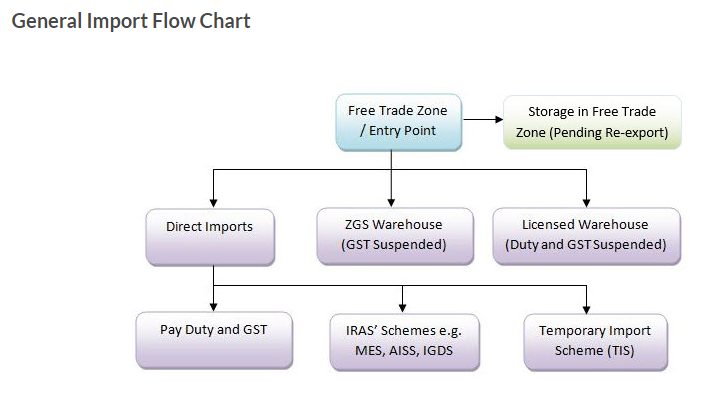
Importation flowchart from Singapore Customs [2]:
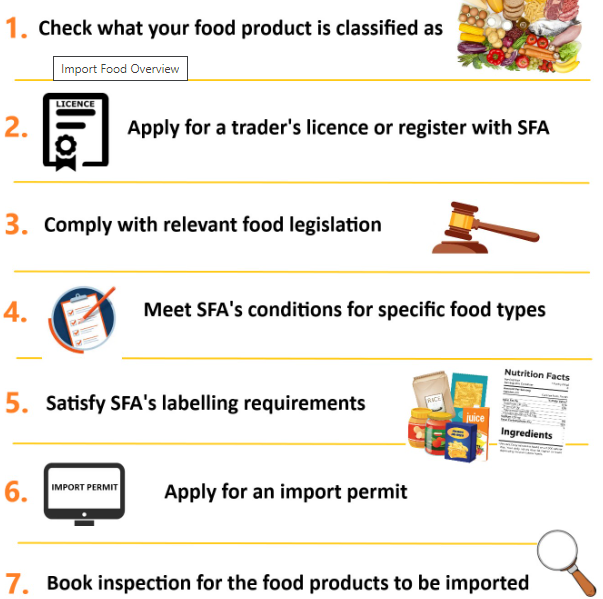
Importation flowchart for all food from Singapore Food Agency [5]:
9.7 References
1. Singapore Customs - Documents for Clearance of Goods
2. Singapore Customs Overview - Quick Guide for Importers
https://www.customs.gov.sg/businesses/importing-goods/overview
3. Singapore Food Agency - Import & Export -Applying for Import Permit
https://www.sfa.gov.sg/food-import-export/commercial-food-imports#applying-for-import-permit
4. Food Permit Application FAQs
https://www.sfa.gov.sg/docs/default-source/food-import-and-export/food-permit-applications-faqs.pdf
5. Singapore Food Agency - Food Import & Export
https://www.sfa.gov.sg/food-import-export/commercial-food-imports
6. Singapore Food Agency - Import Requirements of Specific Food Products (Updated 23 April 2020)
7. Singapore Food Agency - Food Import & Export - Registration of Traders
https://www.sfa.gov.sg/food-import-export/licensing-registration-of-traders
Was this article helpful?