
9. Advertising Aspects
- 6 Mins to read
- DarkLight
9. Advertising Aspects
- 6 Mins to read
- DarkLight
Article summary
Did you find this summary helpful?
Thank you for your feedback
Beers, RTDs, Whisky
Singapore

This section provides information on regulations on advertising and if there are any restrictions or approval processes.
9.1 Applicable Advertising Regulation
General Food
Consumer Protection (Fair Trading) Act [1]
All advertisements in Singapore must comply with the Consumer Protection (Fair Trading) Act, which is Singapore’s main consumer protection law.
Based on Section 4 of the Consumer Protection (Fair Trading) Act, it is an unfair practice for a supplier, in relation to a consumer transaction -
- to do or say anything, or omit to do or say anything, if as a result a consumer might reasonably be deceived or misled;
- to make a false claim;
- to take advantage of a consumer if the supplier knows or ought reasonably to know that the consumer —
- is not in a position to protect his or her own interests; or
- is not reasonably able to understand the character, nature, language, or effect of the transaction or any matter related to the transaction; or
- without limiting paragraphs (a), (b), and (c), to do anything specified in the Second Schedule.
The Second Schedule lists the specific unfair practices including representing that goods or services have sponsorship, approval, performance characteristics, accessories, ingredients, components, qualities, uses, or benefits that they do not have.
Sale of Food Act* [2]
Section 16 does not allow a person to sell any food that is packaged or labeled in a manner that does not comply with all applicable requirements of the Act relating to the identification and labeling of that food; Section 16A does not allow a person who is selling, promoting the sale or appearing to promote the sale of any food or prescribed food contact article that does not comply with all applicable requirements of the Act relating to advertisements promoting the food or food contact article.
* The Singapore Food Safety and Security Act (FSSA) [6] was passed in the Singapore Parliament in January 2025. While the FSSA has not yet come into effect, it would consolidate and amend food safety legislation in Singapore, including the eventual repeal of the Sale of Food Act. The implementation of the FSSA would be in phases, with a full transition expected in 2028.
The FSSA refines the definition of what constitutes a label or an “advertisement”, who may be considered “advertisers” and what would constitute publishing in Singapore.
Section 3 provides a definition of “content” while Section 7 provides definitions on “publish in Singapore”, “advertise” and associated terms - advertisements will not only cover texts and visuals to promote the sale of food or the brand of a food, but also music and sounds, and includes information or material in any combination of forms; advertising medium will apply to advertising in traditional media as well as online and physical space. This includes (i) print and broadcast media such as TV, radio, and newspapers, (ii) digital media encompassing social media and telecommunications services, (iii) out-of-home media such as billboards, bus and train advertisements, and (iv) collateral given away to the public in the promotion of goods and services.
Part 10 of the FSSA covers misleading or deceptive conduct and other marketing offenses, where Section 184 makes it an offense to publish in Singapore any non-compliant advertisement about food or food contact articles. Advertisement includes content that is or contains a false description of the food or is false as to the suitability of the regulated food contact article.
Food Regulations [3]
Based on Regulation 12, an advertisement for food, other than a label, must not contain any statement, word, brand, picture, or mark that is prohibited by Regulation 9, other than to the extent permitted under Regulation 9A or B.
Regulation 9(1) states that no written, pictorial, or other descriptive matter appearing on or attached to, or supplied or displayed with food is to include any claim or suggestion whether in the form of a statement, word, brand, picture, or mark purporting to indicate the nature, stability, quantity, strength, purity, composition, weight, origin, age, effects, or proportion of food or its ingredients that is false, misleading or deceptive, or is likely to create an erroneous impression regarding the value, merit or safety of the food.
Regulation 9(2) states that the use of claims for therapeutic or prophylactic action; claims which could be interpreted as advice of a medical nature from any person; claims that food will prevent, alleviate, or cure any disease or condition affecting the human body; and claims that health or an improved physical condition may be achieved by consuming any food, is prohibited unless permitted under Regulation 9A or 9B.
Regulations 9A and 9B permit claims for products added with phytosterols, phytosterol esters, phytostanols or phytostanol esters, barley beta‑glucan or oat beta‑glucan, claims on the source of energy and an excellent source of protein as long as the criteria or conditions stated in the respective regulations are met.
Code of Advertising Practice (not legally binding) [4,5]
That said, advertisements in Singapore are generally self-regulated by the industry [4]. Food businesses are encouraged to refer to the Singapore Code of Advertising Practice [5], administered by the Advertising Standards Authority of Singapore (ASAS), an advisory Council under CASE, on ethics in advertising. The Code of Advertising Practice is not legally binding.
Note: In response to evolving consumer expectations and advancements in advertising platforms, ASAS is reviewing the Code of Advertising Practice so that it is updated to reflect the evolving concerns and address the demands of new technologies. Public consultation closed on 19 April 2024.
Nevertheless, based on Section I(i), Para 4.1 of the Code of Advertising Practice, the ASAS is empowered to ask an advertiser or an advertising agency to amend or withdraw any advertisement that, in the opinion of ASAS, is contrary to the Code [5]. The ASAS is also empowered to ask an advertiser or advertising agency to withhold such advertisement until it has been modified or, in the case where the ASAS has requested further information in order to decide whether an advertisement is contrary to the Code, pending receipt of such information and a decision.
Category
Alcoholic drinks
Appendix K of the Code of Advertising Practice [5] lays down recommendations relating to the advertising of alcoholic products. The code is not legally binding but it has the support of a number of organizations and government agencies whose representatives constitute the Advertising Standards Authority of Singapore.
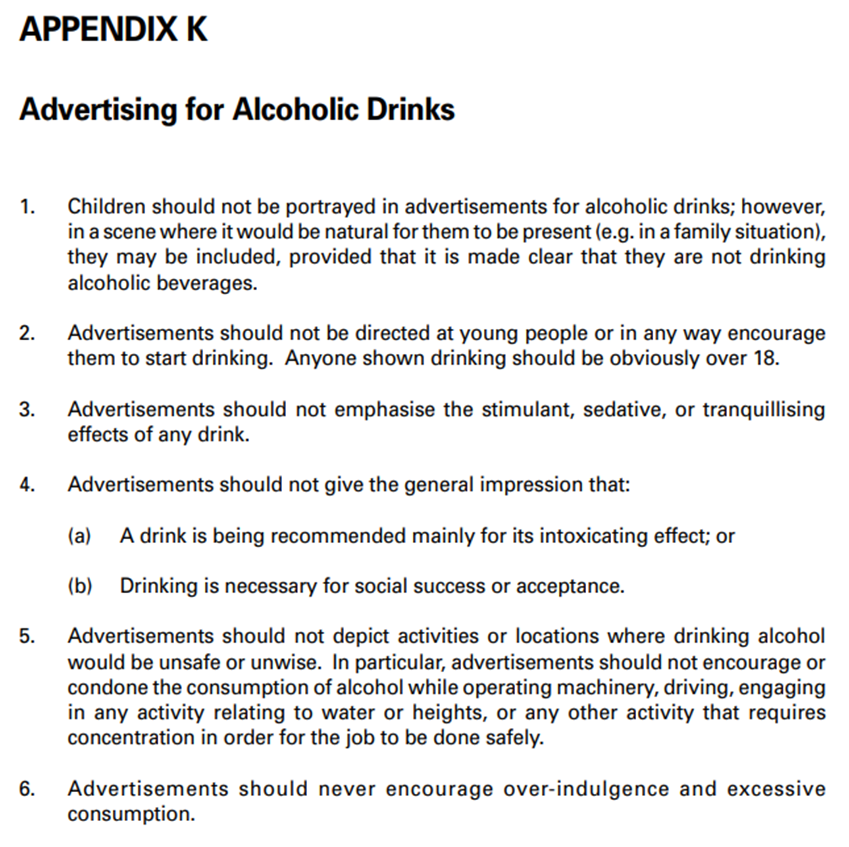 Source: Appendix K of the Code of Advertising Practice [5]
Product
1) Beer
Same as "Category" (alcoholic drinks) above.
2) Ready-to-drink beverages (mainly Chuhai)
Same as "Category" (alcoholic drinks) above.
3) Whisky
Same as "Category" (alcoholic drinks) above.
9.2 Specific Restrictions on Advertising
General Food
Refer to Section 9.1 above.
Category
Alcoholic drinks
According to Appendix K of the Code of Advertising Practice (not legally binding):
- Children should not be portrayed in advertisements for alcoholic drinks; however, in a scene where it would be natural for them to be present (e.g. in a family situation), they may be included, provided that it is made clear that they are not drinking alcoholic beverages.
- Advertisements should not be directed at young people or in any way encourage them to start drinking. Anyone shown drinking should be obviously over 18.
- Advertisements should not emphasize the stimulant, sedative, or tranquilizing effects of any drink.
- Advertisements should not give the general impression that:
- A drink is being recommended mainly for its intoxicating effect; or
- Drinking is necessary for social success or acceptance.
- Advertisements should not depict activities or locations where drinking alcohol would be unsafe or unwise. In particular, advertisements should not encourage or condone the consumption of alcohol while operating machinery, driving, engaging in any activity relating to water or heights, or any other activity that requires concentration in order for the job to be done safely.
- Advertisements should never encourage over-indulgence and excessive consumption.
Product
1) Beer
Same as "Category" (alcoholic drinks) above.
2) Ready-to-drink beverages (mainly Chuhai)
Same as "Category" (alcoholic drinks) above.
3) Whisky
Same as "Category" (alcoholic drinks) above.
9.3 Advertising Approval
General Food
Advertising approval is not required from the authorities. Based on Section I(i) Para 3.1 of the Code of Advertising Practice, the Advertising Standards Authority of Singapore is not geared, nor is it intended to become a clearing house for the approval of all advertising [5].
Category
Alcoholic drinks
Same as "General Food" above.
Product
1) Beer
Same as "Category" (alcoholic drinks) above.
2) Ready-to-drink beverages (mainly Chuhai)
Same as "Category" (alcoholic drinks) above.
3) Whisky
Same as "Category" (alcoholic drinks) above.
9.4 References
1. Consumer Protection (Fair Trading) Act
https://sso.agc.gov.sg/Act/CPFTA2003?ProvIds=P12-#P12-
2. Sale of Food Act
https://sso.agc.gov.sg/Act/SFA1973?ProvIds=P13-#pr16-
3. Food Regulations
https://sso.agc.gov.sg/SL/SFA1973-RG1?DocDate=20230904&ProvIds=P1IV-P4_184A-P4_185-#pr198-
4. Advertising Standards Authority of Singapore’s website
https://asas.org.sg/about/code
5. Singapore Code of Advertising Practice, published by the Advertising Standards Authority of Singapore
https://asas.org.sg/Portals/0/SCAP%202008_1.pdf
6. Food Safety and Security Act (Uncommenced)
https://sso.agc.gov.sg/Act/FSSA2025/Uncommenced/20250504225421?DocDate=20250206&WholeDoc=1#P110-
Was this article helpful?