
8. Safety Parameters
- 3 Mins to read
- DarkLight
8. Safety Parameters
- 3 Mins to read
- DarkLight
Article summary
Did you find this summary helpful?
Thank you for your feedback
General Foods
Australia

This section provides the safety parameters (microbiological, contaminants, heavy metals, pesticides, veterinary residues, and food contact materials).
8.1 Microbiological Standards
Provision, Limits, Testing Methods | |
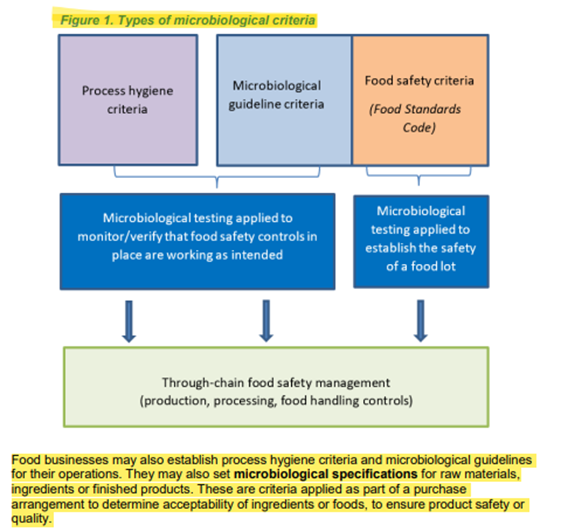
Foodstuff/General Foods | Standard 1.6.1 – Microbiological Limits in Food [1] in conjunction with Schedule 27 – Microbiological Limits in Food [2] describes end-point microbiological criteria that are applied to determine the safety of a food lot or batch. However, these do not cover microbiological limits for all foods since only those foods entered in [2] have specific limits (e.g., dairy, and meat products). While most food products do not have a microbiological standard, additional guidance is available in the Compendium of Microbiological Criteria for Food [3]. This describes how manufacturers can set process hygiene criteria and microbiological guideline material to set their internal microbiological specification for the foods they manufacture (Figure 1 below). Figure 1. Screenshot from ref [3]: FSANZ approach to setting microbiological specifications Testing methods applied in relation to the limits in [2] are the relevant methods of Australian Standard AS5013 or equivalent [1] (refer to Figure 2). These do not necessarily apply to microbiological analyses in [3]. In this case, validated test methods should be used. 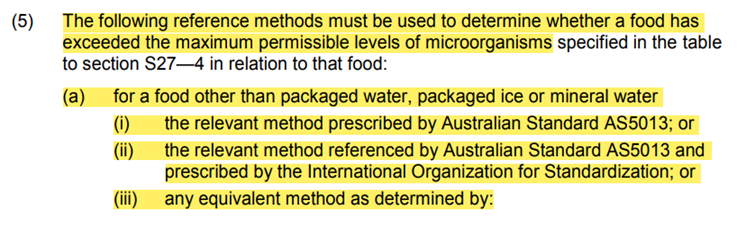  Figure 2. Screenshot from Standard 1.6.1-3 (5) [1]: testing methods Figure 2. Screenshot from Standard 1.6.1-3 (5) [1]: testing methods |
8.2 Contaminants and Heavy Metals
Provision, Limits, Testing Methods | |
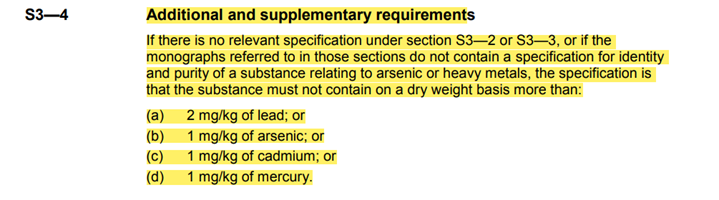
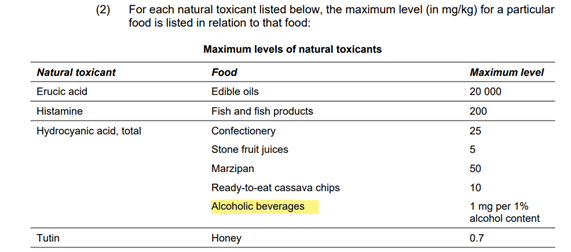
Foodstuff/General Foods | Standard 1.4.1 – Contaminants and natural toxicants [4] in conjunction with Schedule 19 – Maximum levels of contaminants and natural toxicants [5] describe the requirements for contaminants and heavy metals. The maximum levels of metal contaminants [5] only set limits for foods listed in the table in Clause S19-4. This does not include alcoholic beverages. Therefore, the applicable specification for ingredients/food would be as described in Figure 3.
Figure 3. Arsenic and heavy metals from clause S3-4 from ref [6]. Non-metal contaminants are shown in the table to S19-5 [5]. The relevant contaminants are:
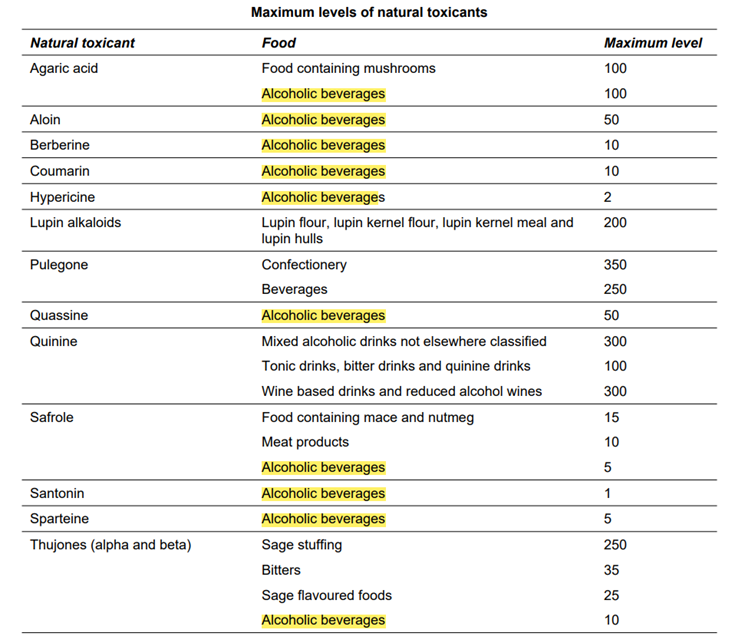
Natural toxicants are shown in the table to S19-6 [5].
|

8.3 Pesticides
Provision, Limits, Testing Methods | |
Foodstuff/General Foods | Pesticides are considered to be AgVet chemicals defined as substances used in agricultural chemical products [6] per Figure 4 below.
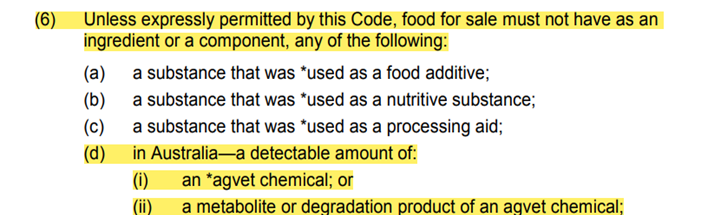
Figure 4. Definition of Agvet chemical from clause 1.1.2- 2 (3) of ref [6] Therefore, information here also applies in Section 8.4. Clause 1.1.1—10(6)(d) of the FSC [7] states that a food for sale must not have, as an ingredient or a component, a detectable amount of an AgVet chemical or a metabolite or a degradation product of the AgVet chemical, unless expressly permitted (Figure 5).
Figure 5. Agvet chemicals in foods for sale from clause 1.1.1- 10 (6) of ref [7] Permissions for Agvet chemical residues are given in Standard 1.4.2 – Agvet chemicals [8] and Schedule 20 [9] and 21 [10]. Schedule 20 sets limits for foods where an AgVet chemical was applied to an ingredient while Schedule 21 applies where an AgVet chemical is potentially present in a food that arose from environmental sources, and not from direct or indirect use of an AgVet chemical on food. Since it is difficult to construct a pesticide release specification using the information in [9] and [10] due to substances being entered as individual chemicals and not based on potential chemicals in an individual food, manufacturers should use the data from their raw material suppliers to set a specification with respect to pesticides in a food product. |

8.4 Veterinary Standards
Provision, Limits, Testing Methods | |
Foodstuff/General Foods “Miscellaneous/ General food” | Please refer to the above. |
8.5 Food Contact Materials
Provision, Limits, Testing Methods | |
Foodstuff/General Foods | Please refer to the other reports on packaging requirements for food contact materials and packaging requirements for food contact materials (hygiene standard). |
8.6 References
1. Standard 1.6.1 – Microbiological Limits in Food
https://www.legislation.gov.au/F2015L00411/latest/downloads
2. Schedule 27 – Microbiological limits in food
https://www.legislation.gov.au/F2015L00453/latest/downloads
3. Compendium of Microbiological Criteria for Food
PDF attached below
4. Standard 1.4.1 – Contaminants and natural toxicants
https://www.legislation.gov.au/F2015L00408/latest/downloads
5. Schedule 19 – Maximum levels of contaminants and natural toxicants
https://www.legislation.gov.au/F2015L00454/latest/downloads
6. Standard 1.1.2 – Definitions used throughout the Code
https://www.legislation.gov.au/F2015L00385/latest/downloads
7. Standard 1.1.1 – Structure of the Code and general provisions
https://www.legislation.gov.au/F2015L00383/latest/downloads
8. Standard 1.4.2 – Agvet chemicals
https://www.legislation.gov.au/F2015L00415/latest/downloads
9. Schedule 20 – Maximum residue limits
https://www.legislation.gov.au/F2015L00468/latest/downloads
10. Schedule 21 – Extraneous residue limits
https://www.legislation.gov.au/F2015L00471/latest/downloads
Was this article helpful?