
11. Middle East
- 1 Mins to read
- DarkLight
11. Middle East
- 1 Mins to read
- DarkLight
Article summary
Did you find this summary helpful?
Thank you for your feedback
PCR Plastic Packaging Regulations
Global
11.1 Regulatory Overview
Plastic recycling is still in nascent stages in the Middle East. Some countries have started plastic waste collection programs, but their efficacy is yet to be ascertained as most of the collected waste is still sent to other countries, especially India, for recycling.
Government initiatives have been launched and plastic recycling centers have been established in UAE, Saudi Arabia, Qatar, but in general, several countries, such as UAE, Egypt and others, have chosen a policy of waste-to-energy for the management of waste plastics.
Especially during the high pick of the pandemic, the recycling activities have slowed down, fearing a secondary transmission of the virus if carrying on the activities of manual selection. Many of the projects that are now developing in the region are mainly going towards incineration.
The regulatory scenario for food contact plastics is established at the level of the Gulf Cooperation Council (GCC), the political and economic alliance of Saudi Arabia, Kuwait, UAE, Qatar, Bahrain, and Oman. Such scenario closely mirrors the EU legislation [1]. However, it doesn’t make reference to policies for the use of recycled plastics in food contact. Extending the concept in use in EU, where plastics obtained from feedstock recycling may be used for manufacturing new food contact plastics, feedstock recycling may be acceptable in the GCC Countries.
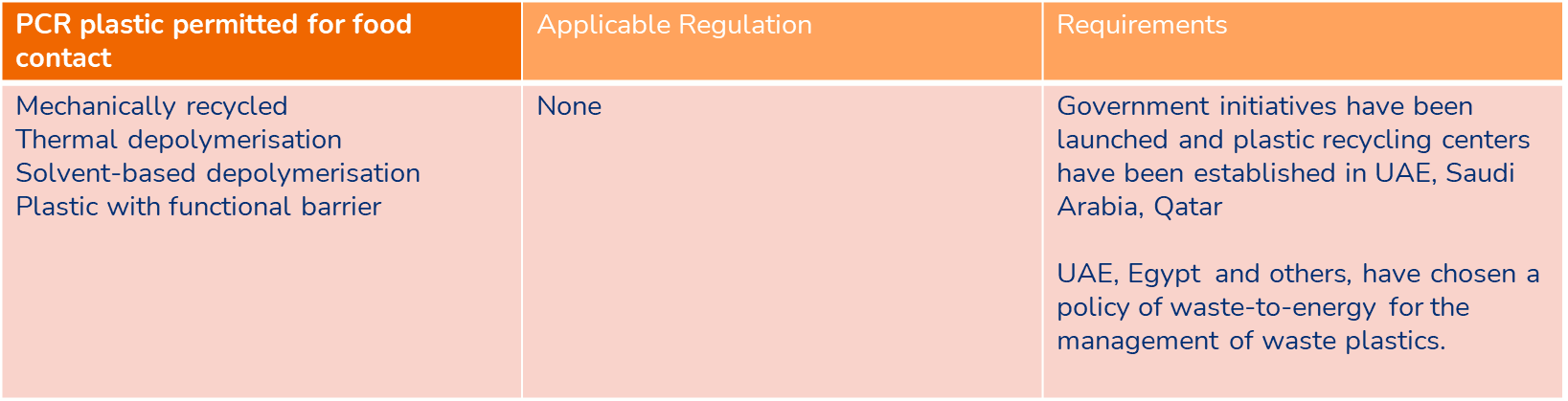 Middle East - Regulatory Landscape
11.2 References
1. Standards Store - GCC Standardization Organization (gso.org.sa)
Was this article helpful?