
7. Importation Requirements
- 6 Mins to read
- DarkLight
7. Importation Requirements
- 6 Mins to read
- DarkLight
Article summary
Did you find this summary helpful?
Thank you for your feedback
Beers, RTDs, Whisky
India

This section provides information on the importation process (shipment, customs, licenses required, and test requirements).
7.1 Shipment Declaration
General Food
FSSAI (Food Safety and Standards Authority of India) mandates specific procedures for the shipment declaration of General Foods to ensure that imported or exported food products meet the required safety and quality standards. It includes vital information such as product details, compliance with FSSAI regulations, and safety certifications. Importers and exporters must use the appropriate FSSAI online portals to submit their shipment declarations and ensure their food products are safe and meet the required standards. [7]
Category
Alcoholic beverages
When importing alcoholic beverages like beer, RTDs, and whisky, the importer (or their customs clearing agent) is responsible for submitting the required shipment declaration to FSSAI and Customs.
The Key Elements of a Shipment Declaration [31]:
- Exporter/Importer Details and IEC code [33]
- Description of goods and HSC - Harmonized System (HS) code
- Invoice value and declaration of FOB and Cost, Insurance, and Freight (CIF) values
- Shipping Details
- Customs and Regulatory Compliance - Applicable duties, taxes, and exemptions, Certificates required for specific goods [13]
- Declaration Statement
Product
1) Beer
Same as "Category" (alcoholic beverages) above.
2) Alcoholic ready-to-drink beverages
Same as "Category" (alcoholic beverages) above.
3) Whisky
Same as "Category" (alcoholic beverages) above.
7.2 Customs Procedure
General Food
The customs procedure for importing goods into India involves a structured process governed by the Customs Act of 1962.
Customs Clearance Process [13]
- Documentation Preparation:
- Mandatory Documents:
- Bill of Lading or Airway Bill
- Commercial Invoice cum Packing List
- Import General Manifest (IGM) submitted by the carrier
- Bill of Entry filed electronically through the EDI (Electronic Data Interchange) system
- Certificate of Origin, as applicable
- Certificate of Inspection or other approvals from regulatory authorities like FSSAI for alcoholic beverages
- Mandatory Documents:
- Filing the Bill of Entry through the Indian Customs EDI system
- Duty Payment:
- Calculate and pay applicable customs duties, including:
- Basic Customs Duty (BCD) as per the Customs Tariff Act.
- Social Welfare Surcharge (SWS).
- Integrated GST (IGST) is based on the classification of the goods.
- Special duties, such as anti-dumping or safeguard duties, may also apply depending on the product type.
- Calculate and pay applicable customs duties, including:
- Inspection and Assessment:
- Customs officials verify the accuracy of the declared information and inspect the shipment for compliance.
- For alcoholic beverages, specific quality tests for alcohol content, contaminants, and compliance with FSSAI standards are conducted.
- Customs Release
- Arrange for cargo delivery through the port or bonded warehouse.
- Post-Clearance Activities:
- Maintain detailed records of the importation process.
- Submit periodic reports to regulatory authorities, if applicable.
Category
Alcoholic beverages
Same as General Food above.
Product
1) Beer
Same as "Category" (alcoholic beverages) above.
2) Alcoholic ready-to-drink beverage
Same as "Category" (alcoholic beverages) above.
3) Whisky
Same as "Category" (alcoholic beverages) above.
7.3 Manufacturing License
General Food
A manufacturing license is not required for importing alcoholic beverages into India unless the import is for bulk alcohol intended for further processing or bottling. Operators importing finished alcoholic products (e.g., beer, whisky, RTDs) for sale must obtain an Import License and comply with labeling, packaging, and safety standards set by the Food Safety and Standards Authority of India (FSSAI) and the Directorate General of Foreign Trade (DGFT).
Category
Alcoholic beverages
Same as General Food.
Product
1) Beer
Same as "Category" (alcoholic beverages) above.
2) Alcoholic ready-to-drink beverages
Same as "Category" (alcoholic beverages) above.
3) Whisky
Same as "Category" (alcoholic beverages) above.
7.4 Test for Importation
General Food
There are specific tests required to support the importation of alcoholic beverages into India. These tests ensure compliance with the Food Safety and Standards Authority of India (FSSAI) regulations and other safety standards.
Mandatory Testing Parameters:
- Alcohol Content [26]:
- Ethyl alcohol content must be within specified tolerance limits:
- ±0.3% for beverages with up to 20% alcohol by volume (ABV).
- ±0.5% for wines.
- ±1.0% for beverages with over 20% ABV.
- Ethyl alcohol content must be within specified tolerance limits:
- Contaminants and Additives [6]:
- Free from prohibited substances such as:
- Chloral hydrate, ammonium chloride, paraldehyde, and pyridine.
- Narcotics, psychotropic substances, and synthetic caffeine (except naturally occurring caffeine).
- Free from prohibited substances such as:
- Heavy Metals [15]:
- Limits on heavy metals like lead, arsenic, cadmium, and mercury to ensure consumer safety.
- Pesticide Residues [15]:
- Residue levels must comply with FSSAI-prescribed limits to ensure the raw materials used (e.g., grains, grapes) meet safety standards.
- Microbiological Standards [32]:
- The product must be free of harmful microorganisms, such as E. coli, Salmonella, and Listeria.
- Specific Quality Attributes:
- Tests for:
- Toxins [15].
- Phenolic compounds in wine [34].
- pH levels, esters, aldehydes, and sugars for beer and RTD [35].
- Tests for:
Testing Process [17]
- Samples are analyzed by FSSAI-accredited laboratories.
- Methods like Pycnometer or Hydrometer Testing are used for alcohol content determination.
- Laboratories also test the suitability of packaging as per the Food Safety and Standards (Packaging and Labeling) Regulation.
Duration and Cost
- Testing timelines typically range from 2-4 weeks.
- Costs vary depending on the range of tests but can include lab fees for parameters like alcohol determination and contamination analysis.
Category
Alcoholic beverages
Same as General Food.
Product
1) Beer
Same as "Category" (alcoholic beverages) above.
2) Alcoholic ready-to-drink beverages
Same as "Category" (alcoholic beverages) above.
3) Whisky
Same as "Category" (alcoholic beverages) above.
7.5 Other Notes or Requirements for Importation
These tests are critical for customs clearance and final approval of alcoholic beverages for distribution in India.
7.6 Overview Flowchart for Importation Process
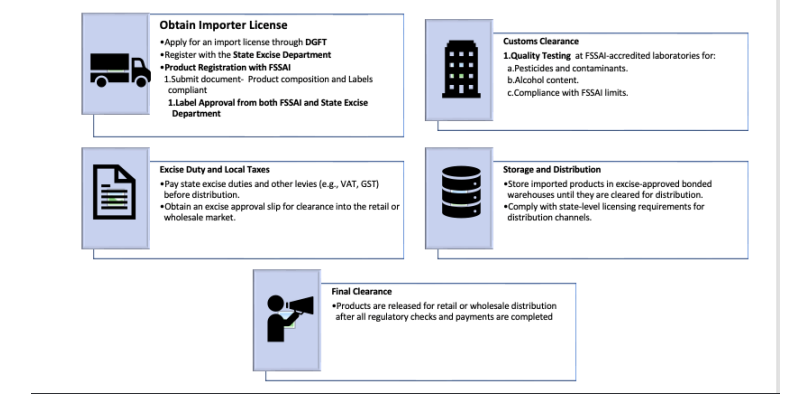
Source: DGFT import license, FSSAI, Tax portal [14]
General Food [14]
- Obtaining an Importer License Apply for an import license through DGFT (Directorate General of Foreign Trade) under the Import Export Code (IEC). Register with the State Excise Department in the state where the product will be distributed.
- Product Registration with FSSAI
- Submit document - Product composition and Labels compliant with Indian standards (alcohol content, health warnings, etc.).
- Label Approval from both FSSAI and the State Excise Department [7]
- Customs Clearance [29]
- Quality Testing at FSSAI-accredited laboratories for:
- Pesticides and contaminants
- Alcohol content
- Compliance with FSSAI limits
- Excise Duty and Local Taxes - Pay state excise duties and other levies (e.g., VAT, GST) before distribution. Obtain an excise approval slip for clearance into the retail or wholesale market.
- Storage and Distribution
- Store imported products in excise-approved bonded warehouses until they are cleared for distribution. Comply with state-level licensing requirements for distribution channels.
- Final Clearance - Products are released for retail or wholesale distribution after all regulatory checks and payments are completed.
Timelines: The entire process can take 4–8 weeks depending on documentation, label approvals, and state excise clearances.
Costs: Include customs duties, excise duties, label approval fees, and FSSAI testing fees. These vary based on alcohol type and state regulations.
Category
Alcoholic beverages
Same as General Food above.
Product
1) Beer
Same as "Category" (alcoholic beverages) above.
2) Alcoholic ready-to-drink beverages
Same as "Category" (alcoholic beverages) above.
3) Whisky
Same as "Category" (alcoholic beverages) above.
7.7 References
1. FSSAI Act 2006
https://fssai.gov.in/cms/food-safety-and-standards-act-2006.php
2. FSSAI Guidelines on Alcoholic Beverages
3. Alimentarius - Alcoholic Beverages Standards
https://www.fao.org/fao-who-codexalimentarius/en/
4. Alcoholic Beverages Standards Regulation, 2018, updated 28 08 2023
https://fssai.gov.in/upload/uploadfiles/files/Comp_Alcoholic_Beverages(III)_28_08_2023.pdf
5. Draft notification on Food Safety and Standards (Alcoholic Beverages) Amendment Regulations, 2023 related to standards of Mead (Honey wine), Craft Beer, Indian liquors and definition of Low Alcoholic Beverages/ RTD, wine-based Beverages and, Country Liquors, etc.
https://comments.fssai.gov.in/Bestviewwl.aspx?NOTIFICATION_ID=4345
6. FSSAI Food Additives Regulations (2011)
https://www.fssai.gov.in/upload/uploadfiles/files/Food_Additives_Regulations.pdf
7. FSSAI Packaging and Labelling Regulations, 2011
https://www.fssai.gov.in/upload/uploadfiles/files/Compendium_Labelling_Display_23_09_2021.pdf
8. FSSAI Food Safety and Standards Act, 2006 (Chapter 9 – Penalties and Offenses)
9. FSSAI Nutrition and Health Claims Regulations, 2018
https://fssai.gov.in/upload/uploadfiles/files/Gazette_Notification_Advertising_Claims_27_11_2018.pdf
10. FSSAI proposed standards Claims
https://fssai.gov.in/upload/uploadfiles/files/Notice_Comments_Alcoholic_Beverages.pdf
11. FSSAI Food Safety and Standards (Advertising and Claims) Regulations, 2018
12. BIS FMCS - Foreign Manufacturer Certification Scheme
https://www.bis.gov.in/fmcs/certification-process/products-under-fmcs/
13. Custom clearance process
14. Direct and Indirect Taxes
15. Pesticide residue FSSAI Pesticide and Contaminant Regulations (Food Safety and Standards (Contaminants, Toxins, and Residues) Regulations, 2011)
16. Consumer Protection Act, 2019 Specifies penalties for misleading advertisements, including alcohol-related campaigns
17. BIS standards for packaging materials (e.g., IS 15410 for food-grade plastics)
18. IS 3752 Specification for Beer
19. IS 6613: Standards for distilled beverages
https://www.services.bis.gov.in/tmp/rp_19122023_658141877ea41.pdf
20. Haryana Excise law
21. Delhi Excise Law
22. Advertising Standards Council of India (ASCI): ASCI oversees advertising content to ensure ethical practices, including compliance for surrogate advertising of alcoholic beverages. For detailed guidelines
https://www.ascionline.in/wp-content/uploads/2024/04/Code-Book_Codes_Webready.pdf
23. Cable Television Networks (Regulation) Act, 1995: This act prohibits direct advertising of alcohol on cable TV and sets conditions for surrogate advertising
Home | Ministry of Information and Broadcasting
24. Food Safety Mantra Blog on FSSAI Alcoholic Beverages Standards: A helpful summary of the FSSAI and excise-related guidelines for alcohol advertising
Alcoholic Beverages | FSSAI Guidelines | Food Safety Mantra Blog
25. Consumer Protection Act, 2019: Specifies penalties for misleading advertisements, including alcohol-related campaigns
Legislative Department | Legislative Department | India
26. Alcohol test
27. Food Safety and Standards (Approval for Non-Specified Food) Regulations, 2017
28. FSSAI Food Licensing and Registration System
https://foscos.fssai.gov.in/about-flrs
29. Food Import Clearance System
30. ReFoM portal
https://sites.fssai.gov.in/refom/
31. Food safety and standard (Import) Regulation, 2017
https://www.fssai.gov.in/upload/uploadfiles/files/Compendium_Food_Import_Regulations_05_06_2022.pdf
32. Microbiological standards
https://www.fssai.gov.in/upload/uploadfiles/files/20_%20Appendix%20B.pdf
33. Shipment declaration
34. ISO 5555: Standard for testing phenolic compounds in wines
35. ISO 15192: Standard for beer quality testing, including compounds like esters and aldehydes
Was this article helpful?