
7. Importation Requirements
- 13 Mins to read
- DarkLight
7. Importation Requirements
- 13 Mins to read
- DarkLight
Article summary
Did you find this summary helpful?
Thank you for your feedback
Beers, RTDs, Whisky
Thailand

This section provides information on the importation process (shipment, customs, licenses required, and test requirements).
7.1 Shipment Declaration
General Food
Importers are required to submit Form Kor Sor Kor 99/1, an import declaration along with excise tax and VAT returns, for importing all general goods, except for products that require different documentation as specified by the Customs Department [1, 2, 3].
The following documents must be prepared for duty payment, insurance, side loading and unloading procedures, warehouse formalities, and bonded goods for duty-free shops:
- Import Entry Declaration (Kor Sor Kor 99/1)
- Product Release Order (Kor Sor Kor 100/1)
- Invoice
- Packing List
- Bill of Lading (sea) or Car Manifest (land)
- Insurance Premium Invoice
- Import License or other required documents for restricted or prohibited goods as per applicable laws
- Certificate of Origin (if requesting a duty reduction)
- Other relevant documents, such as ingredient lists, product characteristics, or usage descriptions
- For procedures involving multiple shipments, additional blueprints, plans, prints, or other supporting documents related to the consideration must be included to prepare shipping documents for multiple shipments.
Category
Alcoholic beverages
Same as General Food above. In addition, please refer to the import license requirements for alcoholic beverages in Section 7.5 below.
Product
1) Beer
Same as "Category" (alcoholic beverages) above.
2) Alcoholic ready-to-drink beverages (such as Chuhai)
Same as "Category" (alcoholic beverages) above.
3) Whisky
Same as "Category" (alcoholic beverages) above.
7.2 Customs Procedure
General Food
Customs procedures for importing goods [1, 2, 3, 4]
1. Register to Use the e-Customs System
Entities wishing to conduct customs formalities electronically must register with the Customs Department. This registration provides access to the TCS system for customs clearance services. Importers can register in one of three ways:
- Online Registration via the Customs Department Website: Visit Online Customs Registration https://registeronline.customs.go.th/RON/
- Online Registration via the Customs Trader Portal:
- Available for:
- Thai nationals not previously registered (effective July 1, 2021)
- Juristic persons with all directors of Thai nationality (effective August 3, 2022)
- Access at Customs Trader Portal https://www.customstraderportal.com/auth/login
- Available for:
- In-Person Registration at Customs Offices: Register at the Customs Department's registration service counters.
Entities can track their registration status and customs formalities via the e-Tracking system at e-Tracking https://e-tracking.customs.go.th/ETS/index.jsp.
Documents Required for Registration:
- Application form (as prescribed by the Customs Department)
- ID card
- Copy of company registration
- Tax ID card or proof of income tax payment
- Certificate of training completion (customs broker or customs specialist course)
- Employment certificate from the customs broker (if applicable)
- One recent 1-inch photograph (taken within the last 6 months)
- Copies of the documents above (2–5) with certified signatures
Submit these documents to the Registration and Privileges Bureau of Customs Standards and Procedures, Customs Department, or a customs office. Approved registration is valid for three years.
After submission of all documents to the e-Customs system, along with the arrival report containing vessel information, the system verifies the data, flags discrepancies, and assigns the shipment to one of three categories:
- Green Line: Exempt from inspection
- Red Line: Requires inspection
- Yellow Line: Requires verification of license exemption (import by land only)
2. Payment of Duties and Taxes
Importers or their agents must pay import duties and taxes in accordance with the Thai Customs Tariff Decree B.E. 2530 and applicable trade agreements [1].
3. Inspection and Release of Cargo
The inspection process is determined by the assigned line:
- Green Line: Exempt from inspection. The importer can immediately release the goods by contacting a customs officer.
- Red Line: Inspection is required. The importer must contact a customs officer for an inspection before releasing the goods.
- Yellow Line (Land Imports Only): Conditions for license exemption must be verified by a customs officer before the goods can be released.
Category
Alcoholic beverages
Same as General Food above.
Product
1) Beer
Same as "Category" (alcoholic beverages) above.
2) Alcoholic ready-to-drink beverage (such as Chuhai)
Same as "Category" (alcoholic beverages) above.
3) Whisky
Same as "Category" (alcoholic beverages) above.
7.3 Manufacturing License
General Food
A manufacturing license is not required. Instead, food importers must possess certifying documents demonstrating that their manufacturing practices meet or exceed the standards outlined in the Annex of Notification No. 420 [5].
GMP 420 requirements apply to establishments involved in the production of Specific Controlled Foods, Standard or Quality Controlled Foods, or Foods requiring labeling. These requirements are mandatory for facilities utilizing machinery with a total power of at least 5 horsepower (or equivalent) or employing a workforce of at least seven people [5].
Some examples of certifications equivalent to GMP 420, as specified by the Thai FDA [7], include:
- Good Hygiene Practices (GHPs) - General Principles of Food Hygiene CXC 1-1969, Codex Alimentarius International Food Standards.
- Hazard Analysis and Critical Control Point System (HACCP) - General Principles of Food Hygiene CXC 1-1969, Codex Alimentarius International Food Standards.
- Food Safety Management Systems - ISO 22000: 2018, International Standard Organization.
- Global Standard for Food Safety Issue 8 - British Retail Consortium.
- International Food Standard (IFS) - IFS Version 8.
- SQF Quality Code - Edition 9, The Food Industry Association.
- SQF Food Safety Code for Manufacturing - Edition 9 (2020), The Safe Quality Food Institute.
- Code of Federal Regulations Title 21 Part 110 - Current Good Manufacturing Practice in Manufacturing, Packing, or Holding Human Food, USFDA.
- Regulation for Enforcement of the Abattoir Act - Ordinance of the Ministry of Health and Welfare No. 44 (November 7, 2019), Ministry of Health, Labour and Welfare, Japan.
- JFS-B Standard [Requirements for Organizations] (Sectors: E/L) Version 2.0, October 21, 2019, Japan Food Safety Management Association.
- JFS-B Standard (Sector: CI, CII, CIII, CIV/K) - Version 3.0, May 5, 2022, Japan Food Safety Management Association.
- JFS-C Standard Document [Requirements for Organizations] (Sector: CI, CII, CIII, CIV/K) Version 3.0, October 2, 2020, Japan Food Safety Management Association.
Requirements on the Certification Bodies (CB) and Certificates [6]
• Issuing Agencies for Documents or Certificates
Documents or certificates for food production system standards must be issued by competent authorities in the country of origin, other agencies recognized by the competent authorities, or Certification Bodies (CB) accredited by Accreditation Bodies (AB) recognized as members of the International Accreditation Forum (IAF). Additionally, credible organizations that comply with the Guidelines for the Design, Operation, Assessment, and Accreditation of Food Import and Export Inspection and Certification Systems (CAC/GL 26-1997) are also eligible to issue such documents.
• Document Format and Verification
Original documents are preferred for submission. However, if the original is unavailable, certified copies may be used, provided they are verified by the issuing agency, the embassy of the origin country in Thailand, or authorized personnel such as a Notary Public. In cases where document content can be verified through a public database, certified copies are not required. Verification must include details such as the name of the food production standard, the name and address of the certified production site, the certification scope, the certification or expiration date, and the name of the issuing agency.
• Electronic and Translated Documents
Electronic documents signed with an electronic signature are acceptable if they comply with applicable electronic transaction laws. For documents in languages other than Thai or English, a certified translation must accompany the submission. The translation may be certified by an embassy or consulate, a certified translation agency, a Thai national holding a bachelor's degree in the relevant language, or an instructor teaching the language at a higher education institution.
• Validity of Documents or Certificates
Documents or certificates must specify their validity period unless the certifying agency provides evidence confirming compliance with the relevant standards. If no expiry date is stated, the document or certificate is deemed valid for one year from the issuance or certification date.
Category
Alcoholic beverages
GMP 420 is not applicable to alcoholic beverage manufacturers because the FDA's announcement classifying alcoholic beverages as controlled label products, issued on October 12, 2002, was repealed by an FDA notification published on May 30, 2007. As a result, alcoholic beverages are no longer classified as controlled-label products and are not required to comply with GMP 420 requirements [8].
Product
1) Beer
Same as "Category" (alcoholic beverages) above.
2) Alcoholic ready-to-drink beverages (such as Chuhai)
Same as "Category" (alcoholic beverages) above.
3) Whisky
Same as "Category" (alcoholic beverages) above.
7.4 Test for Importation
General Food
When importing food into Thailand, not every batch of goods is sampled for testing. The need for sampling and testing depends on several factors, including the type of food, the importer’s compliance history, and the customs risk classification (green, yellow, or red line) assigned to the shipment during customs declaration.
- Thai FDA or customs authorities may conduct sampling based on risk assessments or regulatory requirements. High-risk products, such as perishable items, foods with a history of non-compliance, or new imports, are more likely to be sampled. Random inspections and testing may also be carried out as part of routine monitoring to ensure compliance with food safety standards. If there is suspicion of non-compliance or the product is subject to specific regulatory scrutiny, sampling may target the particular shipment.
- The customs risk classification assigned during customs declaration affects the likelihood of food sample testing:
- Green Line: Minimal checks; goods are generally cleared without sampling or inspection.
- Yellow Line: Shipments flagged for document verification. Sampling may occur if there are concerns about the documents or if the product is high-risk.
- Red Line: Shipments flagged for both document verification and physical inspection. Sampling is more likely, especially for high-risk products or shipments with documentation discrepancies.
- Importer Responsibility: The importer is responsible for ensuring compliance with Thai FDA and customs requirements, including covering testing costs if requested by authorities.
- Testing Facilities: Testing is conducted by government laboratories or private labs accredited by the Thai FDA, depending on the circumstances.
Category
Alcoholic beverages
Same as General Food. The authority influencing the decision to test the sample is the Customs and Excise Department.
Product
1) Beer
Same as "Category" (alcoholic beverages) above.
2) Alcoholic ready-to-drink beverages (such as Chuhai)
Same as "Category" (alcoholic beverages) above.
3) Whisky
Same as "Category" (alcoholic beverages) above.
7.5 Other Notes or Requirements for Importation
General Food
Procedures for Acquiring Permission to Import Food with Thai FDA
In addition to Customs procedures, Importers need to carry out Procedures for acquiring permission to import food into the Kingdom of Thailand with the Thai FDA.
- Apply for Import Licenses with the Thai FDA [9]:
- Obtain a food import license. - A food importer must hold a valid commercial registration certificate and ensure that import and storage premises meet the required criteria. Below are the steps to apply for a food import license:
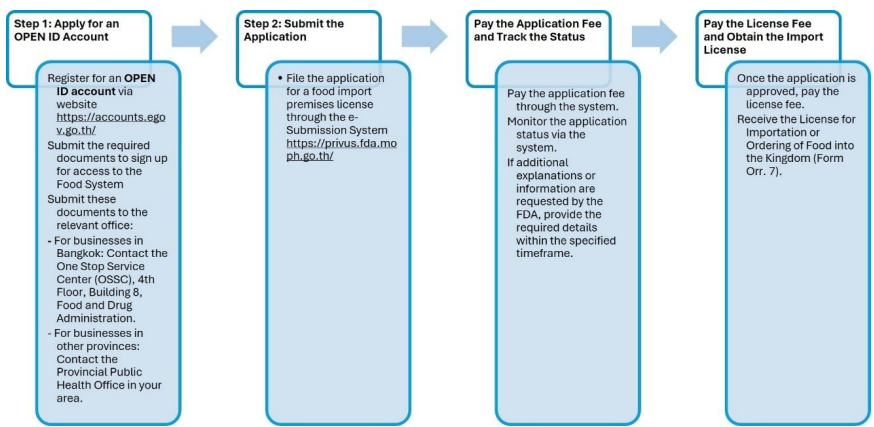 Procedure 2. Application for Food Import Licenses
- Apply for a food serial number as required for the product as per Section 6.2 of this guidebook.
- Obtain a License per Invoice (LPI) from the Thai FDA: For each import, the business operator or agent must access the system using their national ID number to obtain the LPI. Register for an LPI user account through the National Single Window (NSW) at http://www.thainsw.net.
- File an Import Declaration: Submit the import declaration with Thai Customs as part of the customs formalities as per Section 7.1 above. Carry out import procedures with Customs as mentioned in Section 7.2.
Importers can obtain the necessary licenses by submitting applications through one of the following channels [10]:
- One-Stop Service & Consultation Center (OSSC):
- Located at the Food and Drug Administration Building, Ministry of Public Health.
- More details are available at https://en.fda.moph.go.th/one-stop-service-center/category/one-stop-service-center-ossc
- Provincial Public Health Offices:
- Submit applications to the Provincial Public Health Office where the food production premises or the importer’s headquarters are located.
- If the food category has not been authorized for approval at the Provincial Public Health Office, the application and supporting documents will be forwarded to the Food and Drug Administration (FDA) office.
- Note: Forwarding the application to the FDA office may result in additional processing time.
- Online Submission (E-Submission):
- Applications can also be submitted via the FDA’s online system https://privus.fda.moph.go.th/ for faster processing.
Category
Alcoholic beverages
Licenses related to the import and sale of alcoholic beverages will be processed with the Excise Department, instead of the Thai FDA. Importing alcoholic beverages into Thailand requires obtaining a Liquor Import License from the Excise Department.
Liquor Import License from the Excise Department [11, 12, 13]
To import alcoholic beverages into Thailand, importers must be licensed by the Excise Department. There are five types of liquor import permits that are established:
- Type 1: For liquor imported for general sale (excluding bonded warehouses of duty-free shops under the Customs Act).
- Type 2: For liquor imported for sale in bonded warehouses of duty-free shops under the Customs Act.
- Type 3: For liquor imported as samples or for non-commercial purposes, stored in bonded warehouses under the Customs Act.
- Type 4: For liquor imported as raw materials for liquor production
- Type 5: For liquor imported for purposes other than those specified in Type 1 to Type 4.
Applicant Qualifications
Applicants must meet specific qualifications based on the type of license they seek:
- Type 1: Must hold a Type 1 liquor sales license and be the sole distributor of the liquor to be imported.
- Type 2: Must hold a Type 2 liquor sales license and a license to operate a duty-free bonded warehouse under the Customs Act.
- Type 3: Must hold a license to operate a bonded warehouse under the Customs Act.
- Type 4: Must hold a liquor production license.
- Type 5: Must be either a Thai juristic person or an individual aged 20 or older.
Pre-Application Requirements for Type 1 License
Before applying for a Type 1 license, the following steps are mandatory:
- Label Approval: Submit an application for label approval with:
- A sample label.
- Proof of sole distributorship issued by the foreign liquor manufacturer or trademark holder.
- Other specified documents. Approved labels must comply with the Director-General’s specifications.
- Sample Analysis: Provide liquor samples for quality analysis or submit a certified analysis report from:
- An agency designated by the Director-General as a liquor quality analysis agency.
- A foreign government agency.
- An agency certified by a foreign government responsible for overseeing liquor production by foreign manufacturers.
Upon label approval and quality confirmation, the Type 1 license application may proceed.
Procedure to Obtain a Liquor Import License:
Applications must be submitted to the Director-General at the Excise Area Office or the relevant Excise Area Branch Office near the customs checkpoint where liquor will be imported. The application must be accompanied by all required documents and evidence.
- Business Registration: Ensure the business is registered in Thailand with objectives that include the importation and distribution of alcoholic beverages.
- Application Submission:
- Submit a permission request form as specified by the Director General of the Excise Department. The form to be used is P.S.08-01, available at the following link: https://edmanual.excise.go.th:50001/document/pdf/ED06-0002-F2
- Applications can be submitted at the Excise Department headquarters or a Provincial Excise Office.
- Required Documents:
- Applicants’ Identity Documents Issued by Government Agencies:
- ID Card (for individuals): original document
- Certificate from the Ministry of Commerce (for company): 1 copy (issued within the last 6 months)
- Identification Card of the Authorized Person (for company): original document
- Additional documents for Type 1 License (Importing for Sale, Not in Duty-Free Bonded Warehouses under the Customs Act)- All documents: 1 copy, signed and certified true copy.
- Liquor Sales License (Type 1)
- Invoice or Proforma Invoice
- Approval Letter for Use of Labels on Imported Liquor Containers
- Evidence of Sole Agency for Selling Imported Liquor in Thailand (Original Language Version)
- Evidence of Sole Agency for Selling Imported Liquor in Thailand (Thai Translation)
- Certificate of Analysis Results for Liquor Samples Imported into the Kingdom
- Additional documents for Type 2 License (Importing for Sale in Duty-Free Bonded Warehouses under the Customs Act) - All documents: 1 copy, signed and certified true copy.
- Type 2 Liquor Sales License
- Invoice or Proforma Invoice
- License for Setting Up Bonded Warehouses of the Duty-Free Type
- Applicants’ Identity Documents Issued by Government Agencies:
- Payment Channels: Pay in person at the Area Excise Office or Excise Department Branch Office. Monday to Friday, 8:30 AM - 4:30 PM.
- Type 1 License: 1,200 baht per copy.
- Type 2 License: 1,200 baht per copy.
- Other License Types: 300 baht per copy.
- License Issuance and validity: Upon approval of the application and documents, the Excise Department will issue a Liquor Import License in the format specified by the Director General. The license is valid for six months from the date of issuance and may be used for a single import only.
Product
1) Beer
Same as "Category" (alcoholic beverages) above.
2) Alcoholic ready-to-drink beverages
Same as "Category" (alcoholic beverages) above.
3) Whisky
Same as "Category" (alcoholic beverages) above.
7.6 Overview Flowchart for Importation Process
General Food
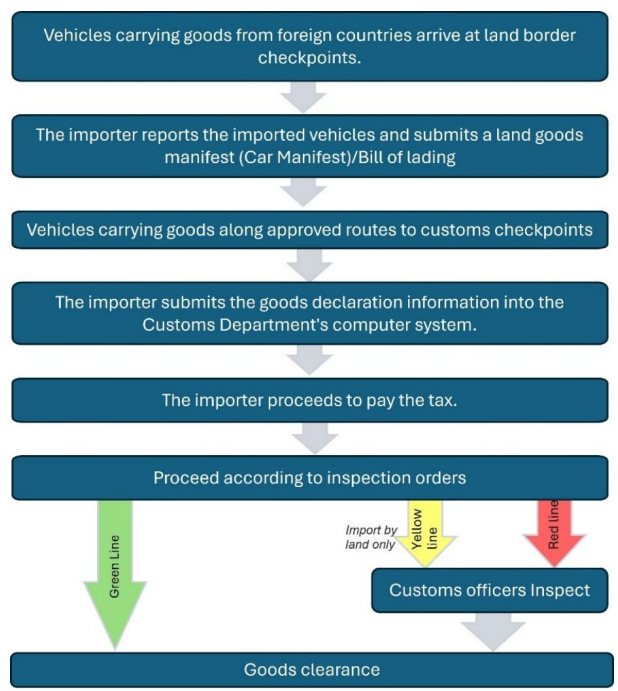 Procedure 3. Customs procedures for importing goods
Category
Alcoholic beverages
Same as General Food above.
Product
1) Beer
Same as "Category" (alcoholic beverages) above.
2) Alcoholic ready-to-drink beverages (such as Chuhai)
Same as "Category" (alcoholic beverages) above.
3) Whisky
Same as "Category" (alcoholic beverages) above.
7.7 References
1. The customs tariff decree B.E. 2530 bhumibol adulyadej, rex. B.E. 2530
http://www.customs.go.th/data_files/88691df20853d143a73b669fd134065f.pdf
2. Customs procedures for importing goods by land
3. Customs procedures for importing goods by sea
4. Registration as an importer-exporter with the Customs Department
5. MOPH Notification No. 420 Re: Food Production Processes, Processing Equipment/ Utensils and Storage Practices
https://food.fda.moph.go.th/media.php?id=509431569765769216&name=P420_E.pdf
Examples of Food Standard of Manufacturing Practices are equivalent to or not lower than the requirements prescribed in the Annex of the MOPH Notification No. 420
https://food.fda.moph.go.th/media.php?id=529123641481371648&name=Ex_420_EN.pdf
6. Recognised GMP certifications by Thailand FDA
https://moph.cc/GMPpackinghouse
7. Notification of the Food and Drug Administration Re: Document or Certificate of Food Production System Standards for Import of Food Products
https://food.fda.moph.go.th/media.php?id=703114996913152000&name=announ-fda-import67_EN.pdf
8. FDA Notification - Regarding the cancellation of the Food and Drug Administration's announcement that alcoholic beverages are label-controlled products
https://food.fda.moph.go.th/food-law/announ-fda-50
9. Food Importation
https://en.fda.moph.go.th/our-services-new/food-importation/
10. The Public Manual for Entrepreneurs - Food Products
https://food.fda.moph.go.th/media.php?id=461454372606451712&name=EngVersion.pdf
11. EXCISE ACT B.E. 2560 (2017)
https://lawelcs.excise.go.th/img/Excise_Act_EN.pdf
12. Requesting permission to import liquor into the Kingdom from Excise Department
https://www6.excise.go.th/portal/ExciseTax/manual/BB_052.pdf
13. Ministerial Regulation Permission to Import Liquor into the Kingdom (B.E. 2560)
https://www.ratchakitcha.soc.go.th/DATA/PDF/2560/A/095/65.PDF
Was this article helpful?