
7. Importation Requirements
- 6 Mins to read
- DarkLight
7. Importation Requirements
- 6 Mins to read
- DarkLight
Article summary
Did you find this summary helpful?
Thank you for your feedback
Beers, RTDs, Whisky
Philippines

This section provides information on the importation process (shipment, customs, licenses required, and test requirements).
7.1 Shipment Declaration
A goods declaration must be lodged within 15 days from the date of discharge of the last package from the vessel or aircraft. Upon request, the period to file the goods declaration may be extended on valid grounds for another 15 days: provided that the request is made before the expiration of the original period within which to file the goods declaration. Below is the proposed HS code classification.
General Food (e.g.: processed food)
Section IV: Prepared Foodstuffs; Beverages, Spirits and Vinegar; Tobacco and Manufactured Tobacco Substitutes.
Category
Alcoholic beverages
Chapter 22: Beverages, Spirits and Vinegar.
Product
1) Beer [1]
Chapter22.03 Beer made from malt.
Heading 2203.00.10 – Stout or porter:
Commodity 2203.00.11 – – Of an alcoholic strength by volume not exceeding 5.8 % vol.
Chapter22.03 Beer made from malt.
Heading 2203.00.10 – Stout or porter:
Commodity 2203.00.19 – – Other
Chapter22.03 Beer made from malt.
Heading 2203.00.90 – Other, including ale:
Commodity 2203.00.91 – – Of an alcoholic strength by volume not exceeding 5.8 % vol.
Chapter22.03 Beer made from malt.
Heading 2203.00.90 – Other, including ale:
Commodity 2203.00.99 – – Other.
2) Alcoholic ready-to-drink beverages (such as Chuhai) [2]
Chapter22.06 Other fermented beverages (for example, cider, perry, mead, saké); mixtures of fermented beverages and mixtures of fermented beverages and non-alcoholic beverages, not elsewhere specified or included.
Heading 2206.00.90 – Other:
Commodity 2206.00.99 – – Other
3) Whisky [3]
Chapter22.08 Undenatured ethyl alcohol of an alcoholic strength by volume of less than 80 % vol.; spirits, liqueurs, and other spirituous beverages.
Commodity 2208.30.00 ‑ Whiskies.
7.2 Customs Procedure
General Food
All goods imported into the Philippines are subject to duty and tax upon importation, including goods previously exported from the Philippines, except as otherwise provided for in RA No. 10863 or the Customs Modernization and Tariff Act (CMTA) or in other laws [4, 5].
Importation begins when the carrying vessel/aircraft enters the Philippine territory with the intention to unload therein [4, 5].
Importation is deemed terminated when:
- The duties, taxes, and other charges due upon the goods have been paid or secured to be paid at the port of entry and the legal permit for withdrawal has been granted; or
- In case the goods are deemed free of duties, taxes, and other charges, the goods have legally left the jurisdiction of the Bureau [4, 5].
All goods may be freely imported into and exported from the Philippines without the need for import and export permits, clearances, or licenses [4, 5].
According to CMTA, the following are the types of importation:
- Free Importation and Exportation
- Regulated Importation and Exportation
Goods that are subject to regulation shall be imported or exported only after securing the necessary goods declaration or export declaration, clearances, licenses, and any other requirements, prior to importation or exportation. In case of importation, submission of requirements after arrival of the goods but prior to release from customs custody shall be allowed but only in cases provided for by governing laws or regulations [4, 5].
Pursuant to CMTA, no duties and taxes shall be collected on goods with a FOB or FCA value of ten thousand pesos (PHP10,000.00) or below [4, 5].
For goods valued over PHP 10,000, the following are the considerations for the determination of goods to be processed as Informal Entry:
- Goods of a commercial nature with Free on Board (FOB) or Free Carrier At (FCA) value of less than fifty thousand pesos (P50,000.00); and
- Personal and household effects or goods, not in commercial quantity, whether or not subject to duties and taxes;
- Conditionally Tax and/or Duty-Exempt Importations under Section 800 of the CMTA;
- Clearance of previously imported diplomatic supplies and equipment of foreign embassies and tax-exempt institutions sold to a non-privileged buyer [5, 6].
Formal Entry covers goods of a commercial nature with Free on Board (FOB) or Free Carrier (FCA) value of not less than PHP 50,000 and Personal and household effects or goods, not in commercial quantity, imported in a passenger’s baggage or mail [4, 5].
Meanwhile, Informal Entry covers goods of a commercial nature with a Free on Board (FOB) or Free Carrier (FCA) value of less than PHP 50,000 [4, 5].
All imported goods shall be subject to the lodgment of a goods declaration [4, 5].
A goods declaration must be lodged within 15 days from the date of discharge of the last package from the vessel or aircraft. Upon request, the period to file the goods declaration may be extended on valid grounds for another 15 days: Provided that the request is made before the expiration of the original period within which to file the goods declaration [4, 5].
Failure to lodge the goods declaration within the prescribed period constitutes an implied abandonment of the goods [4, 5].
Permits, Clearances and Certifications [1,2,3]
- Permit to Operate as Excise Taxpayer
- Electronic Authority to Release Imported Goods (E-ATRIG)
- License to Operate (LTO)
- Certificate of Product Registration (CPR)
- FDA Certification/Notification/Clearance (for those not requiring LTO and/or CPR)
- Certificate of Analysis (if applicable)
Bureau of Internal Revenue
Documentary Requirements [1,2,3]
- Bill of Lading
- Packing List
- Commercial Invoice
- Import Entry and Internal Revenue Declaration
Procedures [1,2,3]
- Importer/Broker will log in to www.nsw.gov.ph and fill up and submit the application for ATRIG through NSW System.
- The Receiving Officer checks the completeness of the basic documentary requirements. If found complete, RO receives the application through the NSW system, assigns an Office Control Code, and forwards documents to the concerned Processing Officer. If the application is rejected/held, the importer will be notified through email that the application was rejected or in a pending state.
- The Processing Officer (Revenue Officer) evaluates the submitted documentary requirements to determine whether or not the application requires any of the following:
- Conduct of ocular inspection;
- Resolution of technical/factual issues (for referral to the Laboratory Unit);
- Resolution of legal issues (for referral to the Law Division).
- The Processing Officer prepares computation in Excel format, prepares eATRIG, and forwards the docket to the Reviewing Officer.
- The Reviewing Officer reviews eATRIG, and forwards the docket to the Approving Officer, if found in order. Otherwise, s/he returns the docket to the Processing Officer.
- The Approving Officer reviews and approves eATRIG, if found in order, authorizes the transaction, and electronically transmits eATRIG to BOC. Otherwise, s/he returns the docket to the Reviewing Officer.
Category
Alcoholic beverages
Same as the Customs Procedures described under General Food above.
Product
1) Beer
Same as "Category" (alcoholic beverages) above.
2) Alcoholic ready-to-drink beverage (such as Chuhai)
Same as "Category" (alcoholic beverages) above.
3) Whisky
Same as "Category" (alcoholic beverages) above.
7.3 Manufacturing License
General Food
There is no license required for importation, only the License to Operate (LTO) of the food importer/distributor is required for importation.
License to Operate (LTO) is governed by an Administrative Order [9], updated in 2020 [10]. The LTO application is done via an eService online, a procedure has been issued providing details [11].
Category
Alcoholic beverages
Not applicable.
Product
1) Beer
Same as "Category" (alcoholic beverages) above.
2) Alcoholic ready-to-drink beverages (such as Chuhai)
Same as "Category" (alcoholic beverages) above.
3) Whisky
Same as "Category" (alcoholic beverages) above.
7.4 Test for Importation
General Food
The Certificate of Analysis including testing of safety parameters (if applicable) is a requirement for importation. [1, 2, 3]
For the safety parameters, please refer to Section 8 of this guidebook.
Category
Alcoholic beverages
The Certificate of Analysis may be required for importation when safety parameters apply (see Section 8). [1, 2, 3].
See Section 6.2 for methanol content testing.
Product [1, 2, 3]
1) Beer
Same as "Category" (alcoholic beverages) above.
2) Alcoholic ready-to-drink beverages (such as Chuhai)
Same as "Category" (alcoholic beverages) above.
3) Whisky
Same as "Category" (alcoholic beverages) above.
7.5 Other Notes or Requirements for Importation
General Food
None.
Category
Alcoholic beverages
Same as General Food above - none.
Product
1) Beer
Same as "Category" (alcoholic beverages) above.
2) Alcoholic ready-to-drink beverages
Same as "Category" (alcoholic beverages) above.
3) Whisky
Same as "Category" (alcoholic beverages) above.
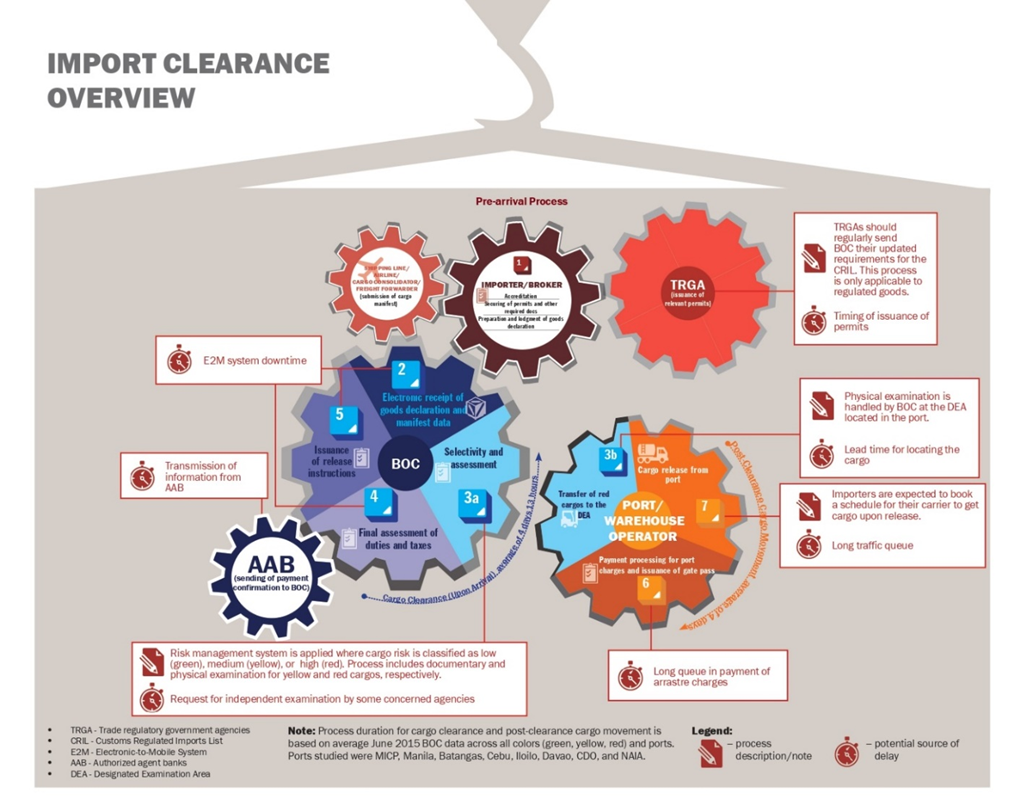
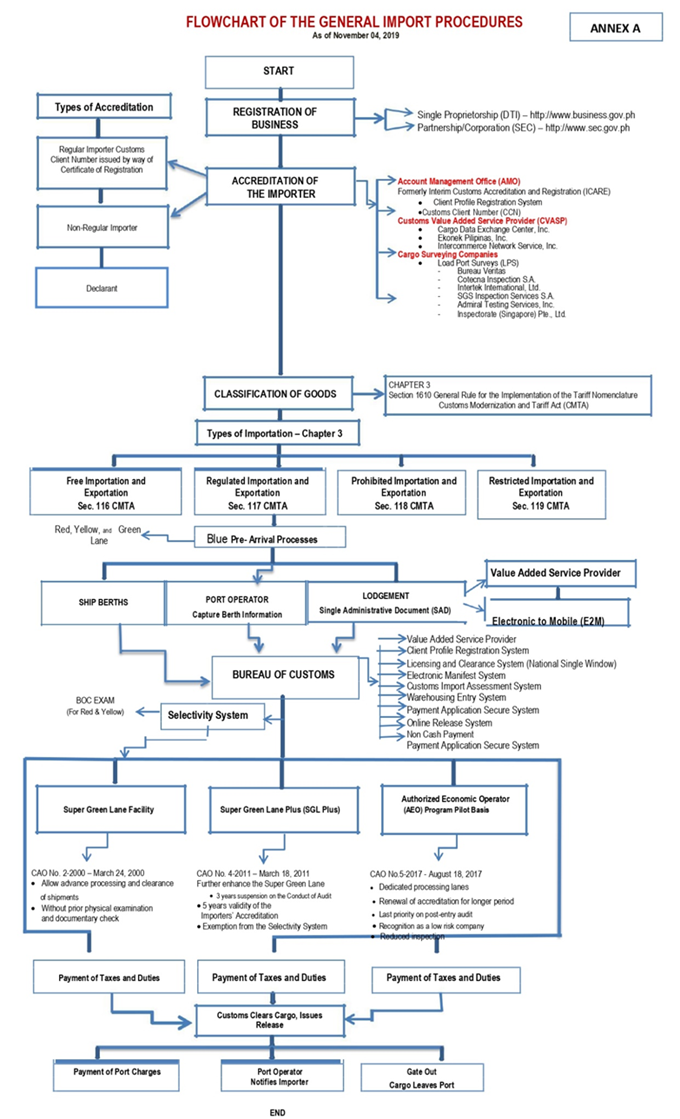
7.6 Overview Flowchart for Importation Process
General Food
Import Clearance Overview [7]
Flowchart of the General Import Procedures [8]
Category
Alcoholic beverages
Same as the flowcharts for General Food above.
Product
1) Beer
Same as "Category" (alcoholic beverages) above.
2) Alcoholic ready-to-drink beverages (such as Chuhai)
Same as "Category" (alcoholic beverages) above.
3) Whisky
Same as "Category" (alcoholic beverages) above.
7.7 References
1. Philippine National Trade Repository: Beer made from malt
https://www.pntr.gov.ph/of-an-alcoholic-strength-by-volume-not-exceeding-5-8-vol/
https://www.pntr.gov.ph/other-374/
https://www.pntr.gov.ph/of-an-alcoholic-strength-by-volume-not-exceeding-5-8-vol-2/
https://www.pntr.gov.ph/other-375/
2. Philippine National Trade Repository: Other fermented beverages (for example, cider, perry, mead, saké); mixtures of fermented beverages and mixtures of fermented beverages and non-alcoholic beverages, not elsewhere specified or included
https://www.pntr.gov.ph/other-378/
3. Philippine National Trade Repository: Whiskies
https://www.pntr.gov.ph/%e2%80%91-whiskies/
4. RA No. 10863: Customs Modernization and Tariff Act (CMTA)
https://customs.gov.ph/wp-content/uploads/2023/01/CMTA-RA-10863-2.pdf
5. Guidelines for Importation
https://customs.gov.ph/guidelines-on-importation/
6. Customs Administrative Order (CAO) No. 02-2021: Clearance of Goods under the Informal Entry Process
7. Import Clearance Overview
https://customs.gov.ph/wp-content/uploads/2023/01/Import-Transaction-Overview-Infographic_v1.0.pdf
8. Flowchart of the General Import Procedures
9. Administrative Order on LTO CONFIDENTIAL
https://www.fda.gov.ph/wp-content/uploads/2021/03/Administrative-Order-No.-2014-0029.pdf
10. Revised Unified Licensing, 2020
https://www.fda.gov.ph/wp-content/uploads/2020/05/Administrative-Order-No.2020-0017.pdf
11. New Online LTO application procedure via eServices
Was this article helpful?