
7. Importation Requirements
- 3 Mins to read
- DarkLight
7. Importation Requirements
- 3 Mins to read
- DarkLight
Article summary
Did you find this summary helpful?
Thank you for your feedback
Beers, RTDs, Whisky
South Korea

This section provides information on the importation process (shipment, customs, licenses required, and test requirements).
7.1 Shipment Declaration
General Food
Article 27 of the Enforcement Rule of the Special Act on Imported Food Safety Management [4] requires importers to submit an import notification form along with the following listed documents to the head of the regional office of the Ministry of Food and Drug Safety overseeing the customs clearance location. The import notification can be made at least five days before the expected arrival date, and any changes to key details such as the port of arrival, expected arrival date, entry location, and expected entry date must be immediately reported in writing.
The required documents are:
- Packaging with Korean labeling (including packaging with stickers printed with Korean labeling) or documents detailing the Korean labeling.
- 1-2 photos of the imported food, etc.
Category
Alcoholic drinks
Same as "General Food" above.
Product
1) Beer
Same as "Category" (alcoholic drinks) above.
2) Ready-to-drink beverages (mainly Chuhai)
Same as "Category" (alcoholic drinks) above.
3) Whisky
Same as "Category" (alcoholic drinks) above.
7.2 Customs Procedure
General Food
Articles 20, 21, and 22 of the Special Act on Imported Food Safety Management [2] outline the customs clearance requirements. Import declarations are submitted electronically through the Uni Pass website (https://unipass.customs.go.kr/csp/index.do). The inspection order is determined based on the classification of the importer and the product. Once the shipment passes the compliance inspection, it is cleared through customs.
Category
Alcoholic drinks
Same as "General Food" above.
Product
1) Beer
Same as "Category" (alcoholic drinks) above.
2) Ready-to-drink beverages (mainly Chuhai)
Same as "Category" (alcoholic drinks) above.
3) Whisky
Same as "Category" (alcoholic drinks) above.
7.3 Manufacturing License
General Food
According to Article 5 of the Special Act on Imported Food Safety Management [2], importers and overseas manufacturing facilities must register. The necessary details for registration, as specified in Article 2 of the Enforcement Rule of the Special Act on Imported Food Safety Management [4], include:
- The name, location, representative, phone number, email address, and country of the overseas manufacturing facility
- Production items
- Type of business
- Whether a food management system is applied
The process of registering a foreign food facility is conducted electronically via the “Imported Food Information Maru” website (https://impfood.mfds.go.kr). Detailed instructions for the registration process are available on the website’s English page, making it easy to follow.
The name and address of the foreign food facility provided for registration must be those recognized by the government of the exporting country for the factory that manufactures and processes the product.
Category
Alcoholic drinks
Same as "General Food" above.
Product
1) Beer
Same as "Category" (alcoholic drinks) above.
2) Ready-to-drink beverages (mainly Chuhai)
Same as "Category" (alcoholic drinks) above.
3) Whisky
Same as "Category" (alcoholic drinks) above.
7.4 Test for Importation
General Food
Importers can submit foreign testing certificates in place of or in addition to detailed inspections (Annex 9 of [4]) to show that the product conforms to the Food Code's standards and specifications.
Category
Alcoholic drinks
Same as "General Food" above.
Additionally, alcoholic drinks also need to conform to the Enforcement Decree of the Liquor Tax Act’s standards (details are provided in Section 2.2 of this guidebook).
Product
1) Beer
Same as "Category" (alcoholic drinks) above.
2) Ready-to-drink beverages (mainly Chuhai)
Same as "Category" (alcoholic drinks) above.
3) Whisky
Same as "Category" (alcoholic drinks) above.
7.5 Other Notes or Requirements for Importation
General Food
Annex 10 of the Enforcement Rule of the Special Act [4] outlines the classification criteria for imported food, which determines the type of imported inspection required. The classifications are as follows:
- First-grade imported food
- Second-grade imported food
- Third-grade imported food
- Same Importer and Same Imported Food
Imported food entering the country for the first time is classified as first-grade imported food, necessitating a detailed inspection (Annex 9 of [4]).
Category
Alcoholic drinks
Same as "General Food" above.
Product
1) Beer
Same as "Category" (alcoholic drinks) above.
2) Ready-to-drink beverages (mainly Chuhai)
Same as "Category" (alcoholic drinks) above.
3) Whisky
Same as "Category" (alcoholic drinks) above.
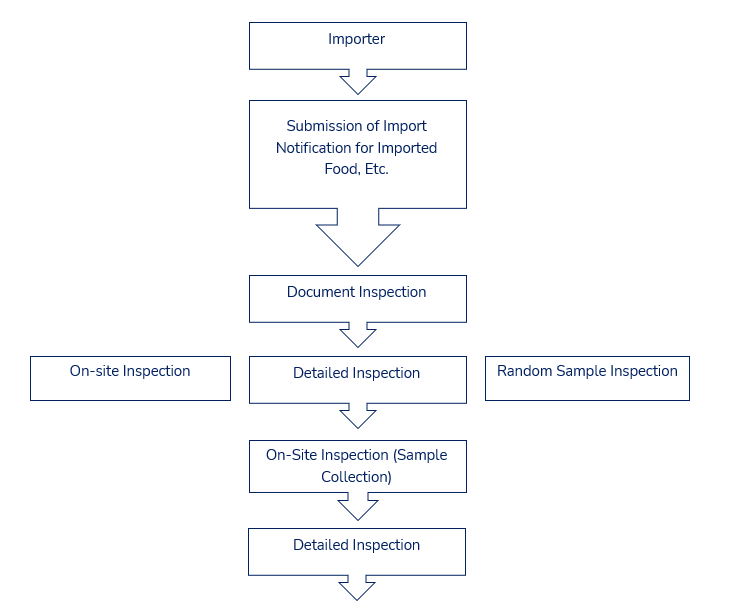
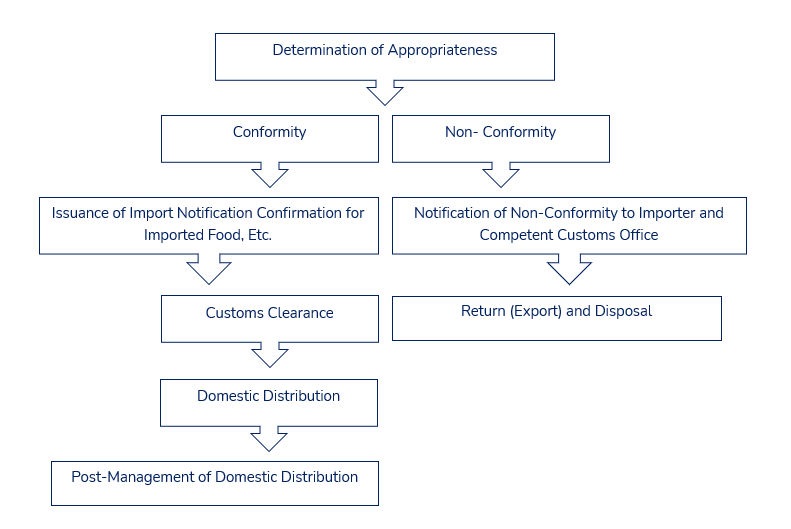
7.6 Overview Flowchart for Importation Process
General Food
The importation process is provided below [5]:
Category
Alcoholic drinks
Same as "General Food" above.
Product
1) Beer
Same as "Category" (alcoholic drinks) above.
2) Ready-to-drink beverages (mainly Chuhai)
Same as "Category" (alcoholic drinks) above.
3) Whisky
Same as "Category" (alcoholic drinks) above.
7.7 References
1. The regulation regarding the declaration and Inspection of Imported food, etc. – Issued on 13 Jun 2024
https://www.law.go.kr/admRulLsInfoP.do?chrClsCd=&admRulSeq=2100000242592#AJAX
2. Special Act on Imported Food Safety Management – revised on 18 Mar 2024
https://www.law.go.kr/LSW//lsInfoP.do?lsiSeq=269925&ancYd=20250318&ancNo=20825&efYd=20260101&nwJoYnInfo=N&efGubun=Y&chrClsCd=010202&ancYnChk=0#0000
3. Enforcement Decree of the Special Act on Imported Food Safety Management – revised on 3 Jul 24
https://law.go.kr/lsInfoP.do?lsiSeq=263551&ancYd=20240702&ancNo=34664&efYd=20240703&nwJoYnInfo=Y&efGubun=Y&chrClsCd=010202&ancYnChk=0#0000
4. Enforcement Rule of the Special Act on Imported Food Safety Management – revised on 15 Nov 2024
https://www.law.go.kr/lsInfoP.do?lsiSeq=266517&ancYd=20241115&ancNo=01992&efYd=20241115&nwJoYnInfo=Y&efGubun=Y&chrClsCd=010202&ancYnChk=0#0000
5. Importation process guidebook
https://impfood.mfds.go.kr/ebook/e-book.html
Was this article helpful?