
7. Importation Requirements
- 4 Mins to read
- DarkLight
7. Importation Requirements
- 4 Mins to read
- DarkLight
Article summary
Did you find this summary helpful?
Thank you for your feedback
Beers, RTDs, and Whisky
Taiwan

This section provides information on the importation process (shipment, customs, licenses required, and test requirements).
7.1 Shipment Declaration
General Food
The importation process is normally managed by local companies or their appointed custom broker.
The documents required include [1]:
- Air Waybill (AWB)
- Invoice or commercial invoice—One copy shall be enclosed
- Packing List (P/L)
- Import Permit (I/P) (as described in the sections below)
- Power of attorney (co-signed by the duty-payer and the authorized customs broker. However, if the declaration is done electronically, there is no need for the customs broker to sign the power of attorney)
- Two copies of the cargo value declaration
- Conditions of Certificate of Origin (C/O) Submission (where applicable)
- Catalogs, manuals, or drawings--to be submitted according to customs inspection or valuation
- Others—subject to laws and regulations governing corresponding articles
Category
Alcoholic drinks
No specific requirements. Same as General Food above.
Product
Beer, RTDs, and Whisky
Same as "Category" (alcoholic drinks) above.
7.2 Customs Procedure
General Food
Application for inspection with TFDA and declaration of the relevant information of the product are required and shall be in accordance with the customs commodity code and classification of the designated number for the imported food.
The Regulations of Inspection of Imported Foods and Related Products [3] provide guidance on the procedure for the process. The Applicant or Representative shall file an application for inspection to the inspection authority at the port of entry within fifteen days prior to the entry date. The documents required include:
- An application form for inspection
- A declaration form of product information
- A photocopy of the application for import declaration
- Necessary documents and papers required by the Food and Drug Administration, Ministry of Health and Welfare (MOHW).
The company should refer to the Regulation Instruction Codes provided in the Classification of Commodities and Regulation set by the International Trade Administration [2].
The inspection authority has different food inspection procedures. The procedure taken will be based on the risk of the imported food. Below is the list of inspection processes that may be performed:
- Batch-by-batch inspection: Inspect each submitted batch of product on an on-site verification and sampling analysis basis.
- Randomly-selected batch inspection: Randomly select each submitted batch of product by following inspection rate, and inspect the chosen product by on-site verification and sampling analysis.
- Regular randomly selected batch inspection: The inspection is performed based on a 2-10% inspection rate.
- Reinforced randomly selected batch inspection: The inspection is performed based on a 20-50% inspection rate.
- Batch-by-batch verification: On-site inspect each submitted batch of product.
- Certification inspection: Certificate Document inspection for an excellent industry that is registered by an entente or agreement between the health and safety competent authority of Taiwan and the exporting country.
- Oversee inspection: For specific products, each submitted batch of product shall be inspected by on-site verification and sampling analysis. And the inspection rate is not changed by the inspection result.
For those products not be selected in randomly-selected batch inspection, the inspection authorizes may exam extra by on-site verification and sampling analysis. For products be designated for batch-by-batch verification, the inspection authorizes may exam extra by sampling analysis. [3]
Category
Alcoholic drinks
To import Alcoholic drinks into Taiwan, the company must first secure an Alcohol importer license. The application can be found on the following link: https://www.nta.gov.tw/Eng/singlehtml/341?cntId=40bb86dde79a43cabfee00f3fde30dde.
According to the Administrative Regulations Governing the Inspection of Imported Alcohol [4], the company should apply for inspection of imported alcohol prior to importation. Similar to food products, there are also several different inspection processes for imported alcoholic drinks:
- Lot-to-lot inspection: By this means, after the application for inspection, the lot of alcohol shall be retained temporarily for inspection by sampling, and is permitted to be imported once the result of the inspection is found to conform to the stipulations.
- Lot-sampling inspection: By this means, after the application for inspection, the sampling probability shall be no less than 5% per lot. The lot of alcohol that is chosen to be sampled shall be retained temporarily for the sampling inspection and is permitted to be imported once the result of the inspection is found to conform to the stipulations.
- Release-after-documentary examination: By this means, the application for inspection may be completed and the alcohol product may be permitted to be imported upon the application being verified by computer that the alcohol is in conformity with the stipulation of Paragraph 1, Article 6; in addition, the first case of such alcohol products being accompanied by the aforesaid documents as stipulated in Article 6 of the Administrative Regulations Governing the Inspection of Imported Alcohol, the alcohol shall be imported once the documents are found to conform to the stipulations after examination and in the case that hygienic safety concerns remain, the sampling inspection measure may be applied.
Product
Beer, RTDs, and Whisky
Same as "Category" (alcoholic drinks) above.
7.3 Manufacturing License
General Food
There is no requirement for imported General Food products to seek approval for manufacturing facilities.
Category
Alcoholic drinks
There is no requirement for imported alcoholic products to seek approval for manufacturing facilities.
Product
Beer, RTDs, and Whisky
Same as "Category" (alcoholic drinks) above.
7.4 Test for Importation
General Food
The test done is dependent on the type of food imported, and/or if there are safety alerts based on domestic and foreign information. The company has the responsibility to ensure the imported food product meets the hygiene standards set by the Taiwan FDA.
Category
Alcoholic drinks
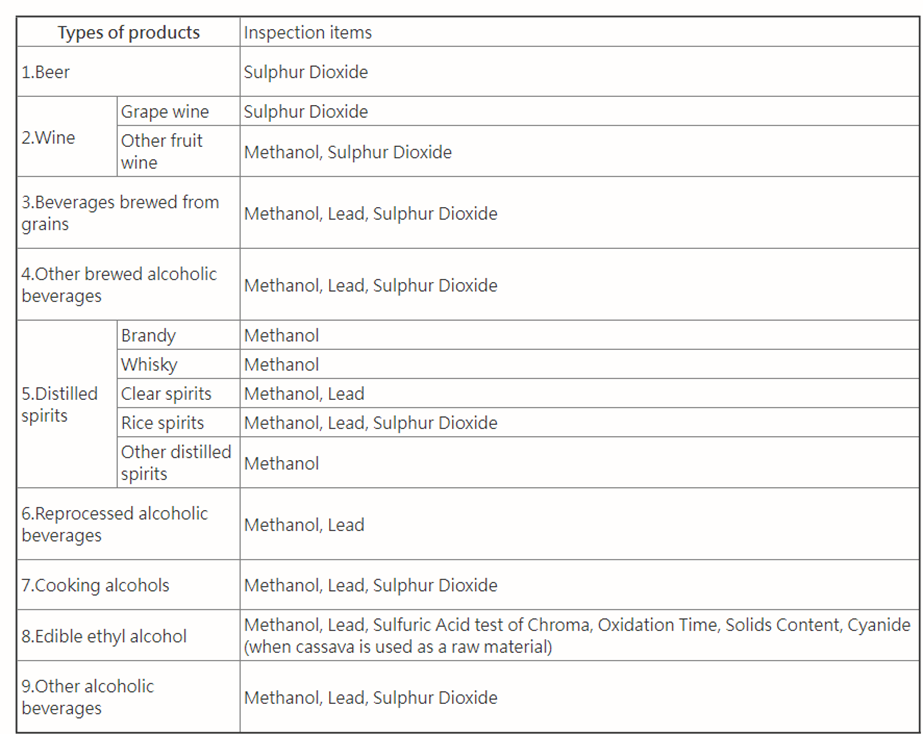
According to the Q&A on Inspection of Imported Alcohol [5], the general tests items include Sulphur Dioxide, Methanol, and Lead (see screenshot below); other tests may be done if there are safety alerts based on domestic and foreign information.
Product
Beer, RTDs, and Whisky
Same as "Category" (alcoholic drinks) above.
7.5 Other Notes or Requirements for Importation
None.
7.6 Overview Flowchart for Importation Process
General Food
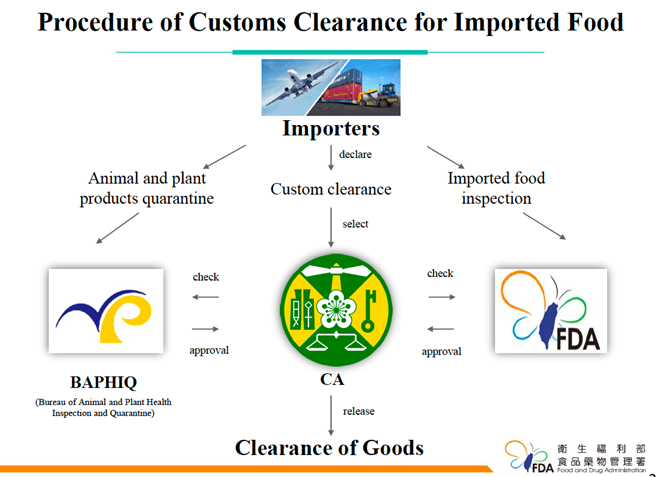
Importation includes Shipment and Customs as illustrated in Sections 7.1 and 7.2 above. Additionally, the following chart applies:
Category
Alcoholic drinks
Same as General Food above.
Product
Beer, RTDs, and Whisky
Same as "Category" (alcoholic drinks) above.
7.7 References
1. Guidance on Custom clearance for import cargo in Taiwan
https://web.customs.gov.tw/etaipei/singlehtml/1328
2. Classification of Commodities
https://fbfh.trade.gov.tw/fh/ap/listIERegf_e.do?q_type=1&language=E
3. Regulations of Inspection of Imported Foods and Related Products
https://law.moj.gov.tw/ENG/LawClass/LawAll.aspx?pcode=L0040017
4. Administrative Regulations Governing the Inspection of Imported Alcohol
https://www.nta.gov.tw/Eng/singlehtml/2d92d7dec52641e58c27fdd1a4b7f6ee
5. Q&A on Inspection of Imported Alcohol
https://www.nta.gov.tw/Eng/singlehtml/2740#p2
Was this article helpful?