
7. Importation Requirements
- 3 Mins to read
- DarkLight
7. Importation Requirements
- 3 Mins to read
- DarkLight
Article summary
Did you find this summary helpful?
Thank you for your feedback
General Foods
Japan

This section provides information on the importation process (shipment, customs, licenses required, and test requirements).
7.1 Shipment Declaration
Requirements for import clearance can vary depending on the type of food products. Therefore, it is recommended to have a pre-import consultation with the Food Surveillance Office (FSO) of the MHLW at a local Quarantine Office by preparing documents in Japanese that explain product details such as product specification, list of ingredients (including additives and processing aids), manufacturing method [1]. The FSO would help food business operators (mainly importers) understand the procedures and information that are necessary for their specific products. Pre-import consultation is recommended particularly when the product is imported to Japan for the first time, or when there are any changes to the product (e.g., ingredient composition, manufacturing method).
Documents required to be submitted during import notification/declaration shall also be prepared in advance. All required documents are listed in Section 7.2 - Customs Procedure - below.
7.2 Customs Procedure
1. Outline of Import Clearance
Any person wishing to import goods must declare them to the Director-General of Customs and obtain an import permit after the necessary examination of the goods concerned. The formalities start with the lodging of an import declaration and end with the issuance of an import permit after the necessary examination and payment of Customs duty and excise tax. In this way, measures are taken to ensure the fulfillment of the requirements for the control of foreign exchange and other regulations concerning the importation of goods.
2. Import Declaration
(1) Completion and Submission of Import Declarations
Declaration must be made by lodging an import (Customs duty payment) declaration describing the quantity and value of goods as well as any other required particulars.
This import declaration must be made, in general, after the goods have been taken into a Hozei area or other specially designated zone.
Note: The Hozei area is the place designated by the Ministry of Finance and approved by the Director-General of Customs as an area to place cargo arriving from overseas. [2]
(2) Declarant
Import declaration must be made, in principle, by the person who is importing the goods. Usually, a Customs broker files the declaration as a proxy for importers.
(3) Documents to be Submitted
An import (Customs duty payment) declaration form must be prepared in triplicate and submitted to Customs with the following documents:
- Invoice
- Bill of lading or Air Waybill
- The certificate of origin (where a WTO rate is applicable)
- Generalized system of preferences, certificates of origin (Form A) (where a preferential rate is applicable)
- Packing lists, freight accounts, insurance certificates, etc. (where deemed necessary)
- Licenses, certificates, etc. required by laws and regulations other than the Customs Law (when the import of certain goods is restricted under such laws and regulations)
- Detailed statement on reductions of, or exemption from Customs duty and excise tax (when such reduction or exemption is applicable to the goods)
- Customs duty payment slips (when goods are dutiable)
In principle, Customs requires only those additional documents necessary to ascertain important considerations for permission.
7.3 Manufacturing License
Not applicable.
7.4 Test for Importation
Test requirements are determined by the FSO of the MHLW on a case-by-case basis depending on the type of product. Specific test requirements can be confirmed during pre-import consultation with the FSO of the MHLW at a local Quarantine Office (please refer to Section 7.1 above on Shipment Declaration).
7.5 Other Notes or Requirements for Importation
None.
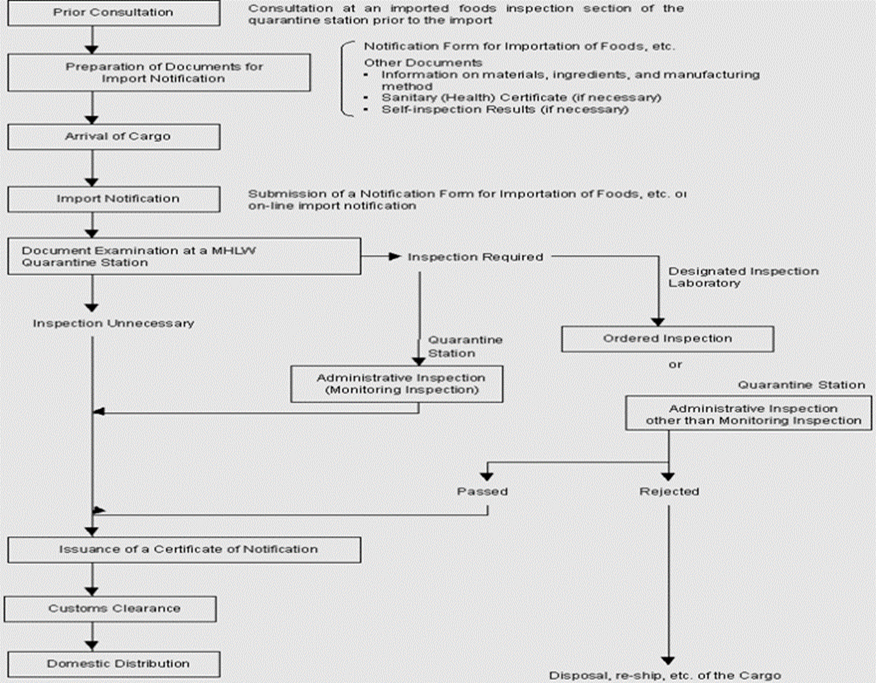
7.6 Overview Flowchart for Importation Process
Importantly, food products are subject to Import Notification by the MHLW before the customs clearance described in Section 7.2 above. In the Import Notification, the MHLW checks the conformity of the imported food product with the Food Sanitation Act (Act No. 233 of 1947) and any other applicable regulations. Additional details of the Import Notification can be seen on MHLW's webpage in English [3].
7.7 References
1. Pre-Import Consultation (available from the webpage of the Tokyo Quarantine Station) (in Japanese)
https://www.forth.go.jp/keneki/tokyo/kanshi_hp/a013.html
2. Japan Custom - Outline of Export Clearance (FAQ)
https://www.customs.go.jp/english/c-answer_e/extsukan/5001_e.htm
3. Import Procedure under Food Sanitation Act (available from the website of the MHLW) (in English)
https://www.mhlw.go.jp/stf/seisakunitsuite/bunya/kenkou_iryou/shokuhin/yunyu_kanshi/kanshi/index_00004.html
Was this article helpful?