
7. Importation Requirements
- 6 Mins to read
- DarkLight
7. Importation Requirements
- 6 Mins to read
- DarkLight
Article summary
Did you find this summary helpful?
Thank you for your feedback
General Foods Thailand
This section provides information on the importation process (shipment, customs, licenses required, and test requirements).
7.1 Shipment Declaration
Importers must submit Form Kor Sor Kor 99/1, an import declaration with excise tax and VAT returns for importing all types of general goods except for products for which the Customs Department requires other types of documents [1].
Documents that should be provided for importing goods for duty payment, insurance method, side loading and unloading formalities, warehouse formalities, and duty-free shop bonded goods must have supporting documents including:
- Import entry declaration (Kor Kor. 99/1)
- Delivery Order (Kor Kor. 100/1)
- Invoice
- Packing List
- Bill of Lading
- Insurance Premium Invoice
- Import license or any other documents in case of prohibited import goods under conditions of relevant laws
- Certificate of Origin in case of requesting a reduction in the duty rate
- Other documents such as ingredient lists, characteristics, uses of products, etc., or documents exchanged between exporters and importers or any other parties that import the goods such as container man, bank insurer, etc.
7.2 Customs Procedure
(I) Register to use the e-Customs system:
Entities wishing to perform customs formalities or conduct electronic customs procedures must register with Customs. Importers can either register with the system directly (i.e. at their own office) or through an agent with the Customs Department to have an account on customs clearance services, known as the TCS system [2]. This can be done in 3 different ways:
- Register via the online customs registration system on the website of the Customs Department (Online Customs Registration), or
- Register via the online visitor registration system via the Customs Trader Portal (available for Thai national registrants that have not yet been registered with the Customs Department from July 1, 2021, and juristic persons with all directors of Thai nationality that have not yet been registered with the Customs Department from August 3, 2022), or
- Register at the registration service of the Customs Department.
Entities can check the registration information, and registration status and can track the status of customs formalities by signing up for the Customs clearance status tracking system (e-Tracking).
Registration with the Customs Department requires the following documents:
- Application for registration of work on the issuance of (According to the form prescribed by the Customs Department)
- ID card
- Copy of company registration
- Tax ID card or proof of personal income tax payment
- Certificate through the training course of the agent from the Institute of Customs Science Human Resources Management Office, Customs Department from an association or institute certified by the Customs Department, or a certificate through a customs specialist training course from the Institute of Customs Science Office of Human Resources, Customs Department
- Employee/employee certificate of the customs broker (except those who have a customs clearance card or a customs clearance assistant card and have passed the training and testing from the Institute of Customs Science according to the notification of the Customs Department No. 13/2549 within December 31, 2008)
- One 1-inch straight-faced photograph taken within the last 6 months.
- One copy of the documents under (2) - (5) with a signature to certify the correctness by filing an application at the Registration and Privileges Bureau of Customs Standards and Procedures, Customs Department, or submitting through the customs office. However, the registrant will be able to work on the issuance of goods for three years from the date of permission.
(II) Submission and verification of Customs declaration:
Documents that are used as information for import declaration:
- Import entry declaration (Kor Kor. 99/1)
- Delivery Order (Kor Kor. 100/1)
- Invoice
- Packing List
- Bill of Lading
- Insurance Premium Invoice
- Import license or any other documents in case of prohibited import goods under conditions of relevant laws.
- Certificate of Origin in case of requesting a reduction in the duty rate
- Other documents that show information of import or trading which the sellers or exporters exchange or documents between exporters and importers or any other parties that import the goods such as container man, bank insurer, etc.
After all the documents are submitted to the e-Customs system along with an arrival report with the information of the carrying vessel, the e-Customs system will then check and verify the submission, identifying any discrepancies and specifying whether the shipment is a green line or red line.
(III) Payment of duties and taxes:
Importer or agent completes import tax duty according to Thai Customs Tariff Decree B.E. 2530 and other trade agreements.
(IV) Inspection and release of cargo:
Inspection for cargo release shall be conducted following two lines:
- Exempted from inspection (green line), or
- Requiring inspection (red line).
The determination of the green line vs. red line is according to the random risk identification process from the system of Thai Customs. Thai Customs will notify the applicant about the inspection line via the Electronic Customs System.
In case the Green Line is picked, this simply implies a required online screening that will take only a few minutes. The importer or customs broker can pick up the goods from the customs bond.
In case the Red Line is picked, the supporting documents will have to be presented and the cargo will have to be physically examined by customs officials. If the information is correct, the goods will be released at customs bond.
7.3 Manufacturing License
A manufacturing license is NOT required. Instead, manufacturers of imported foods are required to submit the certificates showing compliance with the criteria laid down in the Notification of the Ministry of Public Health (No. 193) B.E. 2543 (2000) [3] or equivalent details to the mentioned notification of the Ministry of Public Health, or one of the following food quality assurance systems [4]:
- General principles of Food Hygiene as prescribed by International Food Standard FAO/WHO; Codex.
- Hazard Analysis and Critical Control Point System.
- ISO: Quality Management System.
- Other principles or systems which are equivalent to stipulation (1) - (3).
The certificates shall be original copies or certified by a certification body certified by the embassy of the producer’s country in Thailand, or to be certified by governmental offices, notary public, etc.
In cases where certificates are issued in other languages than Thai language or English language, translations shall be certified by the Thai embassy in the producers’ s country, the embassy of the producer’s country in Thailand, governmental offices, or certified international private translator firms which shall be accompanied by a copy of the certificate of translation.
7.4 Test for Importation
Prepackaged foodstuffs will need an additional inspection by the Thai FDA before proceeding through the regular customs formalities [5].
7.5 Other Notes or Requirements for Importation
Imported food products including food supplements require product registration [6]. They must comply with the purpose and type of permission as required by law and in accordance with the permission granted.
- The customs broker must be certified by the Customs Department.
- The exporter must have a system to link the imported health product information to the agency involved in the import authorization.
- Export agents must undergo training in the submission of health product declarations prior to importation (License per Invoice, LPI).
Imported foods for sale follow the below process:
- Apply for a permit document to bring or order food into the Kingdom [7]
- Apply for a food serial number (product registration)
- When it is imported, create a License per Invoice (LPI)
- Prepare goods declaration with customs
- Contact the Food and Drug Administration
- Submit the goods invoice/notice to collect items by international post
- Submit Invoice or consignment
- Submit the Health product import notification (LPI)
- Assign power of attorney for formalities at the Food and Drug Administration
- Food samples imported for inspection at the food and drug checkpoint (label according to the relevant Ministry of Public Health notification)
- Prepare other documents according to the relevant notifications of the Ministry of Public Health (e.g. Certificate of Origin)
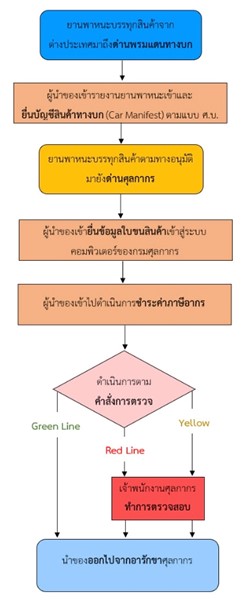
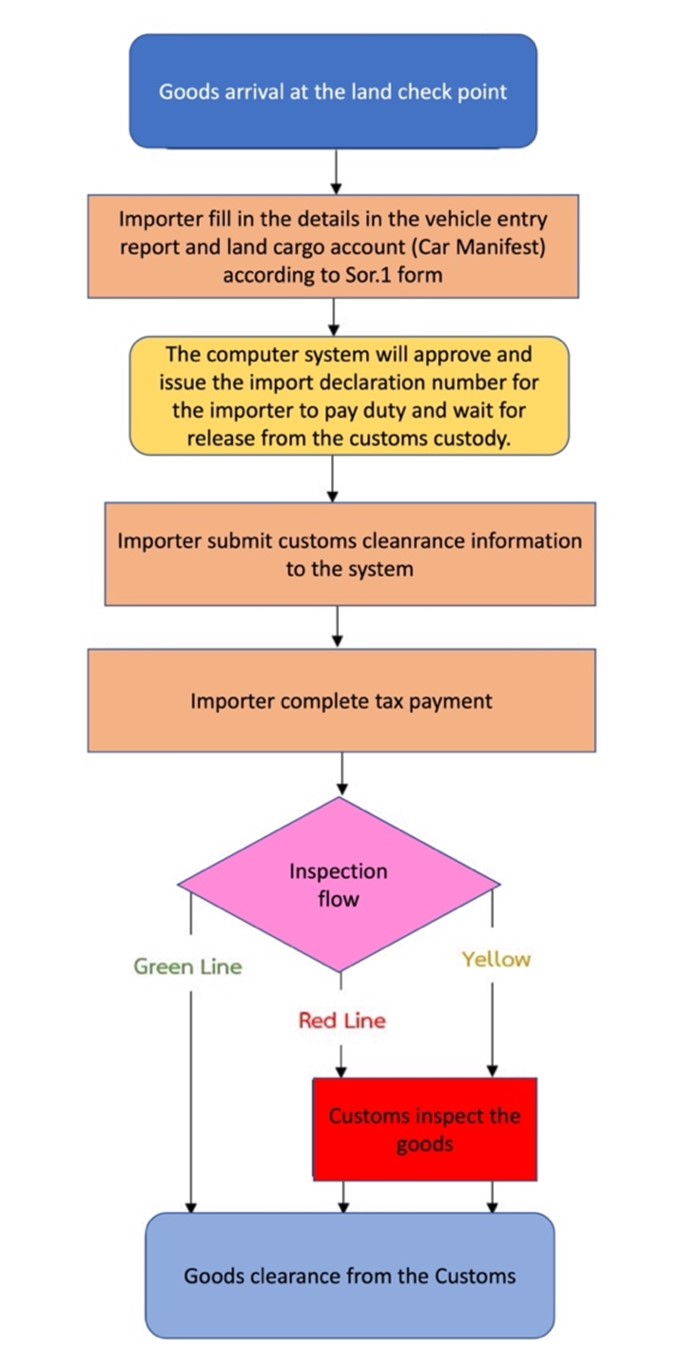
7.6 Overview Flowchart for Importation Process
Refer to the Procedure for Importing Goods by Thai Customs - import flowcharts for import by land, ship, and air [8].
7.7 References
1. Import-export of goods - Customs clearance for imports by ship
2. Registration as an importer-exporter with the Customs Department
3. MOPH Notification No. 239 B.E. 2544 (2001) Re: Amendment of the Notification of Ministry of Public Health (No. 193) B.E. 2543 (2000)
4. MOPH Notification No. 420 Re: Food Production Processes, Processing Equipment/ Utensils, and Storage Practices
https://food.fda.moph.go.th/law/data/announ_moph/V.English/P420_E.pdf
5. Thailand: Food and Agricultural Import Regulations and Standards Country Report - TH2022-0045
6. FOOD ACT B . E. 2522
http://food.fda.moph.go.th/law/data/act/E_FoodAct2522.pdf
7. Good Importing Practices (GIP) guidelines for importing or ordering health products into the Kingdom
https://www.fda.moph.go.th/sites/logistics/Shared%20Documents/Other/Announce_GIP.pdf
8. Procedure for importing goods
http://www.customs.go.th/cont_strc_simple.phpxleft_menu=menu_business_160421_02_160421_01_160914_01&ini_menu=menu_business_160421_02&ini_content=business_160426_02_160426_01&root_left_menu=menu_business_160421_02_160421_01&lang=th&top_menu=menu_homepage&left_menu=menu_business_160421_02_160421_01
Was this article helpful?