
7. Importation Requirements
- 10 Mins to read
- DarkLight
7. Importation Requirements
- 10 Mins to read
- DarkLight
Article summary
Did you find this summary helpful?
Thank you for your feedback
General Foods
Brazil

This section provides information on the importation process (shipment, customs, licenses required, and test requirements).
7.1 Shipment Declaration
Goods and products under sanitary surveillance, intended for commerce, industry, or direct consumption, must be authorized for importation as long as they are formally regularized before the National Health Surveillance System with regards to the obligation, where applicable, of registration, notification, model authorization, exemption from registration, or any other form of control regulated by the National Health Surveillance Agency (ANVISA) or by the Ministry of Agriculture, Livestock and Supply (MAPA), depending on the type of products and the authority in charge of their control.
The application for the import license must be done through the Import Module of SISCOMEX, which is the Brazilian system for the importation of products and based on the product application with ANVISA or MAPA who will be the entity responsible for the approvals.
It is worth mentioning that there is Guidance by SISCOMEX [1] for each activity according to the product category.
Authorization for the importation of goods and products under sanitary surveillance by an individual or legal entity shall be based on compliance with technical-administrative guidelines and a request by means of petition, electronic or manual, made available and regulated by ANVISA [2] or MAPA [3].
Companies importing food, food raw materials, or food products must present, upon arrival of the good or product, an official document of regularization of the company issued by the state or municipal authority.
In the case of outsourcing the storage activity, it will be mandatory to present to the health authority at the place of clearance, the contract and regularization of the company that will promote the storage, in accordance with good storage practices provided for in the relevant health legislation.
To start the import process, it will be necessary that the importer establishment register the Import License in SISCOMEX and then link the electronic file in the SISCOMEX Single Portal [4].
ANVISA
The mandatory documents for the initial petition of the import process (import license) are the following:
- Commercial Invoice
- Bill of lading
- Sanitary Licensing (of the importer company based in Brazil)
- Declaration of the Registration Holder authorizing import by a third party (DDR) (if applicable)
- Authorization for importation by an intermediary as per Chapter VIII of the RDC n. 81/2008 [2] (if applicable)
- Supplementary fee and proof of payment (if applicable). The amount will depend on the amount of the commercial invoice among others.
ANVISA has launched a Food Import Manual to guide companies on the import procedure [5].
MAPA
Before the Import License Registration, request the exporter, the following documents:
- Certificate of Registration of the importing establishment issued by the MAPA
- Commercial Invoice indicating:
- Brand
- Type
- Bottle capacity in milliliters
- Incoterms
- Payment terms
- Full details of the producer
- Net and gross weight
- Quantity to be imported
- The total value of the operation
- Packing List
- Certificate of Origin and Analysis of the product, issued by a foreign body and laboratory registered in the Foreign Bodies and Laboratories Registration System (SISCOLE)
- Supplementary fee and proof of payment (if applicable). The amount will depend on the amount of the commercial invoice among others
- Declaration of the Registration Holder authorizing import by a third party (DDR), if applicable
Further information on the Import License can be accessed by visiting the following document issued by the Brazilian Government: https://www.gov.br/siscomex/pt-br/arquivos-e-imagens/2019/09/CARTILHALIWEB.pdf
After making the import license application, the Licenses, Permissions, Certificates, and Other documents required by the product (LPCO) registration must be made through integration with the Single Portal, which allows the user to request the administrative treatment for import operations, and submit the documents that instruct the process electronically, in one place.
The data of the import operation are registered by the user directly in the Single Portal, through the LPCO form. After analysis and administrative processing by the International Agricultural and Livestock Surveillance System (VIGIAGRO), the information is sent directly to the Single Portal, where it can be consulted by users. A Manual for the LPCO registration has been issued for guidance [3].
7.2 Customs Procedure
Customs procedure is conducted by the National Health Surveillance Agency (ANVISA) or by the Ministry of Agriculture, Livestock, and Supply (MAPA), depending on the type of products and the authority in charge of their control.
ANVISA
After obtaining the import license/authorization above-mentioned, the goods to be imported will be inspected, which is a discretionary procedure to be carried out by Anvisa in the import clearance process.
In case the cargo needs inspection, the authorizing agency will insert a text in SISCOMEX, indicating to the importer that the goods have been released for inspection. In this way, the importer will be responsible for presenting, via an addendum, the proof of docking of the cargo in the customs warehouse where the goods are stored and other information that may be requested.
In the case of physical inspection of the cargo, the Anvisa officer responsible for the inspection of the bonded warehouse where the cargo is stored shall schedule the inspection with the importer or his legal representative. This schedule shall be recorded in SISCOMEX or other means chosen by the Inspection Post.
In the case of remote inspection of the cargo, the customs authority shall register in SISCOMEX the proposed date and time of the remote inspection, as well as the name of the inspector responsible. Thus, the importer shall be responsible for requesting the trustee to position the cargo and schedule the remote inspection. For this scheduling, the importer or his agent must contact the customs office where the goods will be inspected.
The legal representative, with identification documents and power of attorney, and the technical manager of the bonded warehouse must be present at the time of the inspection [5].
Once the inspection is completed, products will then clear customs and be ready for the final destination (distributed for sales, industrial processing, etc.).
MAPA
Soft drinks will be used as an example to explain MAPA's Customs Procedure
For the release of the product, an import certification must be obtained. For example, for soft drinks, the "Import Certification for beverages, acetic fermented beverages, wines and grape and wine derivatives" must be obtained. This corresponds to the certification of imported Beverages, Acetic Fermented Drinks, Wines, and Grape and Wine Derivatives, either by issuing the Certificate of Import Inspection -CII at the end of the whole certification process or by issuing sample collection exemption authorizations when the product already has an eligible and valid CII or is classified as of exceptional quality [4].
All mandatory information and documentation must be submitted directly and only in the Single Portal, through the Import Licence, which will continue to be registered in SISCOMEX. The following steps must be taken to apply for this certification:
1. Make Request for the Import Inspection Certificate – CII: The importer must request the certification of the products contained in the Import License - LI, correctly filling out the application. The Import Inspection Certificate - CII fit and valid must be attached (only for cases of requests for a waiver by declared CII).
2. Download the request statement (after evaluation of dispensed products). Based on the data filled in by the importer, the system will search the MAPA certificate bank and generate the "request extract" that can contain up to five different documents, according to the image below:
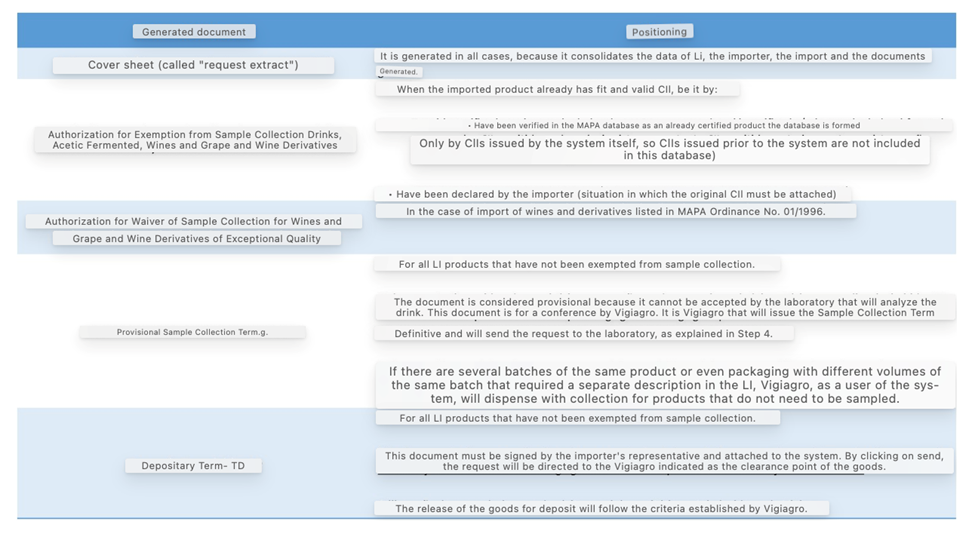
Note: The extract of the request must be submitted to VIGIAGRO. If all products are exempted from sample collection, the request must be finalized.
3. Select Vigiagro and Laboratory (step only available when there is collection of the products): In the same request choose the Vigiagro Merchandise Clearance Unit and the laboratory where the beverage samples will be analyzed. The Depositary Term downloaded with the request statement must be signed and attached to the request. Then the request must be sent.
4. Wait for Vigiagro's analysis: At this stage, the Vigiagro Auditor evaluates the items that will need collection and issues the Definitive Sample Harvesting Term. When the Definitive Sample Collection Term is electronically signed by the Auditor, the importer will receive in the e-mail informed in the request a copy of this document, which must be printed, signed, and sent to the laboratory along with the samples collected. The request is also sent to the laboratory by the Auditor.
5. Wait for laboratory analysis: After sending the application by Vigiagro and in possession of the samples sent by the importer (duly accompanied by the Notice of Collection of Samples), the laboratory informs the date of receipt of samples in the application. After analyzing the products, the laboratory attaches the analysis reports and sends the request for analysis by MAPA's auditor. Laboratory analyses start at a cost of R$ 300,00.
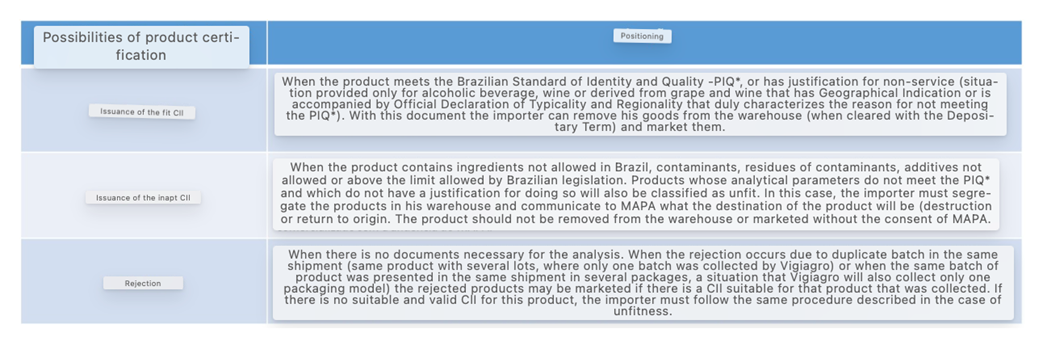
6. Wait for MAPA analysis for the issuance of Import Inspection Certificate – CII: Based on the reports and documentation presented in the SISCOMEX dossier, the MAPA Auditor will define one of three possibilities:
7. Download the Import Inspection Certificate – CII: At this stage, the importer will be able to download the Import Inspection Certificates issued, as well as the laboratory reports.
All these take place in the application through the beverage certification system. Only with the possession of the valid Import Inspection Certificate, (downloaded from the certification system itself), is the importing establishment allowed to market the imported product in the national territory. With that, products then clear customs and are ready for the final destination (distributed for sales, stores, etc.).
To apply for the Import Certification, please visit the following link: https://www.gov.br/pt-br/servicos/obter-certificado-de-inspecao-de-importacao-de-bebidas-fermentados-aceticos-vinhos-e-derivados-da-uva-e-do-vinho
7.3 Manufacturing License
A manufacturing license is not required for the food import procedure. It is only required for the registration/notification.
Note: Only the sanitary license of the importer is required for the import procedure [5].
7.4 Test for Importation
Specific tests for importation are not described in the regulation. It is understood that analysis reports ensuring the quality and safety of the product depending on the specific regulations applicable must be presented. In addition, microbiology and contaminant tests specific to the type of product may be required during inspection.
For example, in Brazil, the classification for beverages is very specific, even for the mixtures to prepare them, thus the testing requirements will also be specific depending on the product of interest for importation [6].
These reports may be requested at the discretion of the sanitary authority whenever there is a need to evaluate the quality and/or composition of imported foods.
When requested, the analytical report of quality control, by batch or departure, must show fully satisfactory analytical results, with records of information in accordance with the documentation presented. The goods or products will be subject to interdiction in the event of condemnatory laboratory results or findings of contravention of sanitary legislation [2][5].
7.5 Other Notes or Requirements for Importation
Cost of the import procedure
The amount of the sanitary inspection fee to be paid by importing companies depends on the subject of the petition and the size of the company, as defined by RDC No. 222/2006 [7].
In food imports, in which the importer is not the holder of the regularization of the product, the payment must be made according to the size of the holder [2]. If the size of the holder of the regularization of the product is greater than the importer in the import process, a fee must be paid, whose value will be the difference in the size of the regularization holder minus the size of the importer. The proof of payment of this complementary fee constitutes a compulsory document for the instruction of the file.
For beverages, the procedure does not describe the current cost for beverage importation. It only mentions that when applicable, laboratory analysis costs are up to the importer. The cost-related laboratory test starts from 300 Brazilian Real (approx. 60 USD) [8]. In addition, local taxes on the beverages imported are applied (approx. 20%). These taxes will depend on the state where the product will be placed.
7.6 Overview Flowchart for Importation Process
Food Imports
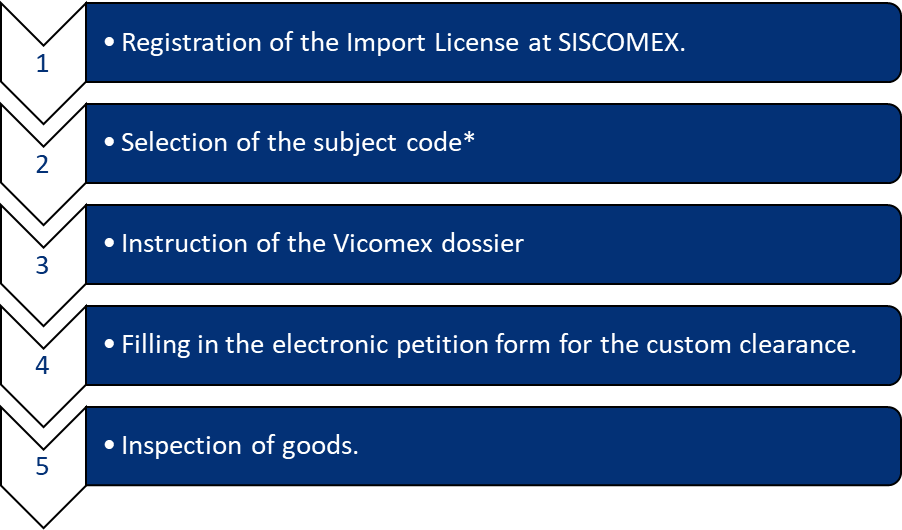
*These codes are described in the Food Import Manual [5].
Beverage Imports
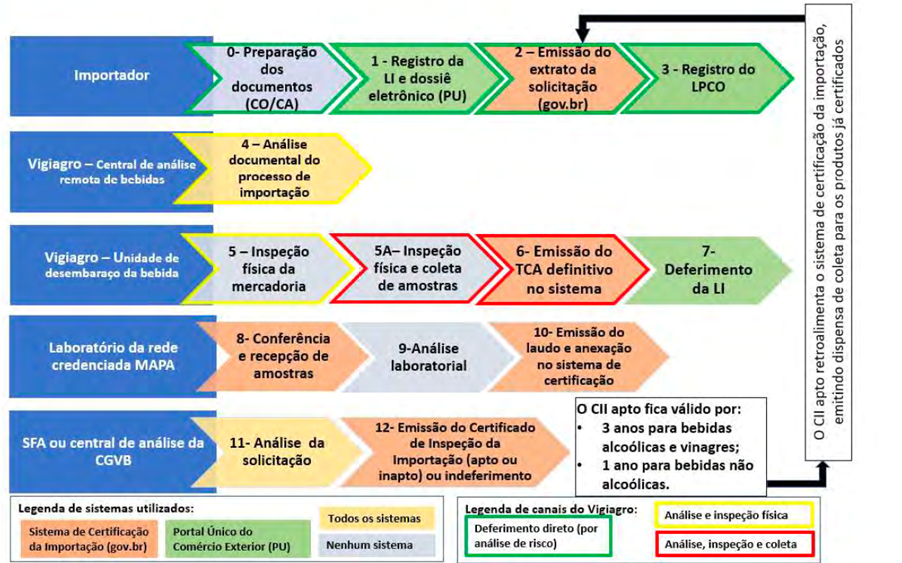
*These codes are described in the Annex in DIPOV Internal Standard [6].
7.7 References
1. SISCOMEX – manuals Posted 3/23/2022 10:04 am Updated 7/20/2022 3:32 pm
https://www.gov.br/siscomex/pt-br/informacoes/manuais
2. Resolution of the Collegiate Board of Directors - RDC No. 81/2008 - IT PROVIDES FOR THE TECHNICAL REGULATION OF IMPORTED GOODS AND PRODUCTS FOR HEALTH SURVEILLANCE PURPOSES
http://antigo.anvisa.gov.br/legislacao#/visualizar/28269
3. Manual for the LPCO registration
https://portalunico.siscomex.gov.br/portal/
5. Food Import Manual
6. Annex to DIPOV Internal Standard No. 1/2019, Consolidating the Standards for Beverages, Acetic Fermented, Wine and Grape and Wine Derivatives, "Beverage Cartouche" - 2nd Edition
7. Resolution RDC N° 222/2006 (updated 2017). Provides for the electronic petition and collection procedures within the scope of the National Health Surveillance Agency - ANVISA and its State and Municipal Health Surveillance Coordination Offices and makes other provisions
http://antigo.anvisa.gov.br/documents/10181/2718376/(2)RDC_222_2006_COMP.pdf/87ee071c-886e-47ac-94af-5590aaa2011e
8. Obtain import certification for beverages, acetic ferments, wines and grape and wine derivatives.
Was this article helpful?