
5. Claim Requirements
- 5 Mins to read
- DarkLight
5. Claim Requirements
- 5 Mins to read
- DarkLight
Article summary
Did you find this summary helpful?
Thank you for your feedback
Health Supplements
Malaysia

This section provides information on the definition of different types of claims and any restrictions or allowance of claims as well as claim registration processes.
5.1.1 Types & Definitions
A Health Supplement claim refers to the beneficial effects of consuming health supplements (HS) to promote good health and well-being (physical and mental) by providing nutrition, enhancing body structure/function, relieving physiological discomfort, and/or reducing the risk of health-related conditions or diseases.
There are 3 types of HS claims:
- General or Nutritional claims: refer to claims related to:
- General health maintenance
- Benefits derived from supplementation beyond normal dietary intake
- Functional claims (medium): maintains or enhances the structure or function of the human body, excluding disease-related claims
- Disease risk reduction claims (high): significantly altering or reducing a risk factor of a disease or health-related condition
5.1.2 List of Prohibited Claims
See section 4.7.
5.2 Nutritional Claims
5.2.1 Permitted Claims
A. List of Nutritional Claims which can be made on the category of Health Supplement
A list of positive claims is not available. NPRA provides some examples/wording of claims as below:
- Supports healthy growth and development
- Nourishes the body
- Relieves general tiredness, weakness
- Helps to maintain good health
- For energy and vitality
- For strengthening the body
Criteria:
- Is in line with established nutrition knowledge in reference texts
- Is related to general well-being in line with scientific knowledge
- The claim does not refer to the structure and/or function of the human body
- In accordance with HS principles and practice in Malaysia
Evidence to substantiate HS claims shall be one or more of the following evidence:
- Standard reference e.g. reference textbooks, pharmacopeia, monographs
- Recommendations on usage from reference regulatory authorities or reference organizations
Notes:
- For a health supplement product making a General or Functional Claim on vitamin(s) and/or mineral(s), it must contain a minimum of 15% of the Codex Nutrient Reference Value (NRV) per daily dose of the vitamin(s) and/or mineral(s). Other ingredients must be substantiated by supporting evidence.
- For example, if the vitamin content is less than 15% NRV, the specific claim for this vitamin is not allowed unless there is evidence to support the claimed effect below this value.
B. List of Functional Claims (medium) which can be made on the category of Health Supplement
A list of positive claims is not available. NPRA provides some examples/ wording of claims as below:
- Vitamin A helps to maintain growth, vision, and tissue development
- Vitamin D helps in the normal development and maintenance of bones and teeth
- Chondroitin helps to promote healthy joints
Criteria:
For claims on established nutrients and ingredients such as vitamins & minerals with daily recommended values:
- Meet the conditions for nutrient function claims as set by the authority
- Claims have consistent scientific support according to scientific review and evaluation
- In accordance with HS principles and practice in Malaysia
Evidence to substantiate HS claims shall be one or more of the following evidence:
- Standard reference e.g. reference textbooks, pharmacopeia, monographs
- Recommendations on usage from reference regulatory authorities or reference organizations
- Good quality scientific evidence from human observational studies (refer to ASEAN Guidelines on efficacy data requirement) (only in the event that human experimental study is not ethical, animal studies will be accepted together with epidemiological studies or other scientific literature and documented traditional use)
- Peer-reviewed scientific data or meta-analysis
Refer to section 5.4 below for the Illustrative Substantiation Evidence List for the list of acceptable references, organizations, and authorities.
5.2.2 Nutritional Claim Registration
All claims made for health supplements must be approved by the National Pharmaceutical Regulatory Agency (NPRA). No separate process to approve new health claims. In case of new claims, the documents stated below shall be submitted to the NPRA for evaluation during product registration.
Claims substantiation must be in line with the respective HS principles and supported by adequate evidence. To reflect all the available usage evidence (including relevant scientific evidence), the evidence shall be summarized as part of the substantiation document for the claim as shown in the below screenshot:
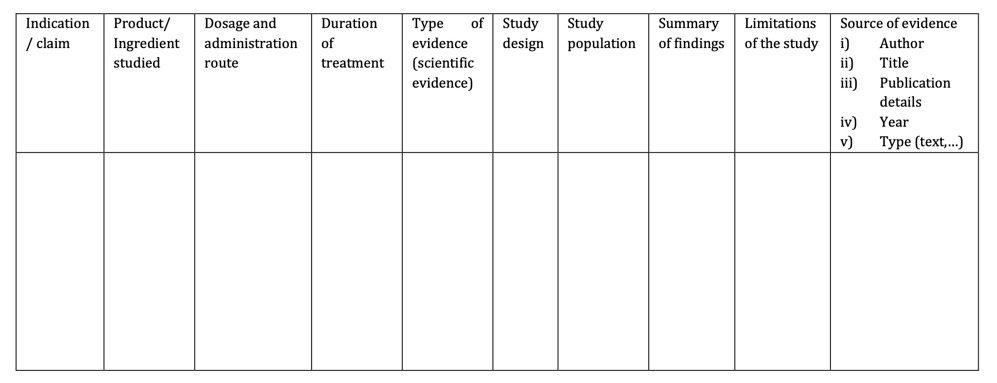
It is recommended to submit as fully as possible according to the Checklist of Dossier Requirement for Health Supplements provided in Attachment 1 in the reference link [1].
- Table 13: Checklist for General/ Nutritional and Medium Claim
- Table 14: Additional Quality Data Checklist for Disease Risk Reduction Claim
Note: Clinical documents to support the disease risk reduction claims shall follow the requirements specified in Part IV.
Estimated cost and duration for new health claim approval process:
Check section 6.2.
5.3 Health Claims
List of disease risk reduction claims which can be made on the category of Health Supplement (HS)
A list of positive claims is not available. NPRA provides some examples/ wording of claims as below:
- Helps to reduce the risk of osteoporosis by strengthening bone
- Helps to reduce the risk of dyslipidemia
Criteria:
- The relationship between the health supplement ingredient or product and disease risk reduction is supported by consistent scientific evidence
- Documented in authoritative reference texts
- Recognized by the Authority reference or international organizations or regulatory authorities
- Adheres to the key principles of health supplement claims
Evidence to substantiate health supplement claims:
A. Compulsory evidence:
- Scientific evidence from human intervention studies on ingredient and/or product
- Toxicological study (chronic)
- Pharmacological study
B. At least 1 additional piece of evidence:
- Standard reference e.g. reference textbooks, pharmacopeia, monographs, etc.
- Recommendations on usage from reference regulatory authorities or reference organizations
- Evidence from published scientific reviews or meta-analysis
- Report prepared by expert committees/ expert opinion (subject to the Authority approval)
Refer to section 5.4 below for the Illustrative Substantiation Evidence List for the list of acceptable references, organizations, and authorities.
5.3.2 Health Claim Registration
Same as 5.2.2 above.
5.4 Other Notes or Requirements for Claims
All claims made for health supplements shall:
- be consistent with the definition of health supplement;
- enable consumers to make an informed choice regarding products;
- not be misleading or false;
- support the safe, beneficial, and appropriate use of the product;
- maintain the level of scientific evidence proportional to the type of claims;
- be for health maintenance and promotion purposes only;
- not be medicinal or therapeutic in nature, such as implied for treatment, cure, or prevention of disease.
See also Attachment 2 in the reference link [1] for the list of allowable claims for specific active ingredients in health supplements.
Illustrative susbstantiation evidence list
A. Reference texts
- Martindale, latest edition. The Complete Drug. Pharmaceutical Press, 2009.
- The ABC Clinical Guide to Herbs. American Botanical Council
- WHO Monographs on Selected Medicinal Plants
- British Pharmacopoeia
- United States Pharmacopoeia
- Indian Pharmacopoeia
- Chinese Pharmacopoeia
- Natural Standards - http://www.naturalstandard.com
- Office of Dietary Supplements, National Institutes of Health - Dietary Supplement Fact Sheets
B. Organizations
- American Botanical Council - www.herbalgram.org
- American Nutraceutical Association
- CODEX Alimentarius
- Global Information Hub for Integrated Medicine - http://www.globinmed.com
- National Centre for Complementary and Alternative Medicine - http://nccam.nih.gov/
- Office of Dietary Supplements, National Institutes of Health (USA) - http://ods.od.nih.gov
C. Reference regulatory authorities
- Australia TGA
- Chinese Health Authority on Chinese medicinal herbs
- European Commission
- Health Canada
- United States FDA
Notes:
- This list is not meant to be exhaustive and will be reviewed from time to time.
- The Authority will conduct a detailed evaluation of the evidence included in the report to ensure that the health claim is substantiated.
- The Authority will consider reviews other than those listed above if the standards of evidence are consistent with those of the Authority.
- All references must be current.
5.5 References
1. Guideline on registration of health supplements
Was this article helpful?