
4. Labeling Requirements
- 13 Mins to read
- DarkLight
4. Labeling Requirements
- 13 Mins to read
- DarkLight
Article summary
Did you find this summary helpful?
Thank you for your feedback
Health Supplements
Malaysia

This section provides information on labeling requirements and the label approval process.
4.1 Mandatory Labeling Parameters
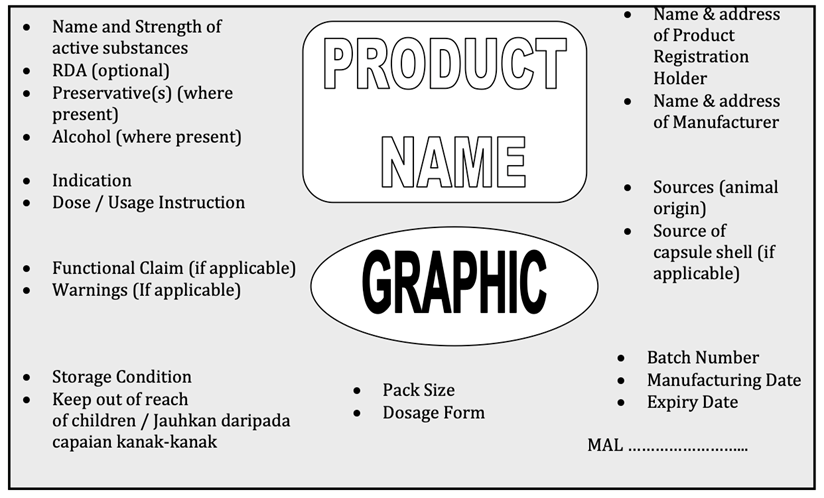
The following information shall be presented on the label of a product on the outer carton, immediate container, or blister/strip:
- Product name
- Dosage form
- Name and strength of active substance(s)
- Batch number
- Manufacturing date
- Expiry date
- Route of administration
- Storage condition
- Country's registration number: is MAL.
- Name and address of product registration holder
- Name and address of the manufacturer
- Warnings and/or Specific labeling (if applicable)
- Pack sizes (unit/volume)
- Name and content of preservative(s) where present
- Name and content of alcohol, where present
- Source of ingredients derived from animal origin (active and excipient) including starting materials and gelatine
- Source of capsule shell (if applicable)
- The words "Keep medicine out of reach of children" or words bearing similar meanings in both Bahasa Malaysia and English
- Security label (MOH hologram)
- RDA for vitamins/multivitamins/mineral preparations used as a dietary supplement (optional)
Note that declaration of nutrition information per serving (e.g. energy, carbohydrate, protein, and fat) is not permitted on a health supplement product label.
Refer to Appendix 19 [Ref 1] Table 1 for details.
Additional Notes:
- Product labels shall follow the standard labeling for Health Supplement as shown above
- Information stated on the left and right panels is interchangeable.
- All information on the label must be truthful and not misleading to the consumers.
- The batch number, manufacturing date, and expiration date can be stated on the label, on top of the cap, or bottom of the bottle.
- The front panel must contain the information above. However, the information on the side panels is interchangeable. Additional cautionary labeling relating to the safety of the product may be imposed.
[1][2]
4.2 Languages
All labels and package inserts must be in Bahasa Malaysia or English. In addition to this, translation to another language is allowed. [1]
4.3 Mandatory Information on Stickers
No additional sticker is permitted.
Any usage of stick-on labels shall have prior approval by the Authority. The label shall be made from good quality material and not easily torn or peeled off. The Authority will only consider the following situations where a stick-on label of such information is permitted:
Words with “Controlled Medicine”, “Ubat Terkawal”, “Keep out of reach of children” and “Jauhkan daripada capaian kanak-kanak”, Product Registration Holder information, and Malaysia Specific Labelling Requirements (if any) shall be printed in a single label.
The registration number (MAL) shall be printed permanently on the product (inkjet) and it is not allowed to be printed on the stick-on label. [1]
4.4 Product Legal Name
Health Supplement.
Note: For multi-vitamins and minerals preparations, it is suggested to be labeled as “multi-vitamins and minerals". [1]
4.5 Product-specific Labeling Statements
Additional Requirements for Labeling:
- Information on the Product Name and Name and Strength of active ingredient(s) must be printed repeatedly (for blister/ strip).
- Product in dosage form of a soft gel with tail (twist and squeeze) shall include the statement ‘Under parent supervision’ on the label.
- For products containing animal origin(s), add this statement: "This product contains substance(s) from animal origin".
- For products containing porcine, add this statement: "This product contains animal part(s) (porcine/pig)".
- The label and package insert of health supplement products with disease risk reduction claims (high) shall have the following statement: “Please consult a doctor/ pharmacist before taking this product."
- There are also specific labeling requirements depending on the substances used in the product formulation e.g. alfalfa, arginine, bee pollen, chitosan, Boswellia serrata, etc.
[2][3] - See Appendix 20 [3] for details.
4.6 Authority Approval
Product labels shall be reviewed and approved during the product registration process by National Pharmaceutical Regulatory Agency (NPRA). Refer to Section 6.2 for more details on the cost and duration of the product label approval process. [2]
4.7 Additional Notes on Labeling
4.7.1 Packaging
- Maximum pack size allowed for tablets, pills, or capsules is based on daily dosing for a quantity not exceeding six (6) months of usage.
- Maximum pack size allowed for products with disease risk reduction claim is for one (1) month supply of products unless justified.
- Product with a dosage form of soft gel with tail (twist and squeeze) shall come with children proof cap.
- Packaging particulars to the listing of packing as follows;
C1: Pack size and fill details by weight, volume, or quantity
C2: container type
C3: Barcode/ serial No (optional)
C4: Recommended distributor’s price (optional)
C5: Recommended retail price (optional)
[2]
4.7.2 The Consumer Medication Information Leaflet (RiMUP)
The Consumer Medication Information Leaflet (RiMUP) is required for health supplements with high claims/ disease risk reduction:
- The Consumer Medication Information Leaflet (RiMUP) is a patient information leaflet for a medicine, which outlines the conditions under which the medicine should be used and information on its known safety.
- Product registration holders are responsible for producing RiMUP, using a format template set by NPRA. The information in RiMUP must be in-line with the approved package insert at the time the RiMUP was evaluated by NPRA.
- The information in RiMUP may be updated several times within its shelf life whenever there is an update in the package insert.
- RiMUP is available for prescription and non-prescription medicines registered for use in Malaysia.
- These leaflets are targeted at consumers and are available in English and Malay language.
[4][5][6]
4.7.3 Additional Requirements
- If the product is without an outer carton, the inner label shall bear all the required information.
- The link to the official company website or website for any purpose of product promotion by the PRH/ product owner/ manufacturer is not allowed to be printed on the product label (applicable to all product categories, including imported products). However, the company email address is permitted on the label.
- The label colors shall differentiate the different strengths of the product as well as products containing different active ingredients that belong to the same PRH.
- Only a single label artwork is permitted for all pack sizes of a registered product.
- Use of QR code is permitted only for the purpose of monitoring inventory of the product, such as batch number, expiry date, and manufacturing date, BUT NOT for linkage to any website. The addition of a QR code on registered product labels without variation approval from NPRA may be considered only if that is the only proposed change to the currently approved labels.
- The label of a registered product containing any Scheduled Poison shall not have colorful artwork or graphics that can be misleading or will adversely influence caregivers’/patients'/children's perceptions of the appropriateness of the medication.
- The font size of the product name on the label, including alphabets and numbers, shall be equal.
- For a product containing two (2) or more active ingredients, the font of each active ingredient that is highlighted on the inner/outer carton must be of equal size and prominence.
- This does not refer to the product name, but the statement made on the label.
- Justification for highlighting only certain ingredients on the product name/label must be provided and is subject to approval by the Drug Evaluation Committee.
[1]
4.7.4 Prohibited visual/graphics/statements on the label
The label should not contain any statement or visual presentation that, whether directly or by implication, is likely to mislead the consumer about any product.
The graphics printed on the outer and inner labels have to be standardized to avoid confusion for the customers.
| Type of Statements (& Examples) | Conditions |
|---|---|
1. Marketing strategy (“Money back guarantee” “Buy 1 free 1”; “Backed by RM5 million product Liability Insurance”) | Prohibited on the product label |
| 2. Usage guide which promotes the use of other product(s) (“After consumption of this product (Product A), for better results, it is recommended to take Product B”) | Prohibited on the product label |
| 3. Consumer testimonial | Prohibited on the product label |
| 4. Clinical Trial results or any information on clinical trials done on the product (“Clinically Tested”; “Randomized Double-Blind Placebo Control Clinical Study") | Prohibited on the product label |
| 5. Reference to Hadith/ Al- Quran/ Bible/ Religious books | Prohibited on the product label |
| 6. Opinion of a prominent figure(s) on a product or its active ingredient/content (Opinion of product/ formulation inventor) | Prohibited on the product label |
| 7. Label design (graphic and color) similar to labels from another company | Prohibited on the product label |
| 8. Statement on active ingredient origin ("Source from the Mountains of the Alps") | Allowed if proven true |
| 9. Introduction of founder/ Manufacturer | Prohibited on the product label |
| 10. Logo with certification (SIRIM/ ISO / GMP/ HACCP) | Prohibited on the product label because certification renewal is on a yearly basis |
| 11. Name/Statement/Logo/Registered trademark which does not satisfy the specifications (“Dr. ABC’s Formula” “Nothing like it”) | Prohibited on the product label |
| 12. Special technique used/ superiority in ingredients (Example: Capsule coat) | Allowed if proven true |
| 13. Nutritional claims with analysis certificate attached (Calorie, Fat, Protein, and others) | Prohibited on the product label |
| 14. Graphics or pictures of internal organs (Example: Kidney, Heart, Nerves) | Prohibited on the product label |
| 15. Gender symbol (male or female) (♀ and/or ♂) | Prohibited on the product label |
| 16. Indecent photographs/ pornography/ graphics/images | Prohibited on the product label |
| 17. Graphics that are incoherent with the indication (The noted indication is for constipation, but the graphics on the label shows a slim-looking lady which denotes an indication of weight loss; an indication for urination but the label graphics contain a picture of a water hose.) | Prohibited on the product label |
| 18. Highlighting unnecessary body parts (The indication is for general health but graphics on the label highlights male and female sexual organ parts) | Prohibited on the product label |
| 19. Graphics of plants or animals that may cause confusion (Radix Ginseng which is improvised as a male sexual part) | Prohibited on the product label |
| 20. Photographs of celebrities (Artists, sports person(s), politicians) | Prohibited on the product label |
| 21. Statement on sugars ("This product contains no added sugar") | Allowed on product label provided the product contains no fructose, glucose, sucrose, or other kinds of sugars with a potential to affect diabetics are not included in the formulation. |
| 22. Negative statement (No gluten, yeast, etc.) | Prohibited on the product label |
| 23. Other statements ("This product is blended with premium quality"; "Certified chemical residue-free") | Prohibited on the product label |
| 24. Label design (graphic/color) similar to/same as an adulterated product | Prohibited on the product label |
Notes:
The list is not meant to be exhaustive and will be reviewed from time to time.
The Authority reserves the right to disallow any other words, phrases, or graphics for the product label, which in its opinion is misleading, improper, or not factual.
[2]
4.7.5 Requirements for active ingredients
The content of the ingredients shall be expressed accordingly in the following manner:
a. quantity per unit dose (e.g. for unit dose formulations - tablet, capsule, lozenge, etc.)
b. percentage composition (%w/w, %w/v, %v/v, etc.)
c. weight per ml. (e.g. for solutions, suspension, etc.)
d. quantity (percentage or amount) per measured dose (e.g. oral liquids, drops, etc.)
Metric weights and measures shall be used.
Use of Protected/Endangered Ingredients:
a) Protected/Endangered Wildlife Species
It is the responsibility of the applicant to ensure that the ingredient(s) derived from wildlife species, its parts, and derivatives used in the formulation COMPLIES with the Wildlife Conservation Act 2010 (Act 716) and International Trade in Endangered Species Act 2008 (Act 686). Both guidelines can be downloaded at the PERHILITAN website.
The applicant shall contact the following department to obtain the necessary permit/ license. A copy of the permit/license shall be submitted with the application form for product registration:
Department of Wildlife and National Parks, Peninsular Malaysia Km. 10, Jalan Cheras, 56100 Kuala Lumpur, Tel: +603-90866800, Fax: +603-90753873.
b) Endangered Botanical Species
It is the responsibility of the applicant to declare the source of the botanical ingredient if it is listed under the International Trade in Endangered Species Act 2008 (Act 686). If the ingredient is from a local source, a special permit/ license shall be obtained from the:
Division of Protection and Quarantine of Plants, Department of Agriculture, Tingkat 1-3, Wisma Tani, Jalan Sultan Salahuddin, 50632 Kuala Lumpur. Tel: +603 - 20301400, Fax: +603 - 26913550.
[2]
4.7.6 Product Name
The product name may include product name, dosage form, and strength (e.g. XYZ Capsule 500mg)
- Dosage form and strength of the product are required to be part of the product name to allow for multiple dosage forms (e.g. tablet, capsule) and strengths (e.g. 200mg and 400mg) for any particular named (proprietary or generic) product.
- If a registered product name is found to be similar to another registered product, NPRA reserves the right to request a change in the product name.
- Products with more than one (1) active ingredient should not include the strength of active ingredients in the product name.
- The product name may include the brand name or trademark name, if applicable.
- Any product name that is the same or similar either in writing or pronunciation, to the product name of an adulterated product is prohibited.
[2]
4.7.7 List of Non-Permissible Product Names for Health Supplement Products
1. Prohibited use of disease names as stated in the Medicines (Advertisement and Sale) Act 1956 (revised 1983). Examples: Diabetes, Asthma, Cancer.
2. Prohibited use of a single active ingredient as a product name in products containing more than one active ingredient unless the product name contains words such as ‘Plus, Compound, Complex, Herbanika. Example: If the product contains Vitamin C, Vitamin E, and Fish Oil, the Product name: “Vitamin C” is not allowed but the product name: “Vitamin C Plus” is allowed.
3. Prohibited use of superlatives. Names that indicate superiority or inefficacy. Example: Power, Superior, Pure, Mustajab, Safe, Healthy, Penawar, VIP, Good, World Number 1.
4. Prohibited use of spelling of words that may cause confusion
- Words that involve names of/part thereof: 20 disease names prohibited in the Medicines (Advertisement and Sale) Act 1956 (Revised 1983)
- Other diseases without scientific proof
- Prohibited indication - Example: Go Out = GOUT (label); Utix
5. Prohibited use of names that may cause ambiguity. Ambiguous product name. Example: B For Energy?
6. Prohibited use of names that may be offensive or indecent. Example: SENXBIG=SEnXBIG (label); Sexy, Enjoy, Paradise, Heavenly, Blue boy, Casanova, Desire.
7. Product name not congruent with the active ingredient. Example: The active ingredient is Evening Primrose oil (EPO) and the product name: “Marine tablet” is not allowed.
8. Prohibited use of product names that have elements of ludicrous belief. Statements referring to ancient beliefs/ negative spirits/ supernatural power. Example: Words such as miracle, magic, magical, miraculous, saintly, and heavenly.
9. Prohibited use of product names similar to the existing approved product names; product names similar to the spelling and pronunciation of words of existing product names. Example: Elegen vs L-gen vs L-jen Forte vs Fort.
10. Prohibited use of product names that may cause ambiguity in the nature of the product (drug/ food/ beverage). Product name similar to a food/ beverage name. Examples: Juice, Health drink, Beverages, Kooky.
11. Prohibited use of product names that represent professional advice or opinion. Example: Dr. Sunny, Professor.
12. Product name that symbolizes a claim. Example: Vigour, Youthful, High, Hi.
13. Product name that uses strength but formulation contains more than one active ingredient. Example: If the product contains multivitamins and minerals. Product name: “XXX multivitamins and minerals 500mg” is not allowed.
14. Other prohibited product names. Example: Minda, IQ, Smart, Unique, Ultra Mega, Detox, Defence, Immunity.
15. Names of organs and brain. Example: Heart, kidney, skin, liver.
Notes:
This list is not meant to be exhaustive and will be reviewed from time to time.
The Authority reserves the right to disallow any other words, phrases, or graphics for the product labels, which in its opinion are misleading, improper, or not factual.
[2][7]
4.7.8 Dosage form
Allowed dosage forms include:
a) Tablets: Caplet, lozenge, chewable tablet, dispersible tablet, effervescence tablet, uncoated tablet, enteric-coated tablet, sugar-coated tablet, film-coated tablet, extended-release tablet;
b) Capsules: Soft capsule, hard capsule, enteric-coated capsule, chewable soft capsule, extended released capsule;
c) Powder/ Granules
d) Liquid: Emulsion, syrup, spray, suspension.
Products in the shape of animal dosage forms are not allowed.
Supporting data from established references (e.g. Standard Pharmacopeia) shall be required for a new dosage form. The form that correctly describes it in terms of its product quality control specifications and performance shall be selected.
A separate application for registration is required for each dosage form.
The following documents are required during the submission of the product dossier for sustained-release/extended-release/timed-release dosage form:
i) Protocol of analysis
ii) In-Process Quality Control (IPQC)
iii) Finished Product Specification (FPQC)
iv) Certificate of Analysis (COA)
[2]
4.7.9 Package Insert (Optional)
The following information is required to be included in a package insert:
(i) Brand or Product Name
(ii) Name and Strength of Active Substance(s)
(iii) Product Description
(iv) Indication
(v) Dose/ Use Instruction
(vi) Contraindications
(vii) Warnings and Precautions
(viii) Interactions with Other Medications
(ix) Statement on usage during pregnancy and lactation
(x) Adverse Effects/ Undesirable Effects
(xi) Overdose and Treatment
(xii) Storage Conditions (may be omitted if the information is stated on the label or outer carton labels)
(xiii) Dosage Forms and packaging available
(xiv) Name and Address of manufacturer/ product registration holder
(xv) Date of Revision of Package Insert
[2]
4.8 References
1. Appendix 19: General Labelling Requirements
2. Guideline on registration of health supplements
3. Appendix 20: Specific Labelling Requirements
4. Consumer Medication Information Leaflets
5. How to use Consumer Medication Information Leaflets (RiMUP)
https://npra.gov.my/images/Guidelines_Central/Guidelines_on_Regulatory/How-to-use-RiMUP.pdf
6. Consumer Side Effects Reporting Form
7. Medicines (Advertisement and Sale) Act 1956 (REVISED - 1983)
Was this article helpful?