
5. Claim Requirements
- 10 Mins to read
- DarkLight
5. Claim Requirements
- 10 Mins to read
- DarkLight
Article summary
Did you find this summary helpful?
Thank you for your feedback
Beers, RTDs, Whisky
Philippines

This section provides information on the definition of different types of claims and any restrictions or allowance of claims as well as claim registration processes.
5.1 Overview of Claims
Philippines adopts Codex Guidelines for Use of Nutrition and Health Claims (CAC/GL 23-1997) [1]. According to Codex, a claim is any representation that states, suggests, or implies that a food has particular characteristics relating to its origin, nutritional properties, nature, production, processing, composition, or any other quality.
Nutrition and health claims shall not be permitted for foods for infants and young children except where specifically provided for in relevant Codex standards or national legislation. [2]
5.1.1 Types & Definitions
Nutrition claim means any representation that states, suggests, or implies that a food has particular nutritional properties including but not limited to the energy value and the content of protein, fat, and carbohydrates, as well as the content of vitamins and minerals. The following do not constitute nutrition claims:
- the mention of substances in the list of ingredients;
- the mention of nutrients as a mandatory part of nutrition labeling;
- quantitative or qualitative declaration of certain nutrients or ingredients on the label if required by national legislation.
Nutrient content claim is a nutrition claim that describes the level of a nutrient contained in a food. (Examples: “source of calcium”; “high in fiber and low in fat”.)
Nutrient comparative claim is a claim that compares the nutrient levels and/or energy value of two or more foods. (Examples: “reduced”; “less than”; “fewer”; “increased”; “more than”.)
Health claim means any representation that states, suggests, or implies that a relationship exists between a food or a constituent of that food and health. Health claims include the following:
- Nutrient function claims – a nutrition claim that describes the physiological role of the nutrient in growth, development, and normal functions of the body. Example: “Nutrient A (naming a physiological role of nutrient A in the body in the maintenance of health and promotion of normal growth and development). Food X is a source of/ high in nutrient A.”
- Other function claims – These claims concern specific beneficial effects of the consumption of foods or their constituents, in the context of the total diet on normal functions or biological activities of the body. Such claims relate to a positive contribution to health or to the improvement of a function or to modifying or preserving health. Examples: “Substance A (naming the effect of substance A on improving or modifying a physiological function or biological activity associated with health). Food Y contains x grams of substance A.”
Reduction of disease risk claims – Claims relating the consumption of a food or food constituent, in the context of the total diet, to the reduced risk of developing a disease or health-related condition. Risk reduction means significantly altering a major risk factor(s) for a disease or health-related condition. Diseases have multiple risk factors and altering one of these risk factors may or may not have a beneficial effect. The presentation of risk reduction claims must ensure, for example, by use of appropriate language and reference to other risk factors, that consumers do not interpret them as prevention claims. Examples: “A healthful diet low in nutrient or substance A may reduce the risk of disease D. Food X is low in nutrient or substance A.” “A healthful diet rich in nutrient or substance A may reduce the risk of disease D. Food X is high in nutrient or substance A."
5.1.2 List of Prohibited Claims
General Food
The following claims should be prohibited:
- The case of well-defined products for which a Codex standard regulates such claims as admissible claims or where appropriate authorities have accepted the product to be an adequate source of all essential nutrients.
- Claims implying that a balanced diet or ordinary foods cannot supply adequate amounts of all nutrients.
- Claims which cannot be substantiated.
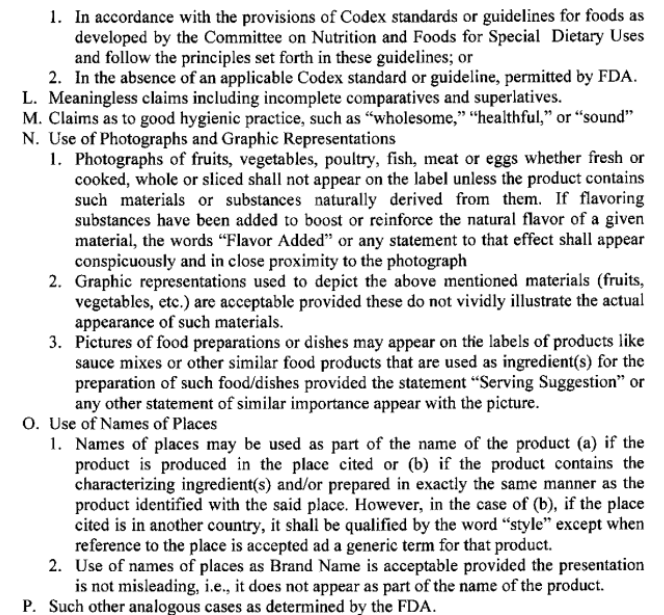
- Claims as to the suitability of a food for use in the prevention, alleviation, treatment, or cure of a disease, disorder, or particular physiological condition unless they are:
- in accordance with the provisions of Codex standards or guidelines for foods as developed by the Committee on Nutrition and Foods for Special Dietary Uses and follow the principles set forth in these guidelines. Or,
- in the absence of an applicable Codex standard or guideline, permitted under the laws of the country in which the food is distributed.
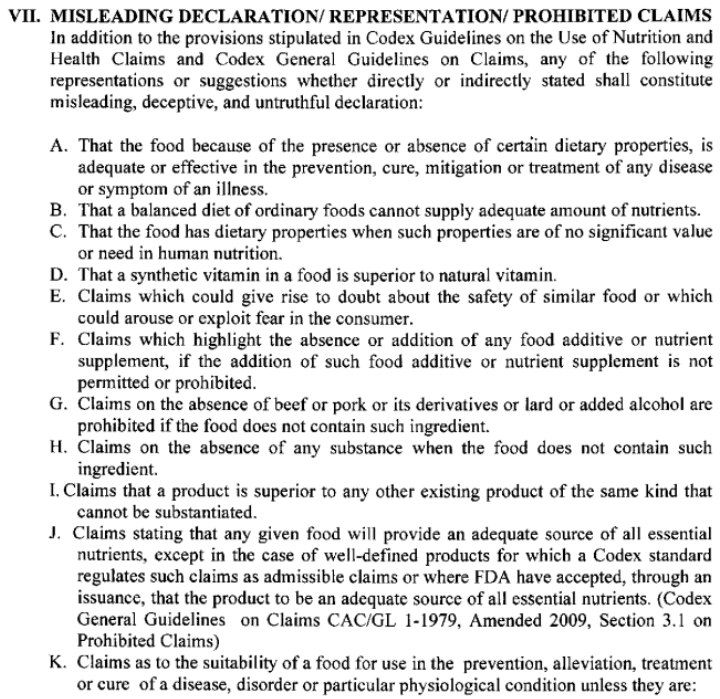
- Claims which could give rise to doubt about the safety of similar food or which could arouse or exploit fear in the consumer.
5.1.3 Potentially Misleading Claims [3]
The following are examples of claims which may be misleading:
- Meaningless claims including incomplete comparatives and superlatives.
- Claims as to good hygienic practice, such as “wholesome”, “healthful”, and “sound”.
5.1.4 Conditional Claims [5]
The following claims should be permitted subject to the particular condition attached to each:
- An indication that a food has obtained an increased or special nutritive value by means of the addition of nutrients, such as vitamins, minerals, and amino acids may be given only if such an addition has been made on the basis of nutritional considerations according to the Codex General Principles for the Addition of Essential Nutrients to Foods. This kind of indication should be subject to legislation by the appropriate authorities.
- An indication that the food has special nutritional qualities by the reduction or omission of a nutrient should be on the basis of nutritional considerations and subject to legislation by the appropriate authorities.
- Terms such as “natural”, “pure”, “fresh”, “homemade”, “organically grown” and “biologically grown” when they are used, should be in accordance with the national practices in the country where the food is sold. The use of these terms should be consistent with the prohibitions set out in Prohibited Claims.
- Religious or Ritual Preparation (e.g. Halal, Kosher) of a food may be claimed provided that the food conforms to the requirements of the appropriate religious or ritual authorities (see also the General Guidelines for the Use of the Term “Halal”, CAC/GL 24-1997).
- Claims that a food has special characteristics when all such foods have the same characteristics if this fact is apparent in the claim.
- Claims which highlight the absence or non-addition of particular substances to food may be used provided that they are not misleading and provided that the substance: (a) is not subject to specific requirements in any Codex Standard or Guideline; (b) is one which consumers would normally expect to find in the food; (c) has not been substituted by another giving the food equivalent characteristics unless the nature of the substitution is clearly stated with equal prominence; and (d) is one whose presence or addition is permitted in the food.
- Claims which highlight the absence or non-addition of one or more nutrients should be regarded as nutrition claims and therefore should invoke mandatory nutrient declaration in accordance with the Codex Guidelines on Nutrition Labeling.
Category
Alcoholic beverages
Same as the claim requirements listed above.
Product
1) Beer
Same as "Category" (alcoholic beverages) above.
2) Alcoholic ready-to-drink beverages (such as Chuhai)
Same as "Category" (alcoholic beverages) above.
3) Whisky
Same as "Category" (alcoholic beverages) above.
5.2 Nutritional Claims
The only nutrition claims permitted shall be those relating to energy, protein, carbohydrate, and fat and components thereof, fiber, sodium, and vitamins and minerals for which Nutrient Reference Values (NRVs) have been laid down in the Codex Guidelines for Nutrition Labeling. [4]
5.2.1 Permitted Claims
General Food
Nutrient declaration
Where a specific nutrition or health claim is applied, then the declaration of the amount of any other nutrient considered relevant for maintaining a good nutritional status as required by national legislation or national dietary guidelines should be mandatory.
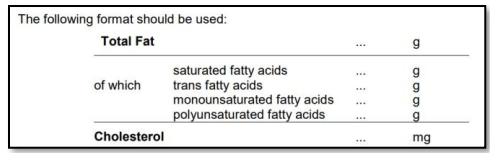
Where the amount and/or type of fatty acids or the amount of cholesterol is declared, this declaration should follow immediately the declaration of the total fat. [4]
Vitamins and minerals may be listed in accordance with the following criteria: Only vitamins and minerals for which recommended intakes have been established and/or which are of nutritional importance in the country concerned should also be declared. When nutrient declaration is applied, vitamins and minerals that are present in amounts less than 5% of Codex Nutrient Reference Value or per 100 g or 100 ml or per serving as quantified on the label should not be declared.
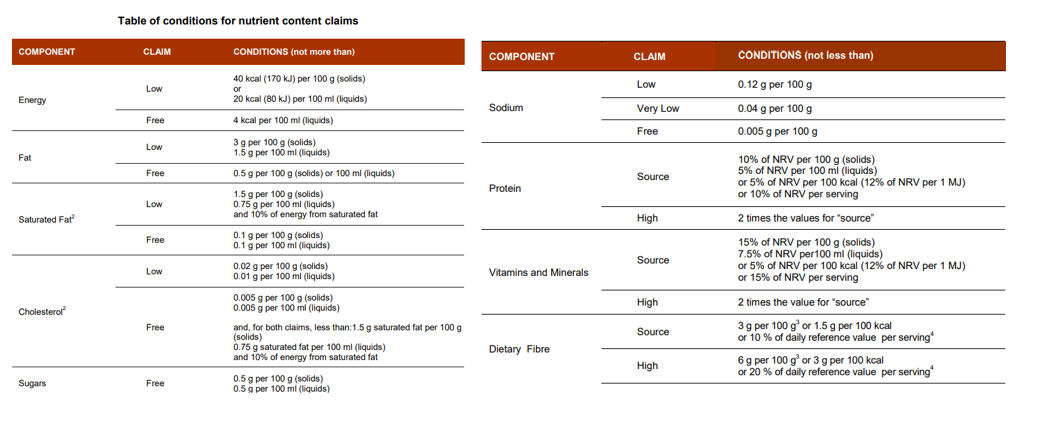
Nutrient Content Claims
 Category
Alcoholic beverages
While the Philippines' regulations do not specifically prohibit nutrition claims on alcoholic products, in practice, alcoholic beverages do not bear nutritional claims. However, if a nutrition claim is used, it should comply with the permitted claims requirements for General Food above.
Product
1) Beer
Same as "Category" (alcoholic beverages) above.
2) Alcoholic ready-to-drink beverages (such as Chuhai)
Same as "Category" (alcoholic beverages) above.
3) Whisky
Same as "Category" (alcoholic beverages) above.
5.2.2 Nutritional Claim Registration
There are no specific guidelines on nutrition claims registration. Manufacturers may substantiate and justify the use of health claims during product registration with the FDA.
5.3 Health Claims
Health claims should be consistent with national health policy, including nutrition policy, and support such policies where applicable. Health claims should be supported by a sound and sufficient body of scientific evidence to substantiate the claim, provide truthful and non-misleading information to aid consumers in choosing healthful diets, and be supported by specific consumer education. The impact of health claims on consumers‟ eating behaviors and dietary patterns should be monitored, in general, by competent authorities. [2]
5.3.1 Permitted Claims
General Food
Health claims should be permitted provided that all of the following conditions are met:
- Health claims must be based on current relevant scientific substantiation and the level of proof must be sufficient to substantiate the type of claimed effect and the relationship to health as recognized by generally accepted scientific review of the data and the scientific substantiation should be reviewed as new knowledge becomes available. The health claim must consist of two parts:
- Information on the physiological role of the nutrient or on an accepted diet-health relationship; followed by
- Information on the composition of the product relevant to the physiological role of the nutrient or the accepted diet-health relationship unless the relationship is based on whole food or foods whereby the research does not link to specific constituents of the food.
- Any health claim must be accepted by or be acceptable to the competent authorities of the country where the product is sold.
- The claimed benefit should arise from the consumption of a reasonable quantity of the food or food constituent in the context of a healthy diet.
- If the claimed benefit is attributed to a constituent in the food, for which a Nutrient Reference value is established, the food in question should be:
- a source of or high in the constituent in the case where increased consumption is recommended; or,
- low in, reduced in, or free of the constituent in the case where reduced consumption is recommended. Where applicable, the conditions for nutrient content claims and comparative claims will be used to determine the levels for “high”, “low”, “reduced”, and “free”.
- Only those essential nutrients for which a Nutrient Reference Value (NRV) has been established in the Codex Guidelines on Nutrition Labeling or those nutrients that are mentioned in officially recognized dietary guidelines of the national authority having jurisdiction, should be the subject of a nutrient function claim.
- Health claims should have a clear regulatory framework for qualifying and/or disqualifying conditions for eligibility to use the specific claim, including the ability of competent national authorities to prohibit claims made for foods that contain nutrients or constituents in amounts that increase the risk of disease or an adverse health-related condition. The health claim should not be made if it encourages or condones excessive consumption of any food or disparages good dietary practices.
- If the claimed effect is attributed to a constituent of the food, there must be a validated method to quantify the food constituent that forms the basis of the claim.
- The following information should appear on the label or labeling of the food bearing health claims:
- A statement of the quantity of any nutrient or other constituent of the food that is the subject of the claim.
- The target group, if appropriate.
- How to use the food to obtain the claimed benefit and other lifestyle factors or other dietary sources, where appropriate.
- If appropriate, advice to vulnerable groups on how to use the food and to groups, if any, who need to avoid the food.
- Maximum safe intake of the food or constituent where necessary.
- How the food or food constituent fits within the context of the total diet.
- A statement on the importance of maintaining a healthy diet.
5.3.2 Health Claim Registration
There are no specific guidelines on health claims registration. Manufacturers may substantiate and justify the use of health claims during product registration with the FDA.
5.4 Other Notes or Requirements for Claims [5]
Category
Alcoholic beverages
While the Philippines' regulations do not specifically prohibit health claims on alcoholic products, in practice alcoholic beverages do not bear health claims. However, if a health claim is used, it should comply with the Health Claims requirements described for General Food in Section 5.3 above.
Product
1) Beer
Same as "Category" (alcoholic beverages) above.
2) Alcoholic ready-to-drink beverages (mainly Chuhai)
Same as "Category" (alcoholic beverages) above.
3) Whisky
Same as "Category" (alcoholic beverages) above.
5.5 References
1. Bureau Circular 2007-002
https://www.fda.gov.ph/wp-content/uploads/2021/05/Bureau-Circular-No.-2007-002.pdf
2. Guidelines for Use Of Nutrition And Health Claims CAC/GL 23-1997
https://www.fao.org/ag/humannutrition/32443-04352e8311b857c57caf5ffc4c5c4a4cd.pdf
3. CODEX General Guidelines on Claims CAC/GL 1-1979 (Rev. 1- 1991)
https://www.fao.org/4/y2770e/y2770e05.htm
4. Guidelines on Nutrition Labelling CAC/GL 2-1985
5. Administrative Order No. 2014-0030
https://www.fda.gov.ph/wp-content/uploads/2021/03/Administrative-Order-No.-2014-0030.pdf
Was this article helpful?