
5. Claim Requirements
- 4 Mins to read
- DarkLight
5. Claim Requirements
- 4 Mins to read
- DarkLight
Article summary
Did you find this summary helpful?
Thank you for your feedback
General Foods
Japan

This section provides information on the definition of different types of claims and any restrictions or allowance of claims as well as claim registration processes.
5.1 Overview of Claims
5.1.1 Types & Definitions
Nutritional Claims
The Food Labeling Standards (Cabinet Ordinance No. 10 of 2015) allow nutrient content claims for specific nutrients as an optional labeling content [1]. When a food product meets the requirements set out by the Standards, it can bear a nutrient content claim without any submission or notification to the authority.
Health Claims
There is no legal definition for "health claims" in Japan. Article 9 (10) of the Food Labeling Standards (Cabinet Ordinance No. 10 of 2015) defines "Foods with Health Claims" as the collective term of the Foods for Specified Health Uses (FOSHU), Foods with Nutrient Function Claims (FNFC), and Foods with Function Claims (FFC) [1].
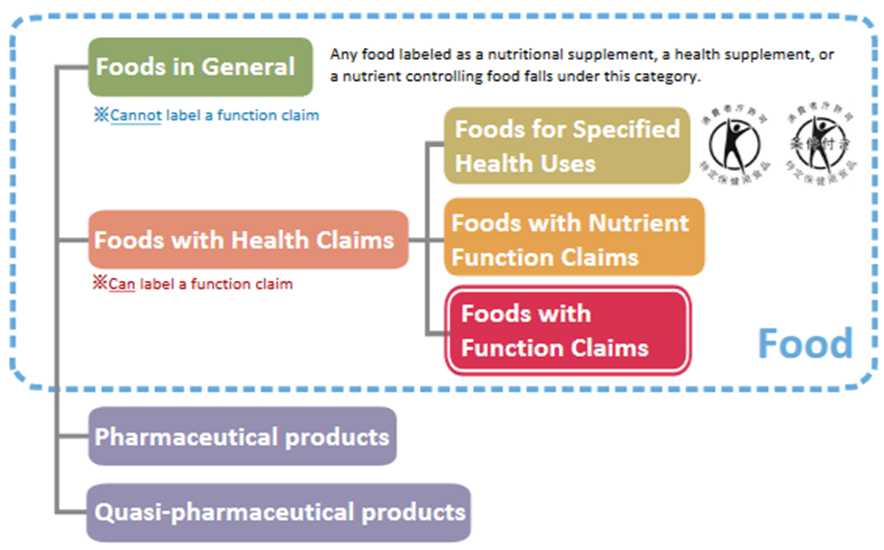
Reference: CAA brochure [5]
Additionally, "Foods with Health Claims" are generally defined as "foods that claim functions of foods according to the standards established by the Japanese government related to safety and functionality".
The CAA gives a general definition of FOSHU as "foods containing a functional ingredient that has physiological effects and claiming that people can expect specific effects on their health by consuming the foods". In order to market a food product as a FOSHU, pre-market approval by the CAA is required.
The CAA gives a general definition of FFC as “foods notified to the CAA as products whose labels bear function claims based on scientific evidence, under the responsibility of food business operators”. In order to market a food product as an FFC, completion of notification to the CAA is required.
5.1.2 List of Prohibited Claims
It is not allowed to make any health claim on food products unless they fall into the categories of FOSHU, FNFC, or FFC by completing the necessary regulatory procedures.
5.2 Nutritional Claims
5.2.1 Permitted Claims
As defined by Article 7 of the Food Labeling Standards (Cabinet Ordinance No. 10 of 2015) [1], the following types of nutrient content claims are permitted for protein, dietary fiber, zinc, potassium, calcium, iron, copper, magnesium, niacin, pantothenic acid, biotin, vitamin A, B1, B2, B6, B12, C, D, E, and K, and folic acid:
- "High in" claims (e.g. "High in protein", "Plenty of Vitamin C")
- "Source of" claims (e.g. "Contain calcium", "Source of dietary fiber")
- "Fortified" claim (e.g. "Vitamin E 30% up", "Double calcium")
The following types of nutrient content claims are permitted for energy, fat, saturated fatty acids, cholesterol, sugars, and sodium:
- "Not-contained" claims (e.g. "Non-sugar", "Calorie zero")
- "Low in" claims (e.g. "Low cholesterol", "Calorie light")
- "Reduced" claims (e.g. "Calorie 30% cut", "Fat 10g off", "Calorie half")
5.2.2 Nutritional Claim Registration
(a) For nutritional claims that are already permitted for use:
No submission is required to make nutrient content claims. Food products can bear a nutrient content claim when they satisfy the prescribed content of the prescribed nutrient (e.g., “high in protein” can be claimed when the product contains 16.2 g of protein per 100 g of the product). Additional details can be seen in the guidance book published by the Tokyo Metropolitan Government [2].
(b) For nutritional claims that are not currently permitted for use:
There is no regulatory process under which food business operators can file a request to the Japanese authorities to add any new nutrient content claims or to change the existing criteria.
5.3 Health Claims
5.3.1 Permitted Claims
FNFC claims can be made when a food product satisfies the prescribed amount of the prescribed nutrient without making a submission to the CAA.
5.3.2 Health Claim Registration
(a) For health claims that are already permitted for use:
FNFC claims can be made when a food product satisfies the prescribed amount of the prescribed nutrient without making a submission to the CAA. Currently, FNFC claims are defined for 13 vitamins, 6 minerals, and 1 fatty acid. For example, a product can bear a claim that “calcium is necessary for the development of bone and teeth” when it contains between 204 – 600 mg of calcium per serving.
Additional details can be seen in the guidance book published by the Tokyo Metropolitan Government [3].
(b) For health claims that are not currently permitted for use:
To make a FOSHU claim, food business operators must file a dossier to the CAA and obtain pre-market approval for each of their finished products. A dossier must contain scientific data that supports the intended FOSHU claim and the safety of the finished product. Additional details can be seen in the guidance document published by the CAA [4].
Similarly, to make an FFC claim, food business operators must complete a notification to the CAA for each of their finished products. Notification documents must contain scientific data that supports the intended FFC claim and the safety of the finished product. Unlike FOSHU, the CAA conducts administrative checks of submitted notifications and accepts them when they pass the administrative check instead of evaluating and granting approval. Under this system, food business operators hold responsibility for FFC claims and the safety of their products. Additional details can be seen in the guidance document published by the CAA [5].
5.4 Other Notes or Requirements for Claims
None.
5.5 References
1. Food Labeling Standards (Cabinet Office Ordinance No. 10 of 2015) (in Japanese)
https://elaws.e-gov.go.jp/document?lawid=427M60000002010
2. Tokyo Metropolitan Government, Section 4 Nutrient Content Claims in Handbook for Nutritional Facts Declaration (in Japanese)
3. Tokyo Metropolitan Government, Section 5 Foods with Nutrient Function Claims in Handbook for Nutritional Facts Declaration (in Japanese)
4. About Approval of FOSHU Products (Shou-Shoku-Hyou No.259 of 2014) (in Japanese)
5. Guideline for Notification of FFC Products (in Japanese)
Was this article helpful?