
Regulatory Status for Use in Cosmetics
- 3 Mins to read
- DarkLight
Regulatory Status for Use in Cosmetics
- 3 Mins to read
- DarkLight
Article summary
Did you find this summary helpful?
Thank you for your feedback
Chondroitin Sulfate Sodium
Japan

This section provides a regulatory assessment for the use of Chondroitin Sulfate Sodium in Cosmetics in Japan.
4.1 Authorized Usage in Cosmetics
Regulatory background on Cosmetics legislation
The Pharmaceuticals and Medical Devices Act also set out the requirements for cosmetics (See section 4.5 - ANNEX 1 -below). Unlike drugs, this Act does not require pre-market authorization by the MHLW on a final cosmetics product or ingredient, but cosmetic business operators must ensure that their products are safe.
Chondroitin Sulfate Sodium
Chondroitin sulfate sodium has been used as a moisturizer in cosmetic products intended for skin care, make-up, body care, and face wash [1]. Therefore, the manufacturer’s Chondroitin sulfate sodium would be allowed for such uses if they come in agreement with final cosmetic product manufacturers.
4.2 Applicable Specifications (including mandatory quality requirements, if any)
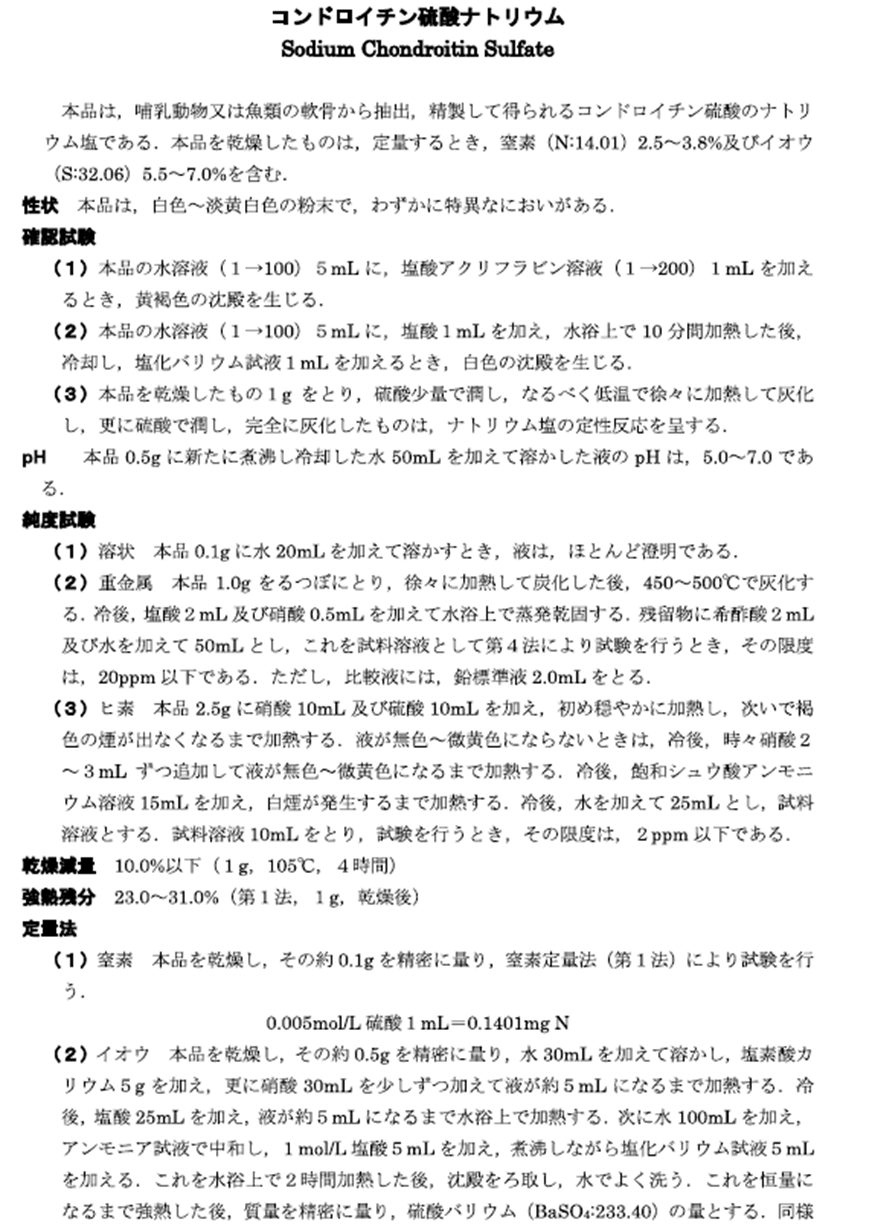
For chondroitin sulfate sodium as a cosmetic ingredient, the MHLW established a specification (See section 4.6 - ANNEX 2 - below), and it is included in the Japanese Standards of Quasi-drug Ingredients (“JSQI”) 2021 [2] which is currently available only in Japanese.
Table 1 compares the main parameters of the JSQI with the specification of the product under consideration. This comparison can not be 100% accurate due to the difference in the analytical method used, and while it is indicated that the product’s manufacturing method (microbial fermentation) does not conform to the JSQI’s definition (extraction from animal soft bone), this does not mean that the product is not allowed for use.
Cosmetics are not subject to pre-market authorization by the MHLW. Final cosmetic product manufacturers can decide which ingredients are used in their products as long as they can ensure that their products conform to the Standards for Cosmetics established by the MHLW [3] and are safe. Conformity with JSQI would help to claim the safety and appropriateness as a cosmetic ingredient, but without such status, the product under consideration can still be used if a final cosmetic manufacturer agrees.
Table 1. Comparison of the Specifications for Chondroitin Sulfate Sodium | ||
Parameter | JSQI 2021 [2] | Product specification |
Definition | This ingredient is a sodium salt of chondroitin sulfate obtained by extracting and purifying the soft bone of mammalian animals or fish | None (obtained by microbial fermentation) |
Assay/content | 2.5 – 3.8% of nitrogen (N: 14.01) and 5.5 – 7.0% of sulfur (S: 32.06) | 95.0 – 105.0% as chondroitin sulfate sodium |
Appearance | White to off-white powder with a characteristic odor | White to off-white powder |
Identification (1) | Yellowish brown precipitate when acriflavine hydrochloride is added | None |
Identification (2) | White precipitate when heated with hydrochloric acid, cooled and then barium chloride is added | None |
Identification (3) | The qualitative reaction of sodium when gradually carbonized at low temperature | None |
pH | 5.0 – 7.0 | 5.5 – 7.5 |
Purity (1) Clarity and color of the solution | Almost clear | NMT 0.35 |
Purity (2) Heavy metals | NMT 20 ppm | NMT 0.002% |
Purity (3) Arsenic | NMT 2 ppm | NMT 1.5 ppm |
Loss on drying | NMT 10.0% | NMT 10.0% |
Residue on ignition | 23.0 – 31.0% | 20.0 – 30.0% |
4.3 Registration Requirements
Similar to the drug ingredients, there is no pre-market registration requirement for cosmetic ingredients. However, Notification of Foreign Cosmetic Manufacturer to the MHLW will be required in order to sell the client’s product as a cosmetic ingredient in Japan (Article 76 of the Order for Enforcement of the Act on Securing Quality, Efficacy, and Safety of Products Including Pharmaceuticals and Medical Devices (Cabinet Order No.11 of 1961) [4]).
4.4 References
1. Cosmetic Ingredients Online – Sodium Chondroitin Sulfate (in Japanese)
https://cosmetic-ingredients.org/humectant/2836/
2. Japanese Standards of Quasi-drug Ingredients (JSQI) 2021 (in Japanese)
https://www.pmda.go.jp/files/000240227.pdf
3. Standards for Cosmetics (Ministry of Health and Welfare Public Notice No. 331 of 2000) (in English)
https://www.mhlw.go.jp/content/000491512.pdf
4. Order for Enforcement of the Act on Securing Quality, Efficacy and Safety of Products Including Pharmaceuticals and Medical Devices (Cabinet Order No.11 of 1961) (in Japanese)
https://elaws.e-gov.go.jp/document?lawid=336CO0000000011
4.5 Annex 1
Categories of Drugs, Cosmetics and Food Products in Japan
Product category | Regulation | Purpose of use | Pre-market regulatory requirement for products | Drug or cosmetic claim or health/function claim | ||
Drug | Prescription drug | Act on Securing Quality, Efficacy and Safety of Products Including Pharmaceuticals and Medical Devices (Act No. 145 of 1960) | Diagnosis, cure, treatment, and prevention of diseases | Approval required | Allowed | |
Over-the-counter (OTC) drug | Approval required | Allowed | ||||
Quasi-drug | To prevent nausea and discomforts, prevent heat rash, soreness, etc. or to encourage hair growth or removing hair | Approval required | Allowed | |||
Cosmetics | To clean, beautify and increase attractiveness, alter the appearance, or keep the skin or hair in good condition | Not required | Allowed to the extent not in conflict with the claims for quasi-drugs | |||
Food | Food with Health Claims (FHC) | Food with Specified Health Uses (FOSHU) | Food Sanitation Act (Act No. 233 of 1947)
Food Labeling Act (Act No. 70 of 2013)
Health Promotion Act (Act No. 103 of 2002) | Maintenance and promotion of health | Approval required | Allowed |
Food with Nutrition Function Claims (FNFC) | Not required but the product must contain the prescribed daily serving of the prescribed nutrients (vitamins and minerals) | Allowed (the prescribed claim for the prescribed nutrients) | ||||
Food with Function Claims (FFC) | Notification required | Allowed | ||||
General food | Food Sanitation Act (Act No. 233 of 1947) Food Labeling Act (Act No. 70 of 2013) | Not defined | Not required | Not allowed | ||
4.6 Annex 2
Sodium chondroitin sulfate specifications from the Japanese Standards of Quasi-drug Ingredients (“JSQI”) 2021 [4]

Was this article helpful?