
4. Labeling Requirements
- 8 Mins to read
- DarkLight
4. Labeling Requirements
- 8 Mins to read
- DarkLight
Article summary
Did you find this summary helpful?
Thank you for your feedback
Mixture of Food Additives
Sri Lanka

This section provides information on labeling requirements and the label approval process.
4.1 Mandatory Labeling Parameters
Category
Food Additives
Specific labeling of food additives is defined under the Food (Additives General) Regulations 2019 [2].
The label printed on or attached to the package or container shall include the common name and INS numbers of the food additives as permitted; and permitted food additives imported, manufactured, sold, transported, distributed, or stored shall include the common names and classes, INS numbers of the food additives and a statement of directions for its storage, if any.
In the case of flavoring substances, it shall be sufficient to state the common name of such food flavoring substance and the specific type of flavor.
When a combination of the same class of additives is present in the final product, the quantity of each such additive shall be expressed as a percentage of the maximum permitted limit of that additive and the total of these percentages shall not exceed a hundred. (Sec 8(2) of [2]).
The labeling of a package or container of a food product containing permitted food additives shall also be in compliance with the provisions of the Food (Labeling and Advertising) Regulations 2005 (Sec 6 of [2]).
The Food (Labeling and Advertising) Regulations (2005) [3] regulate general food labeling in Sri Lanka. The regulations require package or container labeling with the label printed in any two of the three languages (i.e., Sinhala, Tamil, or English). The label must be indelibly printed, painted, or affixed on the main panel (for imports, affixing a supplementary label is permissible). The regulation does not apply to packaged food weighed, counted, and or measured in the consumer’s presence.
The packaging main panel must contain:
- The common name of the contents which must appear in two of the three languages.
- Brand or trade name, if any, in any one or more of the three languages.
- Net contents of the package expressed in international symbols: grams (g); kilograms (kg); milliliters (ml); and or liters (l).
The packaging needs to have on any panel, except in the case of prepacked food products that do not exceed 25 grams, the following in any one or more of the three languages:
- Permitted food additives by name or INS number
- Storage and use instructions
- Name and address of the manufacturer, packer, or distributor in Sri Lanka
- Batch number
- Date of expiry and manufacture (imported bulk food – date of manufacture and repacking) in the format of DD/MM/YY or YY/MM/DD. The expiry date can be on the bottle closure for bottled milk and carbonated milk cans – lid or top/bottom of the can
- List of ingredients by common names in descending order of their proportions
- Country of origin (for imported food)
- For foods treated with ionizing radiation, or utilizing ingredients of the same effect, it must carry a written statement and international symbol in close proximity to the common name of the food.

In addition to the above, under the Food (Irradiation) Regulations – 2005 [6], all packages of irradiated food shall bear the following declaration: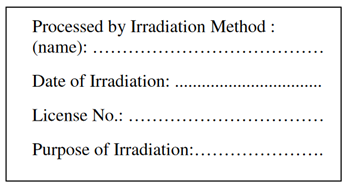
- When an irradiated product is used as an ingredient in another food, such product shall be declared in the list of ingredients.
- When a single ingredient product is prepared from a raw material that has been irradiated, the label of such product shall contain a statement indicating such treatment.
The addition of any ingredient that does not have any natural or added deleterious substance which renders it injurious to health, that is fit for human consumption is permitted [5].
Product
Mixture of Food Additives/Additive Premix
Same as "Category" above. Additionally, the below applies to mixtures of food additives:
It is worth mentioning that for the sale or import of additives premix, besides considering the permissibility of the food additive (including any permitted food additive mixed with any other substance) as an ingredient (B2B) for the preparation of food, it must be dispensed in a container bearing a label in accordance with the requirements similarly as follows (Sec 7 (1) (2) of [2]):
- the common name and the INS number of every permitted food additive present in the preparation in the container; and
- the common name and the INS number, if any, of each other substance present in the preparation in the container.
If two or more such substances are present, the proportion of each permitted food additive and of each other substance present in the preparation of food shall be submitted as given in the technical data sheets, if requested by the Chief Food Authority though quantity declaration is not required.
As a specific example, TBHQ and even citric acid (which can be antioxidants) need to follow the following Labeling Food Antioxidants regulations:
The Food (Antioxidants) Regulations (2009) as amended by the Food (Antioxidants) Amendment Regulations (2013) require the labeling of antioxidants to comply with the provisions of the Food (Labeling and Advertising) Regulations (2005) (Sec 8 of [4]) and every package, or container of food with permitted antioxidants must include a legible label stating the following:
- For each permitted antioxidant, the common or usual name, the appropriate International Numbering System (INS) number, and the percentage of each antioxidant present in the preparation in the container.
- If two or more such substances are present, the proportion of each permitted antioxidant and of each other substance present in the preparation.
4.2 Languages
In general, the languages required are Sinhala, Tamil, and/or English language.
For those label declarations on the main panel following the Food (Labeling and Advertising) Regulations – 2005 [3]:
- the common name of the contents in at least any two of the three languages in boldface type; (accordingly, the declaration can be made in “Sinhala, Tamil or English languages’’);
- brand or trade name if any, in any one or more of the three languages in a manner that shall not mislead any person;
- the net contents of the package or container expressed by the international symbols ‘g’ or ‘kg’ in the case of solids, ‘ml’ or ‘l’ in the case of liquids and, if packaged in a liquid medium, the net drained weight expressed as ‘g’ or ‘kg’.
As mentioned above in Section 4.1, other label declarations on any panel except the main panel shall be in any one or more of the three languages – “Sinhala, Tamil, or English languages”.
4.3 Mandatory Information on Stickers
Usage of supplementary labels (stickers) with the above mandatory labeling information is permitted.
Such supplementary label shall be affixed securely in a manner that it does not distort, deface, or obliterate the original date of manufacture, date of packing, date of expiry, and other information required to be declared by the manufacturer or packer.
A supplementary label conforming to the regulations shall also appear conspicuously and prominently in bold type, in any one or more of the other two languages, indelibly printed or painted or affixed on any other panel of such package or container [3].
The height of the letters used for the common name in the supplementary label shall not be less than one-half of the height of the letters used for the common name on the main panel of the package or container subject to a minimum height of 3 millimeters [3].
4.4 Product Legal Name
“Food Additives”
It is worth mentioning that the text characteristics are as follows [3]:
1. The size of the letters used for the common name shall be not less than one-third of the size of the letters used for the brand name with a minimum height of 3 millimeters. If the common name consists of one word or more than one word such word or words (other than articles, conjunctions, or prepositions) shall be in identical type and size and similarly displayed.
2. The height of the letters used for the common name in the supplementary label as specified in the regulations shall be not less than one-half of the height of the letters used for the common name on the main panel of that package or container subject to a minimum height of 3 millimeters.
4.5 Product-specific Labeling Statements
Category
Food Additives
None.
Product
Mixture of Food Additives/Additive Premix
Same as "Category" above.
4.6 Authority Approval
Category
Food Additives
Product label approval is not in place at present under Sri Lankan laws. It is the responsibility of the trader to abide by the labeling requirements mandated under the Food (Labeling and Advertising) Regulation -2005 [3] and to ensure the food additives used comply with the Food (Additives General) Regulations - 2019 [2] as permitted food additives.
Product
Mixture of Food Additives/Additive Premix
Same as "Category" above.
4.7 Additional Notes on Labeling
The Sri Lankan Food Authority has published the Food (Labeling and Advertising) Regulations 2022 [5], repealing the existing regulation [3], which comes into operation on the 01st of January 2024.
Below are some changes highlighted on the labeling requirements for consideration:
- The common name of the product should be declared in bold type in all three languages.
- Where a label in any one of the three languages has been affixed on an imported package or container of food and a supplementary label conforming to the regulations shall appear conspicuously and prominently in bold type in the other two languages, indelibly printed or painted or securely affixed on such package or container shall be sufficient to satisfy the requirements of these regulations.
- Imported products that are transported to or kept in warehouses authorized by Customs for purposes of compliance with these regulations before Customs clearance are exempted from requirements under the regulation.
- A brand name or a trade name shall be considered deceptive or misleading to a consumer, where it implies directly or indirectly -
- a common name used to identify another food product or category;
- a physiological, biochemical, or psychological function (of food);
- a health effect or an outcome.
- The following declarations shall be made indelibly and legibly on any panel in any one or more of the three languages –
- a complete list of ingredients used in the food by their common names in descending order of ingoing weight (m/m) at the time of manufacture of the food including any permitted food additive by its common name and INS number as prescribed by regulations made under the Act.
- The date of expiry with respect to food contained in a package or a container shall be expressed in terms of –
- day, month, and year;
- year, month, and day; or
- month and year
- Any edible oil (including any refined oil) shall bear clearly and conspicuously, its common name and in close proximity, the source of origin in the same font, size, and color.
4.8 References
http://www.eohfs.health.gov.lk/food/images/pdf/acts/food_act_no26_1980_en.pdf
2. Food (Additives - General) Regulations 2019
http://www.eohfs.health.gov.lk/food/images/pdf/regulations/additive-english.pdf
3. Food (Labelling and Advertising) Regulations 2005
4. Food (Antioxidants) Regulations (2009), Amendment 2013
http://eohfs.health.gov.lk/food/images/pdf/regulations/Antioxident-Regulations-2009.pdf
5. Food (Labelling and Advertising) Regulations 2022
http://eohfs.health.gov.lk/food/images/2319-40_E.pdf
6. Food (Irradiation) Regulations – 2005
http://eohfs.health.gov.lk/food/images/pdf/regulations/food_irradiation_regulations_2005_en.pdf
Was this article helpful?