
4. Labeling Requirements
- 20 Mins to read
- DarkLight
4. Labeling Requirements
- 20 Mins to read
- DarkLight
Article summary
Did you find this summary helpful?
Thank you for your feedback
General Foods
Bolivia

This section provides information on labeling requirements and the label approval process.
4.1 Mandatory Labeling Parameters
4.1.1 Prepackaged
Prepackaged food labels must comply with “points 4.5 and 6 of NB 314001:2015 Labeling of prepackaged foods (Fourth revision)” [1] and with the “Regulation on Labeling of Food Products for Human Consumption” [2].
General Principles
Prepackaged food shall not be described or presented on any label or in any labeling in a manner that is false, misleading, or deceptive or is likely to create an erroneous impression regarding its character in any respect.
If the label is used for a multiple selection of flavors or quantities, it must contain a clear and indelible mark of the product that is on the container.
Prepackaged food shall not be described or presented on any label or in any labeling by words, pictorial, or other devices that refer to or are suggestive either directly or indirectly, of any other product with which such food might be confused, or in such a manner as to lead the purchaser or consumer to suppose that the food is connected with such other product.
Labels in prepackaged foods shall be applied in such a manner that they will not become separated from the container.
All packaging material or labels on the inner face presenting some kind of advertisement (prize, coupons, etc.) and being in direct contact with food must be compatible with it without altering its quality. These materials must be authorized by the competent official health organization; to achieve this, the corresponding endorsements regarding their food grade must be presented.
The inscriptions on labels or labeling must be in clear, visible, easily legible, and durable under normal use. This information should not be disguised by attributes, pictures, or any other written material, printed or graphics, and should appear in a color that contrasts with the background color used.
The area of the main section of the label should be proportional to the size of the label so that the full statement contained therein shall be readily legible under normal viewing conditions.
Font size and number for all items' mandatory labeling will not be less than 1 mm.
If each unit of product is of very small size, with a primary container of less than 25 cm2 that doesn't fit the information required on the label, their label can contain only the name of the product and brand provided that the remaining information is stated on the packaging (secondary container) that contains multiple units of product.
There must be no legend with ambiguous meaning, illustrations or decorations that mislead, or description of product characteristics that can not be verified. They may not hold or claim ownership of prizes, awards, or certificates of any kind, that have not been obtained, and/or recognized by a competent official body.
The labeling may be submitted any information or graphics and written material, printed or graphic, if not inconsistent with the requirements of this Standard and Standard NB 314002:2009 Guidelines for the use of claims, nutritional claims, and health claims [8].
The label or labeling is not required to designate products with geographical names that do not correspond to the region and place of manufacture unless the geographical name is preceded by the words "type" or "style."
It shall not be permitted to attach to food signs therapeutic action, curative than preventive health foods, and special schemes which are approved by the competent authority.
Indications that attribute to the food a therapeutic, curative, or preventive action are not allowed, except for Dietary Foods and Special Diets that are authorized by the competent authority.
Mandatory Labeling of Prepackaged Foods
The following information shall appear on the label of prepackaged foods as applicable to the food being labeled, except to the extent otherwise expressly provided in an individual or specific standard:
- Name of the Food
- Net weight
- Ingredients and additives
- Lot identification
- Marking of date and storage instructions
- Name or company name and address of manufacturer or importer in the case of imported food
- Place and country of origin
- Brand
- Sanitary registration number
- Tax registration code or number
Net Content
The net content shall be declared in the metric system (“System International” units). The net contents shall be declared in the following manner:
- For liquid foods, by volume.
- For solid foods, by weight.
- For semi-solid or viscous foods, either by weight or volume.
- In addition to the declaration of net contents, a food packed in a liquid medium shall carry a declaration in the metric system of the drained weight of the food. For the purposes of this requirement, liquid medium means water, aqueous solutions of sugar and salt, fruit and vegetable juices in canned fruits and vegetables only, or vinegar, either singly or in combination.
- Foods that are packaged in aerosol form must be sold in units of mass and volume.
- Food that due to its main characteristics are commercialized in unit quantities must have quantitative indications referring to the number of units the package contains.
For those products for which net weight can vary because of factors such as environmental differences, after the process of manufacturing, the net weight must be considered at the time of packaging.
The legal units of nominal amount must be written in full or with the mandatory symbols to represent them, preceded by the expressions:
- For mass "Net content", "Cont'd Net ... "," Net weight ... " / Para masa “Contenido neto”, “Cont. Neto…”, “Peso neto…”.
- For the number of units: "Quantities of units ..." "Contains ...," in addition to the net weight (in that case, the net weight is optional) / Para número de unidades: “Cantidad de unidades…”, “Contiene…”, más el peso neto (opcional).
List of ingredients
All ingredients shall be listed in descending order of ingoing weight (m/m) at the time of the manufacture of the food.
The list of ingredients shall be headed or preceded by an appropriate title that consists of or includes the term ‘ingredient’, “elaborated with”, or “elaborated based”.
When an ingredient itself is the product of two or more ingredients, such a compound ingredient may be declared, as such, in the list of ingredients, provided that it is immediately accompanied by a list, in brackets, of its ingredients in descending order of proportion (m/m). Where a compound ingredient (for which a name has been established in a Codex standard or in national legislation) constitutes less than 5% of the food, the ingredients, other than food additives that serve a technological function in the finished product, need not be declared.
The following foods and ingredients are known to cause hypersensitivity and shall always be declared (even if their content is less than 5%):
- Cereals containing gluten; i.e., wheat, rye, barley, oats, spelt, or their hybridized strains and products of these;
- Crustacea and products of these;
- Eggs and egg products;
- Fish and fish products;
- Peanuts, soybeans, and products of these;
- Milk and milk products (lactose included);
- Tree nuts and nut products; and derived products;
- Sulfite in concentrations of 10 mg/kg or more.
In addition, next to the list of ingredients, a declaration must be established in CAPITAL LETTERS and bold with some of the following expressions:
- “THIS PRODUCT CONTAINS…” “CONTAINS…”
- “ESTE PRODUCTO CONTIENE…..” “CONTIENE….”
- “CONTAINS DERIVED FROM…”
- “CONTIENE DERIVADO DE….”
Examples: "THIS PRODUCT CONTAINS SOY". “CONTAINS WHEAT, MILK AND SOY”. CONTAINS DERIVED FROM MILK. ESTE PRODUCTO CONTIENE SOJA “CONTIENE TRIGO, LECHE Y SOJA.”
Except for those ingredients listed in the above paragraph, and unless a general class name would be more informative, the class names that can be used are those listed in Annex A.
Notwithstanding the provision set out in the above paragraph, pork fat, lard, and beef fat shall always be declared by their specific names.
Additives
The use and declaration of food additives should be authorized by the official agency, which must be based on national and international law.
For food additives falling in the respective classes and appearing in lists of food additives permitted for use in foods generally, the following class titles shall be used together with the specific name or recognized numerical identification as required by national legislation.
The following class titles may be used for food additives falling in the respective classes and appearing in lists of food additives permitted generally for use in foods:
- Flavor(s) and Flavoring(s)
- Modified Starch(es)
All food additives carried over into food in a significant quantity or in an amount sufficient to perform a technological function in that food as a result of the use of raw materials or other ingredients in which the additive was used shall be included in the list of ingredients.
A food additive carried over into foods at a level less than that required to achieve a technological function and processing aids are exempted from declaration in the list of ingredients.
Colorants
The label must bear "colored" or "colors", or "artificial color" and/or "natural coloring" using the color code or name of the same, except the yellow No. 5 or tartrazine to be declared as such.
Flavors or flavoring
The label must bear the term "natural flavors or flavoring" and/or "artificial flavoring or flavoring" or else "natural flavor or aroma" and/or "artificial flavor or aroma".
Sweeteners
The "sweeteners" must be declared using the code or the name of the sweetener. The following artificial sweeteners must always be declared as such: "saccharin", "aspartame", and "cyclamates".” Additionally, in the event that any food and/or product contains Aspartame, it must include the legend: "PHENYLKETONURICS: CONTAINS PHENYLALANINE" (debe incluir la leyenda: “FENILCETONÚRICOS: CONTIENE FENILALANINA”).
Other food additives
If additives are added other than those listed above, they must be declared in the ingredient list using the additive code or name.
Lot identification
Each container carrying engraved, marked, or in any other way but indelibly, an indication in code, codes, or in plain language that allows identification of the factory, the lot, or other relevant parameters; the use of special keys or codes must be reported to the Competent Official Body.
For companies that have more than one production factory, the batch identification must clearly identify the manufacturing location (Department) as follows:
- BN: Beni
- CB: Cochabamba
- CH: Chuquisaca
- LP: Peace
- OR: Oruro
- PT: Potosí
- PA: Pando
- SC: Santa Cruz
- TJ: Tarija
If there are companies that have more than one production factory in a single Department, in addition to the identification of the Location, they must use numbers to distinguish the factories from each other.
Date marking and storage instructions
The date marking must be permanent, explicit, and shall follow the implementation of the following provisions:
The deadline for product consumption shall be declared using any of the following expressions:
- "Best until ..." (consumir preferentemente hasta el...)
- "Best before ..." (Consumir preferentemente antes de...)
- "Valid until ..." (Válido hasta…)
- "Validity ..." (Validez...)
- "Expiry date ..." (Vencimiento...)
- "Expiry on ..." (Vence…)
NOTE: The above list does not limit other expressions.
The above expressions shall be accompanied by:
- either the date itself; or
- a reference to where the date is given.
- A print-out made by drilled or permanent marks indicating the month and day or year and month, as appropriate.
The expiry date shall consist at least of:
- the day, the month, and the year for products with a durability of not more than three months;
- the month and the year for products with a durability of more than three months.
The day, month, and year shall be declared in uncoded numerical sequence except that the month may be indicated by 3 first letters.
Durability shall not be required for:
- fresh fruits and vegetables, including potatoes that have not been peeled, cut, or similarly treated;
- wines;
- beverages containing 10% or more by volume of alcohol;
- vinegar;
- food grade salt;
- solid sugars;
- confectionery products consisting of flavored and/or colored sugars;
- chewing gum.
In addition to the minimum date durability, any special conditions for the storage of the food shall be declared on the label if the validity of the date depends thereon.
Name and address
The name and address of the manufacturer, packer, distributor, importer, or legal responsibility of the food within the national territory.
If there are names or company names that include terms such as “organic”, “bio”, “eco”, “ecological”, “natural”, “health”, or “healthy” (In Spanish: “orgánico”, “bio”, “eco”, “ecológico”, “natural”, “sano”, “saludable”) without the products being so, they must include some of the following expressions, clearly and that stands out:
- “This product is not ............” / “Este producto no es .... ”
- “This product is not intended to be” / “Este producto no pretende ser…. ”
Country of origin
The country and place of origin shall be visible on the product label.
All imported food that has not undergone a transformation from its natural state and is packaged in Bolivia, must indicate the following: "Packaged in Bolivia". (Bolivia, debe indicar la siguiente expresión “Envasado en Bolivia”.)
When a food undergoes processing in a second country which changes its nature, the country in which the processing is performed must be regarded as the country of origin for purposes of labeling.
Brand
The brand must be declared on the label. Graphic representation or signs of the trademark can be registered. The nature of the product or service to which it applies shall not be an obstacle to its registration. Other specifications or regulations of relevant entities shall be met by the relevant entities of an existing legislative framework.
As for the brand, the name of products, nutrients, places, or the terms “organic”, “bio”, “eco”, “ecological”, “natural”, “healthy”, or “healthy” may not be used (in Spanish: “orgánico”, “bio”, “eco”, “ecológico”, “natural”, “sano”, “saludable”) without the products being so.
Sanitary Registration Number
It may be declared as follows:
- “Registro Sanitario SENASAG XX-XX-XX-XX-XXXX”
- “R.S. SENASAG XX-XX-XX-XX-XXXX”
The separation of the number may be carried out either through lines, points, or spaces or without them.
Nutritional labeling
In Bolivia, since 2016, Healthy Eating Law 775 establishes, among other things, that the labels of processed products for human consumption include, in addition to nutritional information, a graphic system (traffic light type) on the main panel of the label for nutrients: saturated fat, added sugar, and sodium based on their concentration and according to the following specifications:
- Red Color Bar: assigned for high content components and will have the phrase “VERY HIGH IN…”. “MUY ALTO EN…”
- Yellow Color Bar: assigned for medium concentration components and will have the phrase “MEDIUM IN…” “MEDIO EN…”
- Green Color Bar, is assigned for low components and will have the phrase “LOW IN…” “BAJO EN…”
In addition, the law establishes the parameters according to the concentration levels of said nutrients. However, the law is not implemented through rules or regulations and is therefore not applicable yet [6].
On the other hand, Bolivian Standard NB 314004:2009 Nutritional labeling (First revision) is applicable on a voluntary basis [7].
4.1.2 Not Prepackaged
The labeling of food products intended for final consumption or for hospitality purposes, which are marketed as sold by weight or, where applicable, also in bulk or are in their natural state, must indicate at least the following information [2]:
- Name of the food, nature, and physical condition (if required) (according to the original product)
- Expiration date (according to the original product and if applicable)
- Lot (according to the original product)
- Ingredients (when applicable)
- Company name of the producer, fractionator, and/or packager
Note: the Standard does not specify that allergen declaration is required; however, it is recommend to add it.
Please also see Section 4.7 below on “GMO labeling”.
4.2 Languages
The inscriptions on the labels should be written in Spanish. In the case of import, when the original label is not written in Spanish, instead of putting a new label, an additional label or sticker containing the mandatory information in the Spanish language can be applied. The mandatory information provided should fully and accurately reflect the information contained in the original [1].
4.3 Mandatory Information on Stickers
The application of an additional sticker is acceptable.
Complementary Labeling or sticker is the additional label that is attached to food containers when the original label is presented in a language other than Spanish or when the food business operator wants to include legends, records, and other information required by this standard.
Complementary labels may not modify the list of ingredients, except in cases where a specific ingredient condition is required to be clarified; ingredients may not be increased or eliminated or a new order established; furthermore, they may not modify the name of the product, brand, expiration date, batch number, country of origin, nor data such as name and address of the manufacturer, packer, distributor, importer, exporter or seller of the food [2].
4.4 Product Legal Name
The product shall be named by its specific name, not a generic name, with lettering in outstanding size and color.
When a name or names have been established for a food in a Bolivian standard, at least one of these names shall be used.
In the absence of any such name, either a common or usual name existing by common usage as an appropriate descriptive term that was not misleading or confusing to the consumer shall be used. A common or usual name may be used as long as the name of the specific product also appears on the label.
There shall appear on the label either in conjunction with, or in close proximity to, the name of the food such additional words or phrases as necessary to avoid misleading or confusing the consumer in regard to the true nature and physical condition of the food including but not limited to the type of packing medium, style, and the condition or type of treatment it has undergone; for example: dehydrated, concentrated, reconstituted, smoked [1].
4.5 Product-specific Labeling Statements
N/A. Please refer to Section 4.5 of specific product Guidebooks for product-specific requirements.
4.6 Authority Approval
The product label must be approved by the authorities (SENASAG) [2].
Cost per label: 50 Bs (in the Spanish language) or 100 Bs (in another language) (7.14 or 14.28 USD)
Time:
- Online processing: between 3 to 10 business days.
- In-person processing: between 5 to 15 business days.
Requirements:
a) General Requirements
- Label approval request letter (it is recommended to use the established format)
- Copy of the NIT (tax registration certificate)
- Label model approval request form (Form UIAREGSOL003)
- Affidavit (Form UIAINSPETRLDJUR001)
- Label model (it must be the same one that will be used for marketing), the applicant must present the model per product and, if there are several presentations, each one of them must be attached. Likewise, when a product has several flavor variations, the label of each variation must be presented. The label model may be presented in electronic format according to the established criteria or in physical format.
- Copy of the Health certificate of origin or FSC (in the case of imported products)
b) Specific Requirements
- Organic product certificate issued by the competent authority (in case the product is declared as an organic, ecological, or biological product)
- Certification of awards or recognitions that are declared on the label (if appropriate)
- In the case of products that contain or derive from GMOs, you must attach supporting documents that support such status.
c) Payment of Fee for the Evaluation and Approval Service of the label information content
Process: online or in-person procedure.
- Request for access to the virtual platform.
- Request for information to start the process.
- Filling out and sending online forms and documents or delivering a file with all the requirements.
- Payment for the requested service.
- Evaluation of the information presented.
- Opinion.
- Correction of the request for evaluation of food product labels (in case of observation).
- Registration and printing of the label approval certificate.
- Reception of the digital certificate of approval of food product labels.
Note: The online process is still in the implementation stage by the authority.
4.7 Additional Notes on Labeling
GMO labeling
GMO labeling is applied in accordance with the:
- Regulation on Labeling of Food Products for Human Consumption [2]
- The Technical Regulations for the Labeling of Foods and Products Intended for Human Consumption That Are, Contained or Derived from Organisms Genetically Modified [3]
- List, updated semi-annually, of food species that have GMO events at the international level [4]
All food that is produced, manufactured, imported, and marketed in the Plurinational State of Bolivia, which is, contains, or derives from genetically modified organisms, must contain the following information [3]:
- Legend: “This product is, contains, or is derived from genetically modified material”
- Symbol: Yellow triangle containing the acronym “GMO” and the text “Genetically Modified Organism”
The maximum admissible content is 0.9% of material that is, contains or derives from GMOs, based on the total food or final product without obligation to label.
In the case of import of food or products that are, contain or derive from GMOs, and do not include the required information, the supplier must use complementary labeling including the legend and symbol required in this Regulation.
Specific requirements:
1. The symbol and identification legend of foods and primary and processed products that are, contain or derived from GMOs, must be located on a white background box according to the following specifications:
- Location. It must be placed in a visible place at the top of the food or product label.
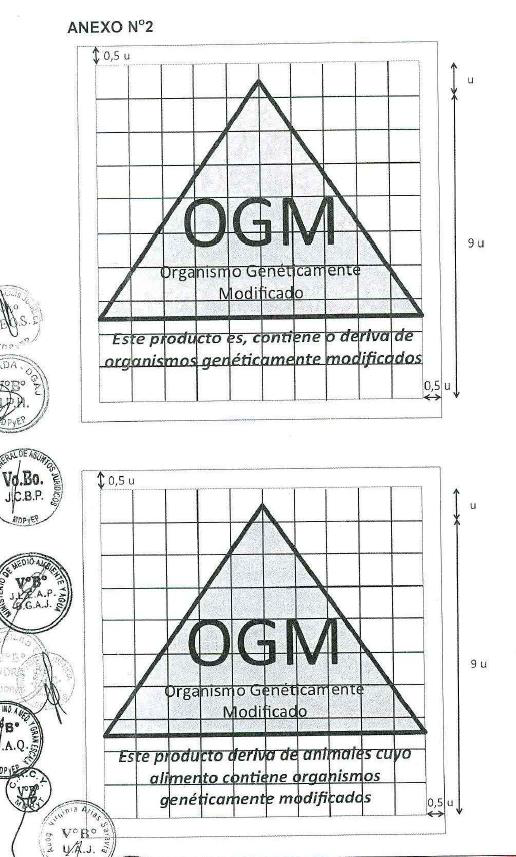
- Size. It must be equal to or greater than 5% of the main face of the label, and must not be less than 1 cm2. The dimensions of the symbol and the legend are detailed in the illustration in Annex N°2.
- Color. symbol must not be camouflaged by attributes, drawings, or any other written, printed, or graphic material.
- Impression. They must be registered in a printed graphic form and not manually on the label and complementary labeling, when applicable.
Symbol. It consists of a triangle with the following characteristics:
- Size. According to Annex No. 2.
- Color. 100% yellow, with a black border.
- Internal text. "GMO" (in the central part) and "Genetically Modified Organism" (in the lower part), in black, with Arial font, according to the dimensions specified in Annex N°2.
Legend. With the following features:
- Size. According to the dimensions specified in Annex No. 2.
- Font. Arial cursive.
- 100% black color.
- Location. Below the base of the triangle and drawn up in a double row according to the dimensions specified in Annex No. 2.
- Text. "This product is, contains, or is derived from genetically modified material." In the case of products of animal origin, the following complementary text must appear: "This product is derived from animals whose food contains genetically modified material."
2. Ingredient information. Processed foods and products must include the following information about ingredients that are, contain, or are derived from a GMO: "Produced from genetically modified (ingredient name)."
Example 1: In a drink based on genetically modified soybeans, the list of ingredients must indicate: "produced from genetically modified soybeans."
Example 2: In a cookie containing lecithin derived from a soybean genetically modified, the list of ingredients must indicate: "produced with lecithin from genetically modified soybeans".
Special requirements:
I. For prepackaged or packaged foods and products whose total packaging surface area is less than 25 cm2, the information required in this Technical Regulation must be declared on the packaging containing several units of the product.
II. The prepackaging or original packaging of foods and products with the characteristics described in the previous paragraph, or that are in bulk, must be displayed visibly and permanently at the point of marketing in order to facilitate the recognition of the labeling determined by this Regulation.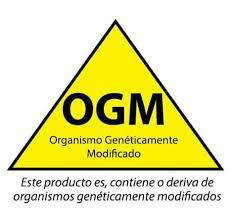
Irradiated food/ingredients
Foods that have been treated with ionizing radiation must be declared "Treated with irradiation" “Tratado con irradiación” on the label. The use of the international symbol indicating that the food has been irradiated is optional, but if used, it must be placed near the name of the product (see Figure 1 below).
Figure 1. Irradiation symbol
When an irradiated food is used as an ingredient in another food, this circumstance must be declared in the list of ingredients.
When a single-ingredient product is prepared from irradiated raw materials, the product label must contain a statement indicating the treatment. [1,2]
Voluntary information
Voluntary information is allowed as long as it does not contradict what is established in current labeling regulations.
Labeling of Organic food
For products called “organic”: the label approval application should include a digital copy of the documentation that proves that the product or raw material and the company have the certification issued by the Certification Body (Third party or through the Participatory Guarantee Systems). In the case of products manufactured in Bolivia, the product must be registered with the National System for Control of Organic Production of SENASAG, in the case of. [2]
Labeling relating to recycling
In the absence of legislation, labeling relating to recycling is voluntary.
Labeling of Halal, Kosher, Vegan, etc.
In Bolivia, there is no regulation for halal or kosher.
Regarding Vegan labeling, the voluntary standard “NB/ISO 23662:2021 Definitions and technical criteria for foods and food ingredients suitable for vegetarians or vegans and for labeling and declaration” can be followed. [5]
4.8 References
1. NB 314001:2015 Labeling of prepackaged foods (Fourth revision) – IBNORCA
https://www.ibnorca.org/tienda/catalogo/detalle-norma/nb-314001:2015-nid=954-3
2. RA N° 042 / 2023 Regulation on Labeling of Food Products for Human Consumption - SENASAG
3. Technical Regulations for the Labeling of Foods and Products Intended for Human Consumption That Are, Contained or Derived from Organisms Genetically Modified
REGLAMENTO OGM segun D.S. 2452.pdf (PDF attached below)
4. List, updated semi-annually, of food species that have GMO events at the international level, for inclusion in “Annex No. 3 and Annex No. 4 of the Technical Regulations for the Labeling of Foods and Products Intended for Human Consumption That Are, Contain or Derived from Organisms Genetically Modified”
Actualización Lista OGM_052024.pdf (PDF attached below)
5. NB/ISO 23662:2021 Definitions and technical criteria for foods and food ingredients suitable for vegetarians or vegans and for labeling and declaration – IBNORCA (voluntary standard)
https://www.ibnorca.org/tienda/catalogo/detalle-norma/nb/iso-23662:2021-nid=3675-3
6. Ley 775 de Alimentación Saludable: Etiquetado de nutrientes críticos, etiquetado nutricional
https://www3.paho.org/bol/dmdocuments/Ley775gaceta.pdf
7. NB 314004:2009 Nutritional labeling (First revision) - – IBNORCA (voluntary standard)
https://www.ibnorca.org/tienda/catalogo/detalle-norma/nb-314004:2009-nid=957-3
8. Standard NB 314002:2009 Guidelines for the use of claims, nutritional claims and health claim
https://www.ibnorca.org/tienda/catalogo/detalle-norma/nb-314002:2009-nid=955-3
Was this article helpful?