
4. Labeling Requirements
- 19 Mins to read
- DarkLight
4. Labeling Requirements
- 19 Mins to read
- DarkLight
Article summary
Did you find this summary helpful?
Thank you for your feedback
General Foods
Spain

This section provides information on labeling requirements and the label approval process.
4.1 Mandatory Labeling Parameters
A. Prepackaged
As an EU Member State, Spain has adopted the harmonized Regulation (EU) No. 1169/2011 of October 25, 2011 [1], on food information provided to consumers. In addition, the batch declaration, according to the local complementary provisions on food labeling must be declared.
Indication of the following particulars is mandatory:
(a) The name of the food (Art 17)
The name of the food shall be its legal name. In the absence of such a name, the name of the food shall be its customary name. The name of the food should be in the same field of vision as the net quantity.
b) The list of ingredients (Art 18)
The list of ingredients shall be headed or preceded by a suitable heading that consists of or includes the word ‘ingredients’. It shall include all the ingredients of the food, in descending order of weight, as recorded at the time of their use in the manufacture of the food. Ingredients shall be designated by their specific name, where applicable, in accordance with the rules laid down in Article 17 and in Annex VI (laying down provisions regarding the name of the food and specific accompanying particulars).
Specific rules regarding the indication and designation of ingredients are laid down in Annex VII. See also ANNEX VII of the FIC Regulation.
Processing aids do not need to be added to labeling if they serve no technological function.
(c) Allergens (Art 21)
Any ingredient or processing aid listed in Annex II of the Regulation or derived from a substance or product listed in Annex II causing allergies or intolerances used in the manufacture or preparation of a food and still present in the finished product, even if in an altered form shall be emphasized through a typeset that clearly distinguishes it from the rest of the list of ingredients, for example by means of the font, style or background color.
ANNEX II
SUBSTANCES OR PRODUCTS CAUSING ALLERGIES OR INTOLERANCES
- Cereals containing gluten, namely: wheat (such as spelt and khorasan wheat), rye, barley, oats or their hybridized strains, and products thereof, except:
- wheat-based glucose syrups including dextrose*;
- wheat-based maltodextrins* ;
- glucose syrups based on barley;
- cereals used for making alcoholic distillates including ethyl alcohol of agricultural origin;
- Crustaceans and products thereof;
- Eggs and products thereof;
- Fish and products thereof, except:
- fish gelatine used as carrier for vitamin or carotenoid preparations;
- fish gelatine or Isinglass used as fining agent in beer and wine;
- Peanuts and products thereof;
- Soybeans and products thereof, except:
- fully refined soybean oil and fat*;
- natural mixed tocopherols (E306), natural D-alpha tocopherol, natural D-alpha tocopherol acetate, and natural D-alpha tocopherol succinate from soybean sources;
- vegetable oils derived phytosterols and phytosterol esters from soybean sources;
- plant stanol ester produced from vegetable oil sterols from soybean sources;
- Milk and products thereof (including lactose), except:
- whey used for making alcoholic distillates including ethyl alcohol of agricultural origin;
- lactitol;
- Nuts, namely: almonds (Amygdalus communis L.), hazelnuts (Corylus avellana), walnuts (Juglans regia), cashews (Anacardium occidentale), pecan nuts (Carya illinoinensis (Wangenh.) K. Koch), Brazil nuts (Bertholletia excelsa), pistachio nuts (Pistacia vera), macadamia or Queensland nuts (Macadamia ternifolia), and products thereof, except for nuts used for making alcoholic distillates including ethyl alcohol of agricultural origin;
- Celery and products thereof
- Mustard and products thereof;
- Sesame seeds and products thereof;
- Sulphur dioxide and sulphites at concentrations of more than 10 mg/kg or 10 mg/litre in terms of the total SO2 which are to be calculated for products as proposed ready for consumption or as reconstituted according to the instructions of the manufacturers;
- Lupin and products thereof;
- Molluscs and products thereof.
*And the products thereof, in so far as the process that they have undergone is not likely to increase the level of allergenicity assessed by the Authority for the relevant product from which they originated.
(d) The quantity of certain ingredients or categories of ingredients (Art 22)
This shall be required where the ingredient or category of ingredients concerned: appears in the name of the food or is usually associated with that name by the consumer; is emphasized on the labeling in words, pictures, or graphics; or is essential to characterize a food and to distinguish it from products with which it might be confused because of its name or appearance. See also Annex VIII.
(e) The net quantity of the food (Art 23)
This shall be expressed using liters, centiliters, milliliters, kilograms, or grams, as appropriate. See also Annex IX
(f) The date of minimum durability or the ‘use by’ date (Art 24)
Specificities about how to declare this date are described in Annex X of the Regulation.
(g) Any special storage conditions and/or conditions of use (Art 25) where appropriate
(h) The name and address of the food business operator
i.e. the operator under whose name or business name the food is marketed or, if that operator is not established in the Union, the importer into the Union market (Art 8).
(i) The country of origin or place of provenance
Failure to indicate this might mislead the consumer as to the true country of origin or place of provenance of the food (Art 26). See also Annex XI. Where the origin of a food is given and is different from the one of its primary ingredient, the origin of the primary ingredient shall be given or at least indicated as being different from the origin of the food.
(j) Instructions for use where it would be difficult to make appropriate use of the food in the absence of such instructions (Art 27).
(k) The actual alcoholic strength by volume for beverages containing more than 1,2 % by volume of alcohol (Art 28).
(l) A nutrition declaration (Art 29 - 36)
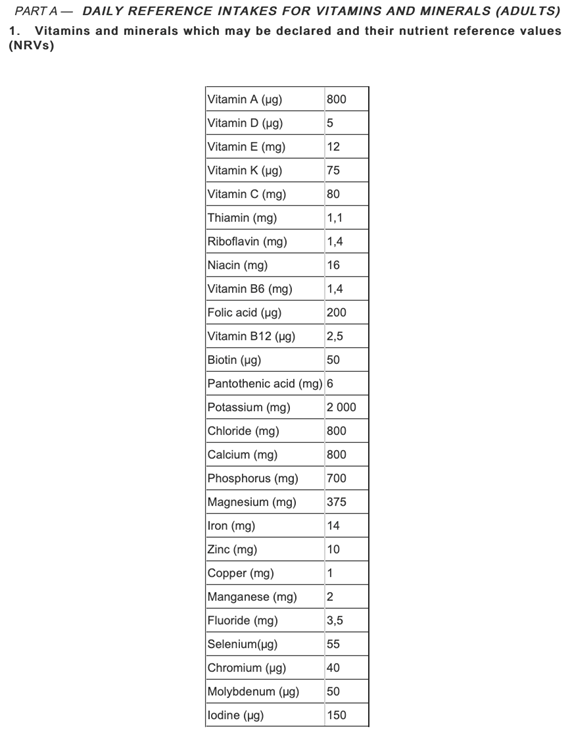
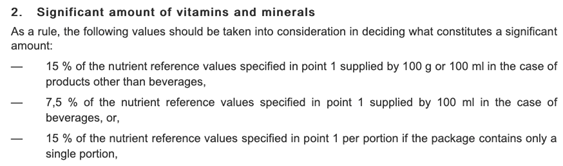
Except for food supplements and mineral waters which gave their own Nutrition declaration provisions, and except for food described in Annex V. Mandatory nutrition declaration must include all the following particulars (Art 30): energy value and the amounts of fat, saturates, carbohydrate, sugars, protein and salt. The declaration may be supplemented with an indication of the amount of mono-unsaturated, polyunsaturates, polyols, starch, fiber, or any vitamins or minerals and present in significant amounts (as described in points 1 and 2 respectively of Part A of Annex XII of the Regulation).
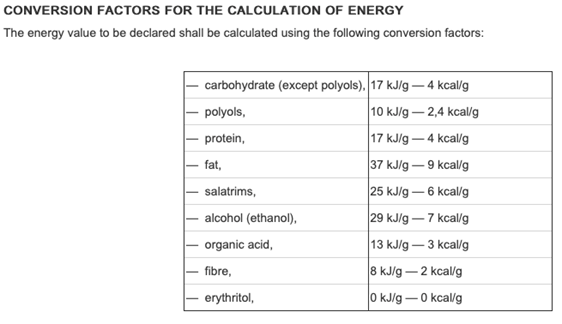
The energy value (calculated using the conversion factors listed in Annex XIV) and the amounts of nutrients shall be those of the food as sold. Where appropriate, the information may relate to the food after preparation, provided that sufficiently detailed preparation instructions are given and the information relates to the food as prepared for consumption (Art 31.3).
- The energy value and the amount of nutrients shall be expressed per 100 g or per 100 ml using the measurement units listed in Annex XV.
- Vitamins and minerals shall be expressed as a percentage of the reference intakes (RI).
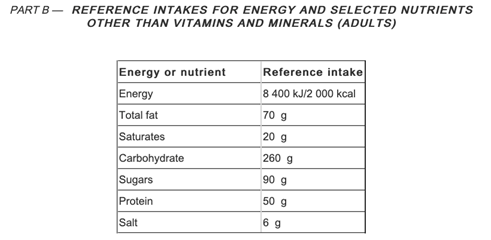
- The energy value and the amounts of fat, saturates, sugars, and salt may be too (RIs are defined in Part A of Annex XIII). In the case of the latter, the following additional statement shall be indicated in close proximity to it: ‘Reference intake of an average adult (8 400 kJ/2 000 kcal)’.
In addition to (in some cases: instead of) the expression per 100g or 100ml, the energy value and the amounts of nutrients may be expressed per portion and/or per consumption unit, easily recognizable by the consumer, provided that the portion or the unit used is quantified on the label and that the number of portions or units contained in the package is stated.
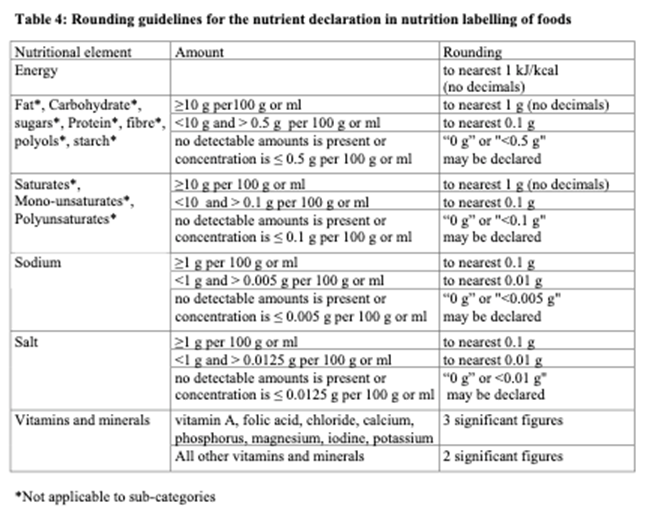
Rounding rules are described in a Guidance from the European Commission [2]:
Tolerances are also provided in this Guidance
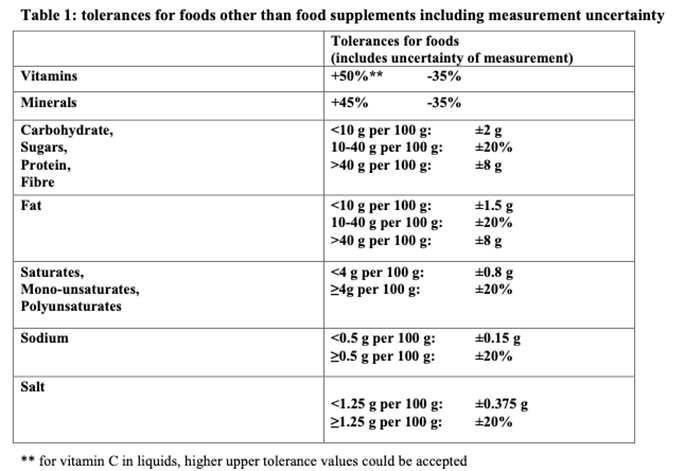
Note: For the nutrition declaration of nutrients for which a nutrition or health claim is made according to Regulation 1924/2006/EC, as well as for added vitamins and minerals according to Regulation 1925/2006/EC, different tolerances may apply which are specified in section 5 of the EC guidance.
(j) The batch information
According to Article 12 of Royal Decree 1808/1991 of 13 December 1991 [3], which regulates the indications or marks used to identify the batch to which a foodstuff belongs, this information shall be declared as follows:
- The batch shall be determined, in each case, by a producer, the manufacturer, or the packer of the foodstuff concerned, or by the first seller established within the EEC.
- The indication of the batch shall be determined and placed under the responsibility of these operators. It shall be preceded by the letter "L", except in cases where it is clearly distinguishable from the other indications on the labeling.
- Where foodstuffs are packaged, the indication of the batch and, where appropriate, the letter "L" shall appear on the packaging or on a label attached to the packaging.
- Exception: When the expiry date appears on the labeling, the indication of the batch may be omitted from the foodstuff, provided that the date is at least the day and the month clearly indicated in order.
B. NOT Prepackaged
Food presented in unpackaged form and food packaged at the place of sale at the request of the purchaser shall comply with those provisions established in Royal Decree 126/2015 of 27 February 2015 [4] approving the general rule on food information on foodstuffs presented unpackaged for sale to the final consumer.
According to Article 4 of this regulation, mandatory food information for foods presented unpackaged for sale to the final consumer and to mass caterers and for foods packed at the place of sale at the request of the purchaser shall include at least the following particulars:
(a) The name of the food:
As laid down in Article 17 of Regulation (EU) No 1169/2011. That name shall be accompanied, where appropriate, by the additional mandatory particulars for specific categories or types of food referred to in points 1, 2, 3, and 4 of Annex III to that Regulation.
(b) Allergen declaration:
As referred to in Article 9(1)(c) of Regulation (EU) No 1169/2011 “any ingredient or processing aid listed in Annex II or derived from a substance or product listed in Annex II causing allergies or intolerances used in the manufacture or preparation of a food and still present in the finished product, even if in an altered form”. This indication shall not be necessary in cases where the name of the food clearly refers to the substance or product concerned.
(c) The quantity of an ingredient or category of ingredients:
In accordance with Article 22 of Regulation (EU) No 1169/2011.
(d) The alcoholic strength:
By volume of beverages containing more than 1,2 % by volume.
(e) Other requirements:
As may be laid down for this form of sale by the relevant national and European Union provisions.
Final consumer packaging or pre-packaged products containing GMOs should be labeled: ‘This product contains genetically modified organisms’ or ‘This product contains genetically modified [name of organism(s)]’
This requirement does not apply to products containing traces of authorized GMOs in a proportion no higher than 0,9 % or lower thresholds established under the provisions of Article 30(2), provided that these traces are adventitious or technically unavoidable.
In order to establish that the presence of this material is adventitious or technically unavoidable, operators must be in a position to supply evidence to satisfy the competent authorities that they have taken appropriate steps to avoid the presence of such material.
D. Irradiated food/ingredients [7]
In the case of products intended for the ultimate consumer and mass caterers:
- if the products are sold as items, the words ‘irradiated’ or ‘treated with ionizing radiation’ shall appear on the label.
- if an irradiated product is used as an ingredient, the same words shall accompany its designation in the list of ingredients.
- the same words shall be required in order to indicate the irradiated ingredients used in compound ingredients in foodstuffs, even if these constitute less than 25 % of the finished product;
The indication of treatment shall in all cases be given on the documents which accompany or refer to irradiated foodstuffs.
Additional mandatory particulars for specific types or categories of foods are laid down in Annex III according to Art 10 of Regulation (EU) No 1169/2011, such as:
- Foods packaged in certain gases
- Foods containing sweeteners
- Foods containing glycyrrhizinic acid or its ammonium salt
- Beverages with high caffeine content or foods with added caffeine
- Foods with added phytosterols, phytosterol esters, phytostanols, or phytostanol esters
- Frozen meat, frozen meat preparations, and frozen unprocessed fishery products
4.2 Languages
Article 15 [1]
1. Mandatory food information shall appear in a language easily understood by the consumers of the Member States where a food is marketed.
2. Within their own territory, the Member States in which a food is marketed may stipulate that the particulars shall be given in one or more languages from among the official languages of the Union.
3. Paragraphs 1 and 2 shall not preclude the particulars from being indicated in several languages.
In Spain, Royal Decree 1334/1999 of 31 July 1999 [8], establishes the mandatory information on the labeling. It is worth mentioning that it is partially revoked, being only the articles related to language and batch declaration are still in force. According to Article 18 of this decree, the information on the label of foodstuffs marketed in Spain shall be expressed, at least, in the official Spanish language of the State. As well as, for unpackaged foods, Article 10 of Royal Decree 126/2015 establishes the same provision (in Spanish language).
4.3 Mandatory Information on Stickers
Acceptable mandatory information on a sticker (Article 13) [1].
4.4 Product Legal Name
Article 17 [1]
1. The name of the food shall be its legal name. In the absence of such a name, the name of the food shall be its customary name, or, if there is no customary name or the customary name is not used, a descriptive name of the food shall be provided.
2. The use in the Member State of marketing of the name of the food under which the product is legally manufactured and marketed in the Member State of production shall be allowed. However, where the application of the other provisions of this Regulation, in particular those set out in Article 9, would not enable consumers in the Member State of marketing to know the true nature of the food and to distinguish it from foods with which they could confuse it, the name of the food shall be accompanied by other descriptive information which shall appear in proximity to the name of the food.
3. In exceptional cases, the name of the food in the Member State of production shall not be used in the Member State of marketing when the food which it designates in the Member State of production is so different, as regards its composition or manufacture, from the food known under that name in the Member State of marketing that paragraph 2 is not sufficient to ensure, in the Member State of marketing, correct information for consumers.
4. The name of the food shall not be replaced with a name protected as intellectual property, brand name, or fancy name.
5. Specific provisions on the name of the food and particulars that shall accompany it are laid down in Annex VI. For the product under scope, those are (Annex VI PART A):
1. The name of the food shall include or be accompanied by particulars as to the physical condition of the food or the specific treatment which it has undergone (for example, powdered, refrozen, freeze-dried, quick-frozen, concentrated, smoked) in all cases where the omission of such information could mislead the purchaser.
5. In the case of meat products, meat preparations, and fishery products containing added proteins as such, including hydrolyzed proteins, of a different animal origin, the name of the food shall bear an indication of the presence of those proteins and of their origin.
6. In the case of meat products and meat preparations that have the appearance of a cut, joint, slice, portion, or carcass of meat, the name of the food shall include an indication of the presence of added water if the added water makes up more than 5 % of the weight of the finished product. The same rules shall apply in the case of fishery products and prepared fishery products that have the appearance of a cut, joint, slice, portion, filet, or whole fishery product.
7. Meat products, meat preparations, and fishery products which may give the impression that they are made of a whole piece of meat or fish, but actually consist of different pieces combined together by other ingredients, including food additives and food enzymes or by other means, shall bear the following indication: in English: ‘formed meat’ and ‘formed fish’ (other languages are described in legislation [1]).
4.5 Product-specific Labeling Statements
Please refer to Section 4.5 of product-specific guidebooks for product-specific requirements.
4.6 Authority Approval
N/A
Food in general is not subject to label authorization as such. Those coming from the EU to be marketed in the country are subject to notification (the first time), a process in which a copy of the food label must be submitted together with the market access requirements. Foods produced in third countries (non-EU) are subject to import controls where evidence of compliance with the food legislation, including labeling rules, must be provided.
4.7 Additional Notes on Labeling
Presentation of Mandatory Particulars [1]:
- Mandatory food information shall appear directly on the package or on a label attached thereto (Art 12.2)
- Mandatory food information shall be marked in a conspicuous place in such a way as to be easily visible, clearly legible, and, where appropriate, indelible. (Art 13.1)
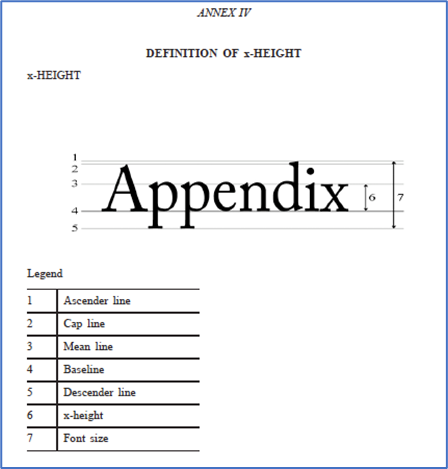
- The mandatory particulars shall be printed on the package or on the label in such a way as to ensure clear legibility, in characters using a font size where the x-height, as defined in Annex IV, is equal to or greater than 1,2 mm. (Art 13.2)
Voluntary Information [1]
Business operators can include as much voluntary information as they want, provided it is not false or misleading (Art 36); however, they cannot do so at the expense of mandatory information.
Labeling of Organic food
Only products satisfying the requirements set out in the Regulation may be labeled as organic or any other term listed in various languages in the Annex such as “bio” or “eco” (Art 23) or use the Community organic production logo (Art 25) [9].
Processed foods can be labeled with the term “organic” or a similar term provided they comply with the requirements set out in the Regulation and at least 95% % by weight, of its ingredients of agricultural origin are organic.
Mandatory indication
1. The label of Organic food must bear:
- the code number of the control authority or control body to which the operator that carried out the last production or preparation operation is subject; and
- in the case of prepacked food, the organic production logo of the European Union shall also appear on the packaging (except in cases referred to in Article 30(3) and points (b) and (c) of Article 30(5)).
2. Where the organic production logo of the European Union is used, an indication of the place where the agricultural raw materials of which the product is composed have been farmed shall appear in the same visual field as the logo and shall take one of the following forms, as appropriate:
- ‘EU Agriculture’, where the agricultural raw material has been farmed in the Union;
- ‘non-EU Agriculture’, where the agricultural raw material has been farmed in third countries;
- ‘EU/non-EU Agriculture’, where a part of the agricultural raw materials has been farmed in the Union and a part of it has been farmed in a third country.
For the purposes of the first subparagraph, the word ‘Agriculture’ may be replaced by ‘Aquaculture’ where appropriate, and the words ‘EU’ and ‘non-EU’ may be replaced or supplemented by the name of a country, or by the name of a country and a region, if all of the agricultural raw materials of which the product is composed have been farmed in that country and, if applicable, in that region.
For the indication of the place where the agricultural raw materials of which the product is composed have been farmed, as referred to in the first and third subparagraphs, small quantities by weight of ingredients may be disregarded, provided that the total quantity of the disregarded ingredients does not exceed 5 % of the total quantity by weight of agricultural raw materials.
The words ‘EU’ or ‘non-EU’ shall not appear in color, size, or style of lettering that is more prominent than the name of the product.
Organic production logo of the European Union
- The organic production logo of the European Union may be used in the labeling, presentation, and advertising of products that comply with this Regulation.
- The use of the organic production logo of the European Union shall be optional for products imported from third countries.
- The organic production logo of the European Union shall comply with the model below (may also be used in black and white):

- National logos and private logos may be used in the labeling, presentation, and advertising of products that comply with this Regulation.
Code numbers: The general format of the code numbers shall be as follows: AB-CDE-999.
Further details on the requirements for the logo and the code are laid down in Annex V of the organic food regulation [9].
Labeling Relating to Recycling
Plastic Recycling Symbol
The Mobius loop (sometimes known as “the chasing arrows”), is found on products throughout Europe and indicates that the product can be recycled. As well as being used on printed packaging, the chasing arrows symbol is sometimes featured in the molds of glass, metal, paper, or plastic products.
The Mobius loop with a number at the center and a letter code indicates the type of plastic the packaging is made from. The symbol is an example of how a plastic type may be indicated on a product. As part of the EU voluntary identification system for plastics, according to the following marks are used for the most common types of plastics [10]:
Table: Commonly Used Types of Plastics
EU Number | Abbreviated Description | Full Plastic Description |
1 | PET | Polyethylene Terephthalate |
2 | HDPE | High Density Polyethylene |
3 | PVC | Poly Vinyl Chloride |
4 | LDPE | Low-Density Polyethylene |
5 | PP | Polypropylene |
6 | PS | Polystyrene |
Labeling of Halal, Kosher, Vegan, etc. [1]
No rules are defined in legislation at the EU level for such labeling. The use of these sorts of labeling is conferred by private certification systems/bodies. In general, the use of this sort of labeling shall follow Article 36 from the harmonized Regulation (EU) No. 1169/201 for voluntary food information:
“(a) it shall not mislead the consumer, as referred to in Article 7;
(b) it shall not be ambiguous or confusing for the consumer; and
(c) it shall, where appropriate, be based on the relevant scientific data.”
4.8 References
1. Regulation 1169/2011 on the provision of food information to consumers
https://eur-lex.europa.eu/legal-content/EN/TXT/?uri=CELEX%3A02011R1169-20180101
2. Source: Guidance Document for competent authorities for the control of compliance with EU legislation on regulation (EU) 1169/2011
3. Royal Decree 1808/1991 of 13 December 1991, which regulates the indications or marks used to identify the batch to which a foodstuff belongs
https://www.boe.es/diario_boe/txt.php?id=BOE-A-1991-30678
4. Royal Decree 126/2015 of 27 February 2015 approving the general rule on food information on foodstuffs presented unpackaged for sale to the final consumer and to mass caterers, foodstuffs packaged at the point of sale at the request of the purchaser, and foodstuffs packaged by retail trade operators
https://www.boe.es/diario_boe/txt.php?id=BOE-A-2015-2293
5. Consolidated Regulation (EC) No 1830/2003 of the European Parliament and of the Council of 22 September 2003 concerning the traceability and labelling of genetically modified organisms and the traceability of food and feed products produced from genetically modified organisms and amending Directive 2001/18/EC
https://eur-lex.europa.eu/legal-content/EN/TXT/PDF/?uri=CELEX:02003R1830-20190726&from=EN
6. Consolidated text: Regulation (EC) No 1829/2003 of the European Parliament and of the Council of 22 September 2003 on genetically modified food and feed
https://eur-lex.europa.eu/legal-content/EN/TXT/?uri=CELEX%3A02001L0018-20210327
7. Consolidated text: Directive 1999/2/EC of the European Parliament and of the Council of 22 February 1999 on the approximation of the laws of the Member States concerning foods and food ingredients treated with ionising radiation
https://eur-lex.europa.eu/legal-content/EN/TXT/?uri=CELEX%3A01999L0002-20081211
8. Royal Decree 1334/1999 of 31 July 1999, approving the general rules on labelling, presentation, and advertising of foodstuffs (repealed with the exception of Article 12 on the lot and Article 18 on the language of labelling)
https://www.boe.es/buscar/doc.php?id=BOE-A-1999-17996
9. Regulation (EU) 2018/848 of the European Parliament and of the Council of 30 May 2018 on organic production and labelling of organic products and repealing Council Regulation (EC) No 834/2007
https://eur-lex.europa.eu/legal-content/EN/TXT/?uri=celex%3A32018R0848
10. Commission Decision 97/129/EC of 28 January 1997 establishing the identification system for packaging materials pursuant to European Parliament and Council Directive 94/62/EC on packaging and packaging waste
https://eur-lex.europa.eu/legal-content/EN/TXT/?uri=celex%3A31997D0129
Was this article helpful?