
4. Labeling Requirements
- 4 Mins to read
- DarkLight
4. Labeling Requirements
- 4 Mins to read
- DarkLight
Article summary
Did you find this summary helpful?
Thank you for your feedback
Foods for Specified Health Uses (FOSHU)
Japan

This section provides information on labeling requirements and the label approval process.
4.1 Mandatory Labeling Parameters
General Food
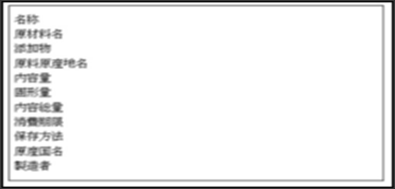
A) Processed foods shall bear the following labeling items and shall be presented in the same table in the following order according to Article 8 and Appended Form 1 of the Food Labeling Standards:
- Product generic name
- List of ingredients (in decreasing order of weight)
- List of additives (in a decreasing order of weight including processing aids unless exempted)
- Net quantity
- Expiry date (use-by date or best-before date)
- Storage conditions
- Country of origin (applicable for imported products)
- Name of food business operator (manufacturer, processor, distributor, or importer)
- Nutrition declaration table (per 100 g, 100 ml, serving, etc.)
- Other labeling items are required on a case-by-case basis by the Food Labeling Standards
The nutrition declaration table shall be prepared according to Article 8 and Appended Form 2 of the Standards. The nutrition declaration shall include the following mandatory information:
- Unit (100 g, 100 ml, serving, etc.)
- Energy (kcal)
- Protein (g)
- Fat (g)
- Carbohydrates/ (g)
- Salt equivalent (g)
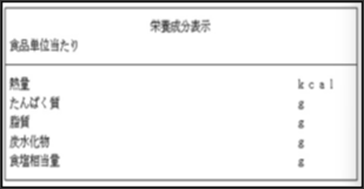
The 5 macronutrients are mandatory for all processed foods, with some exemptions (e.g., the surface area for label indication is 30 cm2 or smaller, alcoholic beverages, foods of which nutritional contribution is very limited such as coffee beans and its extract, herbs and its extracts).
Note: The % of RDI is mandatory for FNFC, but not required for the other foods including general foods and FFC/FOSHU.
Declaration of other nutrients described below is optional but when doing so, there is a specific way required by the regulation.
The contents of the following nutrients can be included in the above table (Article 8 and Appended Form 3). When doing so, cholesterol shall be presented after fat and before carbohydrates. Saturated fatty acid, n-3 fatty acid, and n-6 fatty acid shall be presented as a breakdown of fat. The trans fatty acid can be declared after n-6 fatty acid. Similarly, sugar and dietary fiber shall be presented as a breakdown of carbohydrates. Mono- and di-saccharides shall be presented as a breakdown of sugar. The other ‘optional’ nutrients (i.e., vitamins and minerals) shall be presented after the salt equivalent.
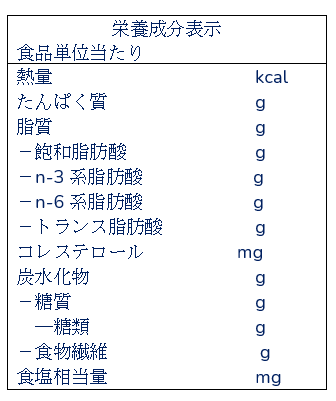
- Unit (100 g, 100 ml, serving, etc.)
- Energy (kcal)
- Protein (g)
- Fat (g)
- Saturated fatty acid (g)
- n-3 fatty acid (g)
- n-6 fatty acid (g)
- Trans fatty acid (g)
- Cholesterol (mg)
- Carbohydrates (g)
- Sugar (g)
- Mono- and di-saccharides (g)
- Dietary fiber (g)
- Salt equivalent (g)
- (vitamins and minerals (mg or µg))
The contents of any other food constituents that are not specified in the Food Labeling Standards (e.g., polyphenol, catechin, be-ta carotin, DHA) can be declared, but they shall be presented, for example, outside of the nutritional declaration table so that consumers can easily understand that they are not the nutrients specified by the Standards.
B) Fresh foods (agricultural products, meat products, and seafood) shall bear the following labeling items:
- Product generic name
- Place of origin
- Other labeling items are required on a case-by-case basis by the Food Labeling Standards
Category
In addition to the mandatory items listed under "General Foods", the following items are required for FOSHU products (the words and sentences in brackets are the precise statements that FOSHU products must bear on their package):
- Food classification (“特定保健用食品” or “条件付き特定保健用食品” meaning “FOSHU” or “Qualified FOSHU”)
- FOSHU mark (see Figure 4.4-1 below)
- FOSHU claim (as approved)
- Nutrition declaration table for the mandatory 5 macronutrients and the content of the functional ingredient (per 100 g, 100 ml, per serving, per unit, etc.)
- Recommended daily intake (as approved)
- Directions for use (as approved)
- Warnings for use (as approved)
- Notes for healthy eating (“食生活は、主食、主菜、副菜を基本に、食事のバランスを。 “バランスを。” (EN: “A balanced diet is based on staple foods, main dishes, and side dishes.")
- % of the contained functional ingredient against the Nutrients Labelling Standard Values (Table 4.1-1) (if the functional ingredient is the nutrient for which a Nutrient Labeling Standard Value is established)
- Instructions for cooking and/or storage (as approved, if applicable)

Figure 4.1-1 FOSHU marks: FOSHU mark (left) - Qualified FOSHU (right)
Table 4.1-1 Nutrition Labeling Standard Values (calculated for the Japanese of 18 years old or older)
Nutrient | Nutrition Labeling Standard Value |
Protein | 81 g |
Fat | 62 g |
Saturated fat | 16 g |
n-3 fatty acid | 2.0 g |
n-6 fatty acid | 9.0 g |
Carbohydrate | 320 g |
Dietary fiber | 19 g |
Zinc | 8.8 mg |
Potassium | 2800 mg |
Calcium | 680 mg |
Chromium | 10 µg |
Selen | 28 µg |
Iron | 6.8 mg |
Copper | 0.9 mg |
Sodium | 2900 mg |
Magnesium | 320 mg |
Manganese | 3.8 mg |
Molybdenum | 25 µg |
Iodine | 130 µg |
Phosphorous | 900 mg |
Niacin | 13 mg |
Pantothenic acid | 4.8 mg |
Biotin | 50 µg |
Vitamin A | 770 µg |
Vitamin B1 | 1.2 mg |
Vitamin B2 | 1.4 mg |
Vitamin B6 | 1.3 mg |
Vitamin B12 | 2.4 µg |
Vitamin C | 100 mg |
Vitamin D | 5.5 µg |
Vitamin E | 6.3 mg |
Vitamin K | 150 µg |
Folic acid | 240 µg |
Calorie | 2200 kcal |
Note: this table contains all the nutrients for which Nutrition Labeling Standard Value is established (under FOSHU, any nutrient can be a functional ingredient).
Product
Same as above.
4.2 Languages
Japanese
4.3 Mandatory Information on Stickers
It is acceptable to capture mandatory labeling information on an additional sticker if such a sticker is used to present labeling information required by the Japanese regulations in the Japanese language.
4.4 Product Legal Name
Category
特定保健用食品 (meaning “Food for Specified Health Uses”)
4.5 Product-specific Labeling Statements
Category
Please see “Category” in Section 4.1 - “Mandatory Labeling Parameters” - above.
Product
Same as above.
4.6 Authority Approval of Product Label
General Food
N/A
Category
Authority approval is required. A product label sample of FOSHU product must be included in a dossier and will be evaluated by the CAA.
Product
Same as above.
4.7 Additional Notes on Labeling
None.
4.8 References
1. Food Labelling Standards (Cabinet Ordinance No.10 of 2015)
Was this article helpful?