
4. Labeling Requirements
- 18 Mins to read
- DarkLight
4. Labeling Requirements
- 18 Mins to read
- DarkLight
Article summary
Did you find this summary helpful?
Thank you for your feedback
General Foods
Malaysia

This section provides information on labeling requirements and the label approval process.
4.1 Mandatory Labeling Parameters
Food products in Malaysia should comply with the standards and labeling requirements in the Food Regulations of 1985 (Update December 2023) [1].
Unless otherwise provided in these Regulations, prepacked food for sale shall bear a label containing the following particulars:
- Product designation
- Ingredients labeling
- Ingredients list
- Statements for ingredients
- Statements for emphasized ingredients
- Food additives
- Nutrition labeling, if required
- Net Content/Net weight
- Product origin & importer
- Allergen labeling
- GMO declaration
- Date marking
Product Designation
a. The appropriate designation of the food or a description of the food containing the common name of its principal ingredients; or if there is no common name of its principal ingredients, an appropriately descriptive term of the food which is not misleading either in conjunction with or in close proximity to the name of the food, such additional words in regard to the true nature and physical condition of the food.
aa. either in conjunction with or in close proximity to the name of the food, such additional words in regard to the true nature and physical condition of the food;
b. In the case of mixed or blended food, words which indicate that the contents are mixed or blended, as the case may be, and such word shall be conjoined with the appropriate designation of the food, in the following form: "mixed" (here insert the appropriate designation of the food); or "blended" (here insert the appropriate designation of the food): provided that the word "mixed" or "blended" shall not be conjoined with the appropriate designation of any mixed or blended food which does not comply with the standard prescribed by these Regulations;
The appropriate designation must be prominent in height, visual emphasis, and position so as to be conspicuous by comparison with any other matter excluding the trademark appearing on the label.
Ingredients List
Where the food consists of two or more ingredients, other than water, food additives, and added nutrients, the appropriate designation of each of those ingredients in descending order of proportion by weight and, wherever required by these Regulations, a declaration of the proportion of such ingredient.
Statements for Ingredients
- Where the food contains beef or pork, or its derivatives, or lard, a statement as to the presence in that food of such beef or pork, or its derivatives, or lard, in the form – "CONTAINS (state whether beef or pork, or its derivatives, or lard, as the case may be)" or in other words to this effect (*)
- Where the food contains added alcohol, a statement as to the presence in that food of such alcohol, in capital bold-faced lettering of a non-serif character not smaller than 6 points, in the form - "CONTAINS ALCOHOL" or in any other words to this effect (*)
- (*) The statements shall appear immediately below the appropriate designation of the food.
- Where the food contains edible fat or edible oil or both, a statement as to the presence in that food of such edible fat or edible oil or both, together with the common name of the animal or vegetable, as the case may be, from which such fat or oil is derived;
- The source of food and food ingredients obtained through modern biotechnology shall be specified as follows: "Genes derived from (source)".
- The sources of food and food ingredients obtained through modern biotechnology shall be specified as follows: "Genes derived from (common name of the animal)".
- Where the ingredients of the food, or the food additives added to such food, are derived from an animal, the common name of such animal shall also be stated on the label of that food. Provided that it shall not be necessary to indicate the name of the animal from which the ingredient or food additive is derived if it can be inferred from the appropriate designation of such ingredient or food additive.
Statements for Emphasized Ingredients
A statement of the percentage of an ingredient by weight or volume as a percentage adjacent to each appropriate ingredient at the time of manufacture for food sold as a mixture or combination where the ingredient is emphasized on the label through words, pictures, or graphics; or is not within the name of the food, but is essential to characterize the food.
This statement is not required:
- If the quantity of the ingredient is required to be stated by these Regulations;
- if the drained weight of the ingredient is required to be stated by these Regulations; or
- if the ingredient is used in small quantities as a flavor.
In the case of food that has lost moisture following any treatment:
- The percentage by weight or volume shall correspond to the quantity of the ingredient used in the finished product; or
- the percentage by weight or volume may be replaced by a statement of the weight of the ingredient used to prepare 100 g or 100 ml of the finished product where the quantity of an ingredient or the total quantity of all ingredients expressed on the labeling exceeds one hundred percent.
A statement of the strength of ingredient: where the standards of strength, weight, or quantity, as the case may be, of any ingredient or component part of any food are mentioned on the label unless otherwise provided in these Regulations:
- "percent" shall mean percent by weight;
- "parts per million" shall mean parts per million by weight;
- "parts per billion" shall mean part per billion by weight.
Food Additives Labeling
- Where the food contains a food additive:
- with the International Numbering System (INS) for food additive number, a statement of the functional class of the relevant food additive followed by the name of the food additive or INS number in brackets; or
- without the International Numbering System (INS) for food additive numbers, only a statement of the functional class and the name of the food additive.
- Where the food contains food additive with more than one functional class, a statement of one functional class only.
- Where the food additive is a flavoring substance, only the functional class shall be stated.
Nutrition Labeling
According to Regulation 18B, "Nutrition labeling" means a description intended to inform the consumer of the nutrient content of a food.
Products required to have nutrition labeling include pasta and bread, milk and milk products (for instance milk and cream), beverage whitener, flour confection, meat products, fish and fish products, preserved eggs, edible fat and edible oil, some vegetable products (for instance salted vegetable, tomato paste, canned vegetable), soup and soup stock, fruit and fruit products, jam, fruit jelly, marmalade, nut and nut products, premix coffee, chocolate, milkshake, sauces, soft drinks, isotonic electrolyte drink, isotonic electrolyte drink base.
Mandatory nutrition parameters to be labeled:
- the amount of energy, expressed in kilocalories (kcal) or kilojoule (KJ) or both per 100 g or 100 ml or per package if the package contains only a single portion and per serving as quantified on the label;
- the amount of protein, available carbohydrate (carbohydrate excluding dietary fiber), total sugars, and fat, expressed in g per 100 g or per 100 ml or per package if the package contains only a single portion and per serving as stated on the label; and
- the amount of sodium expressed in milligrams per 100 g or per 100 ml or per package if the package contains only a single portion and per serving as stated on the label;
- the amount of total sugars shall be labeled for ready-to-drink beverages in the following form:
- “Carbohydrates ..........g
- Total sugars ...........g”
“Sugars” shall be a reference to all monosaccharides and disaccharides contained in food either naturally occurring or added.
“Dietary fiber” means carbohydrate polymers with three or more monomeric units, which are not hydrolyzed by the endogenous enzymes in the small intestine of humans, and when derived from a plant origin, dietary fiber may include fractions of lignin and other compounds associated with polysaccharides in the plant cell walls. “Dietary fiber” includes the following categories:
- Edible carbohydrate polymers naturally occurring in the food as consumed;
- Carbohydrate polymers which have been obtained from food raw materials by physical, enzymatic process or chemical means and have been proven to have a physiological effect to the benefit of health; or
- Synthetic carbohydrate polymers which have been shown to have a physiological effect to the benefit of health.
Where a claim is made regarding the amount or type of fatty acids, the amounts of saturated, monounsaturated, polyunsaturated, and trans fatty acids shall be declared in the following form, as the case may be:
- Fat …… g
- Compromising of
- Monounsaturated fatty acid …… g
- Polyunsaturated fatty acid…… g
- Saturated fatty acid ........ G
- trans fatty acid ........ g
The amount of energy to be listed should be calculated by using the following conversion factors:
- Carbohydrates 4 kcal/g - (17 kJ);
- Protein 4 kcal/g - (17 kJ);
- Fat 9 kcal/g - (37 kJ);
- Alcohol (Ethanol) 7 kcal/g - (29 kJ);
- Organic acid 3 kcal/g - (13 kJ); or
- Dietary fiber 2 kcal/g - (8.5 kJ).
The amount of protein to be listed shall be calculated using the following formula:
Protein = Total Kjeldahl Nitrogen x Conversion factor for specific food
Labeling of vitamins and minerals:
Except as otherwise provided in these Regulations, there may be written on the label of food the amount of vitamins and minerals in accordance with the following criteria:
- Only vitamins and minerals that are listed in the Nutrient Reference Values (NRV); or
- Where the vitamins and minerals are not included under paragraph (a) or (aa) with the written approval of the Director; and
- Only those vitamins and minerals which are present in not less than 5 percent of the Nutrient Reference Value (NRV), supplied by a serving as quantified on the label.
The numerical information on vitamins and minerals shall be expressed in metric units per 100g or per 100 ml or per package if the package contains only a single portion and per serving as quantified on the label; in addition, this information may be expressed as a percentage of the NRV per 100 g or per 100 ml or per package if the package contains only a single portion and per serving as quantified on the label.
Where the numerical information on vitamins and minerals has been expressed as a percentage of Nutrient Reference Values (NRV), the Nutrient Reference Values (NRVs) shown in Figure 1 below shall be used for labeling purposes:
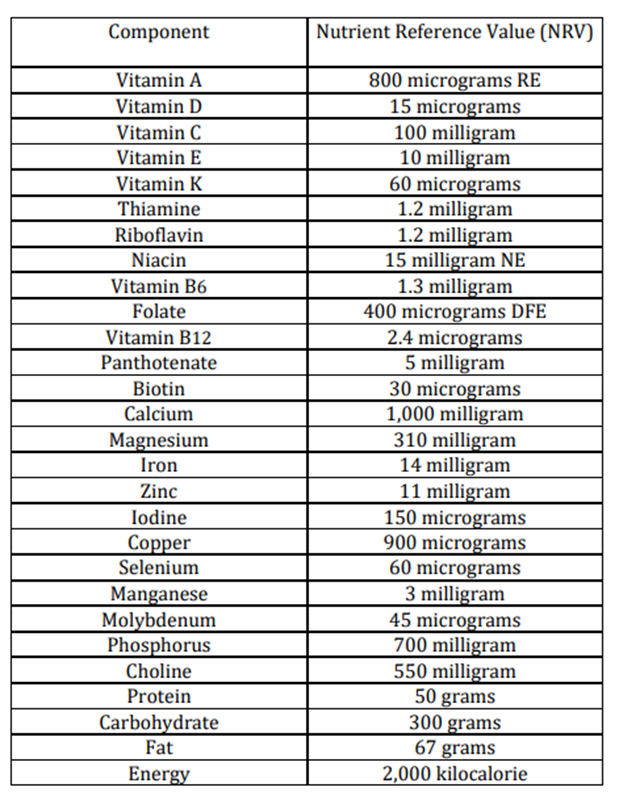
Figure 1. Nutrient Reference Values (NRV)
There may be written on the label of a package of food the amount of cholesterol or dietary fiber in the following manner:
- The amount of cholesterol shall be expressed in mg per 100 g or per 100 ml or per package if the package contains only a single portion and per serving as quantified on the label; and
- The amount of dietary fiber shall be expressed in g per 100 g or per 100 ml or per package if the package contains only a single portion and per serving as quantified on the label.
For products that are not required to have nutrition labeling but that the manufacturer wishes to do so voluntarily, they must also comply with nutrition labeling regulations.
Where a food makes a nutrition claim, it is also mandatory to include nutrition labeling and the amount of any other nutrient for which a nutrition claim is made in respect of the food.
Exemption for nutrition labeling: Nutrition labeling shall not apply to any packages that have a total surface area of less than 100 cm2 and returnable glass bottles, provided that no nutrition claim is made.
Net Content/Net Weight
- A statement of the minimum net weight or volume or number of the content of the package shall be added.
- In the case of food packed in liquid, a statement of the minimum drained weight of the food shall be labeled.
- In the case of food that has lost moisture following any treatment:
- the percentage by weight or volume shall correspond to the quantity of the ingredient used in the finished product; or
- the percentage by weight or volume may be replaced by a statement of the weight of the ingredient used to prepare 100 g or 100 ml of the finished product where the quantity of an ingredient or the total quantity of all ingredients expressed on the labeling exceeds a hundred percent.”
Product Origin & Importer
In the case of food locally manufactured or packaged in this country, the name and business address of the manufacturer or packer, or the owner of the right to manufacture or pack or the agent of any of them; and in the case of imported food, the name and business address of the manufacturer or packer or owner of the right to manufacture, or agent of any of them, and the name and business address of the importer in Malaysia and the name of the country origin of the food shall be labeled.
A telegraphic or code or address at the Post Office; or the name of the company or the trade name of the manufacturer, packer, importer, or seller appearing on any disc, cap, or other device used for sealing any package of food, shall not be sufficient.
“Country of origin of the food” means the country in which the manufactured food last underwent a treatment or process resulting in a substantial change in its nature.
Allergen Labeling
Where the food contains ingredients known to cause hypersensitivity, the ingredients shall be declared on the label. Certain foods or ingredients that are known to cause hypersensitivity are as follows:
- cereal containing gluten including wheat, rye, barley, and oats;
- nut and nut products including peanut and soybean;
- fish and fish products;
- milk and milk products (including lactose); and
- egg and egg product.
GMO Declaration
Food and food ingredients obtained through modern biotechnology shall be labeled as follows:
- in the case of food and food ingredients being composed of or containing genetically modified organisms, the words “genetically modified (name of the ingredient)” shall appear on the label;
- in the case of food and food ingredients are produced from, but do not contain genetically modified organisms, the words “produced from genetically modified (name of the ingredient)” shall appear on the label;
- for the purpose of paragraphs (a) and (b), in the case of single-ingredient foods, the information shall appear on the principal display panel in close proximity to the name of the food and shall be in not less than 10-point lettering;
- for the purpose of paragraphs (a) and (b), in the case of multi-ingredient foods, the information shall appear in the list of ingredients immediately following the ingredients; and
- for the purpose of paragraph (d), the statement “contains the genetically modified ingredient” shall be stated on the principal display panel in close proximity to the name of the food and shall be in not less than 10-point lettering.
Date Marking
Date marking signifying the expiry date or date of minimum durability. The date marking shall be in capital bold-faced lettering of a non-serif character not smaller than 6 points.
The expiry date in respect of any food shall be shown in one of the following forms:
- "EXPIRY DATE or EXP DATE (here insert the date, expressed in day, month and year or in month or year)";
- "USE BY (here insert the date, expressed in day, month and year or in month or year)"; or
- "CONSUME BY or CONS BY (here insert the date, expressed in day, month and year or in month or year)".
The date of minimum durability in respect of any food shall be shown in the following form: "BEST BEFORE or BEST BEF (here insert the date, expressed in day, month, and year or in month or year)". Provided that where only a month of a particular year is stated, it shall be presumed that the expiry date or date of minimum durability, as the case may be, shall be by the end of that month.
Where the validity of the date marking of a food to which this regulation applies is dependent on its storage, the storage direction of that food shall also be required to be borne on its label.
The foods specified in the Fifth Schedule require date marking.
Others
Any other particulars required by these Regulations are to be provided in the case of a particular food.
4.2 Languages
Prepacked foods produced, prepared, or packaged in Malaysia shall be labeled in Bahasa Malaysia.
Imported foods shall be labeled in Bahasa Malaysia or English and, in either case, may include translation thereof in any other language.
4.3 Mandatory Information on Stickers
A sticker label is acceptable for prepacked food when it complies with the requirement of Regulation 12 (5) which states that "Every label required by these Regulations to be borne on a package shall be legibly and durably marked either on the material of the package or on material firmly or permanently attached to the package" [1].
4.4 Product Legal Name
There is no product legal name for the overall category of “General Foods”.
Refer to Section 4.4 of specific product Guidebooks for product-specific requirements.
For general information, see "Product Designation" in Section 4.1 above.
4.5 Product-specific Labeling Statements
Refer to Section 4.5 of specific product Guidebooks for product-specific requirements.
4.6 Authority Approval
Food labels are not required to be approved before marketing. Voluntary, it is possible to obtain approval from the authority for food product labeling. There are procedures available online using the FOSIM (FOSIM - Food Safety Information System of Malaysia) System website [3]. There is no mandatory product label approval process except for specific product categories such as infant formula.
4.7 Additional Notes on Labeling
Form and manner of labeling
- Mandatory labeling particulars shall appear conspicuously and prominently on the label.
- Product designation (product name) to appear on a label shall be so prominent in height, visual emphasis, and position as to be conspicuous by comparison with any other matter appearing on the label. This requirement shall not apply to a trademark.
- Mandatory particulars that are required by these Regulations to appear on a label shall be written in no smaller than 10-point lettering and with equal prominence with any other matter appearing on or attached to the package.
- Notwithstanding the requirement on minimum font size quoted above, the statement related to ingredients list, edible fat or edible oil, food additives, product origin & importer, and nutrition labeling. may be written in no smaller than 4-point lettering unless otherwise provided in these Regulations.
- Every label required by these Regulations to be borne on a package shall be legibly and durably marked either on the material of the package or on the material firmly or permanently attached to the package.
Yet, a label may be firmly placed inside a package if:
- the package is made of clear transparent material; and
- the food contained in the package:
- is not ready for direct consumption; or
- in the case of food ready for direct consumption, is completely enclosed in its natural shell or pod or interior wrapper such that it has no direct contact or is not likely to come into contact with the label.
No label shall appear on the extra wrapper of any food.
Size and color of letters
A) Where the size of letters to be used in labels is prescribed in these Regulations by reference to a minimum number of points, the reference shall be deemed to be a reference to the height of the lower-case letter of the typeface or if the wording is all in capital letters, the height of the capital letters in typeface irrespective of the height of type body.
B) Except as otherwise provided in these Regulations and for internationally accepted unit symbols of weight and measures, the lettering of every word or statement required by these Regulations to appear on labels shall be:
- all capital letters; or
- all lower-case letters; or
- lower case letters with an initial capital letter.
C) In every case to which "all capital letters", or "all lower-case letters" applies, the height of the lettering shall be uniform in every word or statement that is separately required.
D) In every case to which "lowercase letters with an initial capital letter" applies, the height of the lower-case lettering shall be uniform in every word or statement that is separately required.
E) Notwithstanding anything contained in these Regulations, where words are required by these Regulations to appear on labels in letters of a specified size and the package to be labeled is so small as to prevent the use of letters of that size, letters of smaller size may be used if they are of the largest size practicable in the circumstances and are in any event no smaller than 2 points.
F) The requirement in these Regulations as to the height of letters shall be sufficiently complied with if the letters used are of a greater height than the height prescribed.
G) All lettering shall appear in a color that contrasts strongly with its background.
Exemptions from labeling requirements (including sold to restaurants)
Exemptions from regulations on mandatory labeling particulars (Regulation 11), date marking (Regulation 14), and nutrition labeling (Regulation 18B) are prescribed by Regulation 17 Malaysia Food Regulations 1985 [1]:
(a) "Bulk container", including any wagon, crate, silo, tanker, and other similar containers, can be exempted from the requirements of mandatory labeling particulars and date marking (Regulation 11 and Regulation 14).
(b) "Bulk container" includes any box, carton, and other similar containers in which more than one duly labeled package and its content are placed and in which the packages and their contents are not intended to be retained when the packages or the contents are sold by way of retail is exempted from following labeling requirements:
- The presence of ingredients derived from beef or pork (Regulation 11.1.c)
- Alcohol containing (Regulation 11.1.d)
- Displaying ingredients list in descending order of proportion by weight of ingredients, food additives, added nutrients, and the proportion of such ingredients, when required (Regulation 11.1.e)
- Statement as to the presence of edible fat or edible oil or both, together with the common name of the animal or vegetable from which such fat or oil is derived (Regulation 11.1.f)
- Labeling of food additives with functional class and INS number, or functional class and name of food additives (Regulation 11.1.g)
(c) Nutrition labeling shall not apply to any packages that have a total surface area of less than 100 cm2 and returnable glass bottles, provided that no nutrition claim is made.
(d) Labeling the common name of oil and fat, functional class and INS number of food additives, and functional class of flavoring shall not apply to a package where the largest of its surface area is less than 10cm2.
A food product that is designed to sell to B2B channels and restaurants, if it conforms with the description of "bulk container" in paragraph (b), can have a corresponding exemption on labeling requirements as mentioned in such paragraph. It is not a common situation, but if the product's label area is less than 100 cm2 or less than 10 cm2, it may also be exempt from the labeling particulars as described in paragraphs (c) and (d), respectively.
Authority labeling guideline
The Malaysian authority has issued a guideline to facilitate the industry operators to be compliant with food labeling requirements [2]. This guidance is not legally binding, therefore, the operators should be read together with the relevant national legislation.
4.8 References
1. The Malaysian Food Regulations 1985 and its Schedules
https://hq.moh.gov.my/fsq/peraturanperaturan-makanan-1985
2. Guideline on Labelling Requirement under Food Act 1983 and Regulations thereunder
https://hq.moh.gov.my/fsq/xs/dl.php?filename=Garis+Panduan+Pelabelan+2023_.pdf
3. FOSIM Website
https://fosim.moh.gov.my/fssm/public/hom
Was this article helpful?