
4. ASEAN
- 4 Mins to read
- DarkLight
4. ASEAN
- 4 Mins to read
- DarkLight
Article summary
Did you find this summary helpful?
Thank you for your feedback
Biodegradability and Environmental Claims
ASEAN
1. Regulatory Agents
1.1 ASEAN Coordination
A) ASEAN Cooperation on Environment, in particular ASEAN Working Group on Chemicals and Waste (AWGCW)
The AWGCW has not started yet any initiatives on biodegradability and green claims.
https://environment.asean.org/
B) Dialogue for Innovative and Sustainable Growth (DISG), by the AEM-METI (ASEAN Economic Ministers-Ministry for International Trade) Economic and Industrial Cooperation Committee (AMEICC)
The DISG initiative did not tackle yet the topic of biodegradability and green claims.
https://ameicc.org/disg/
1.2 Industry Trade Associations at ASEAN Level
A) ASEAN Regulatory Cooperation Project (ARCP)
The ARCP has not yet started any initiatives on biodegradability and green claims.
B) Responsible Care initiative
Responsible Care is a voluntary initiative under which companies, through their National Associations, work together to continually improve their HSE performance and communicate with stakeholders in an open and transparent manner about their products and processes.
https://scic.sg/index.php/en/responsible-care-in-singapore
2. Regulatory Landscape
The regulatory structure that could potentially regulate environmental claims in ASEAN is recent, and no specific actions on the topic have been taken so far. However, the joint regulating bodies are recently adopting environmental initiatives at various levels. Singapore and Thailand are especially active in leading these efforts. It is to be expected that in the near future new regulations addressing consumer products and in particular environmental claims will be developed. This would be consistent with the trend in other leading markets such as the EU.
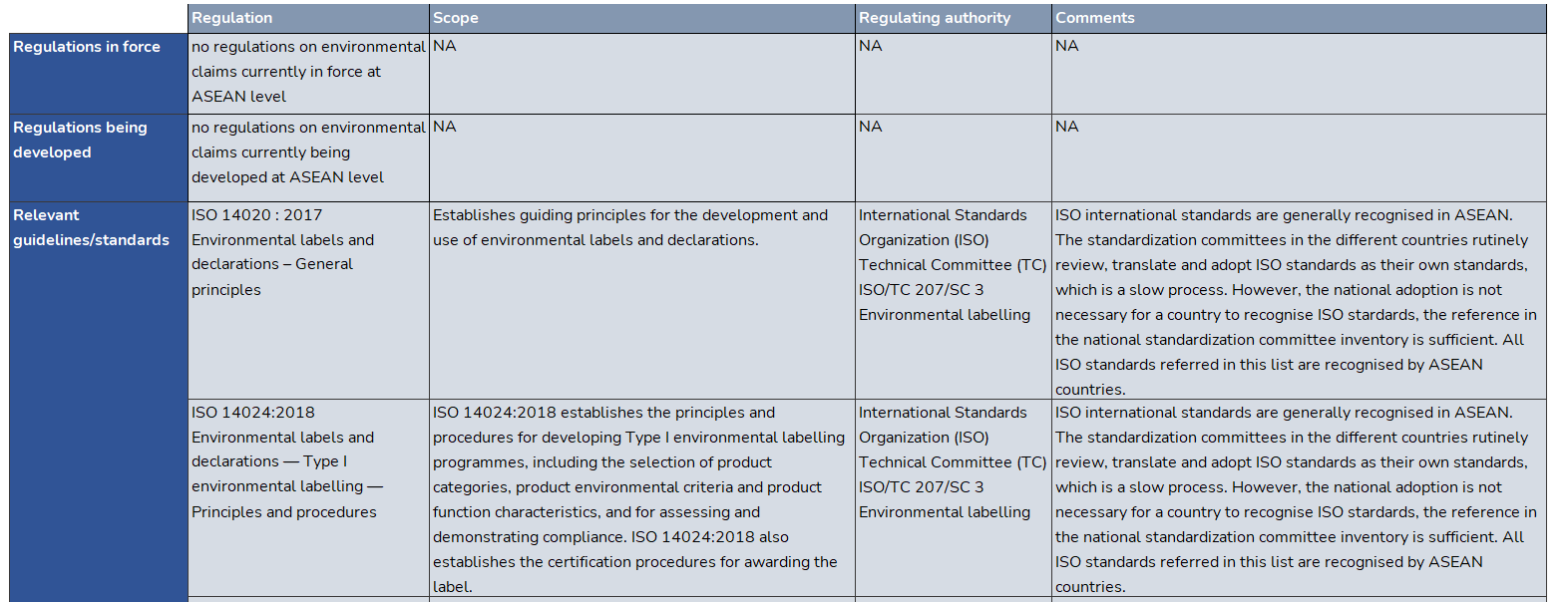
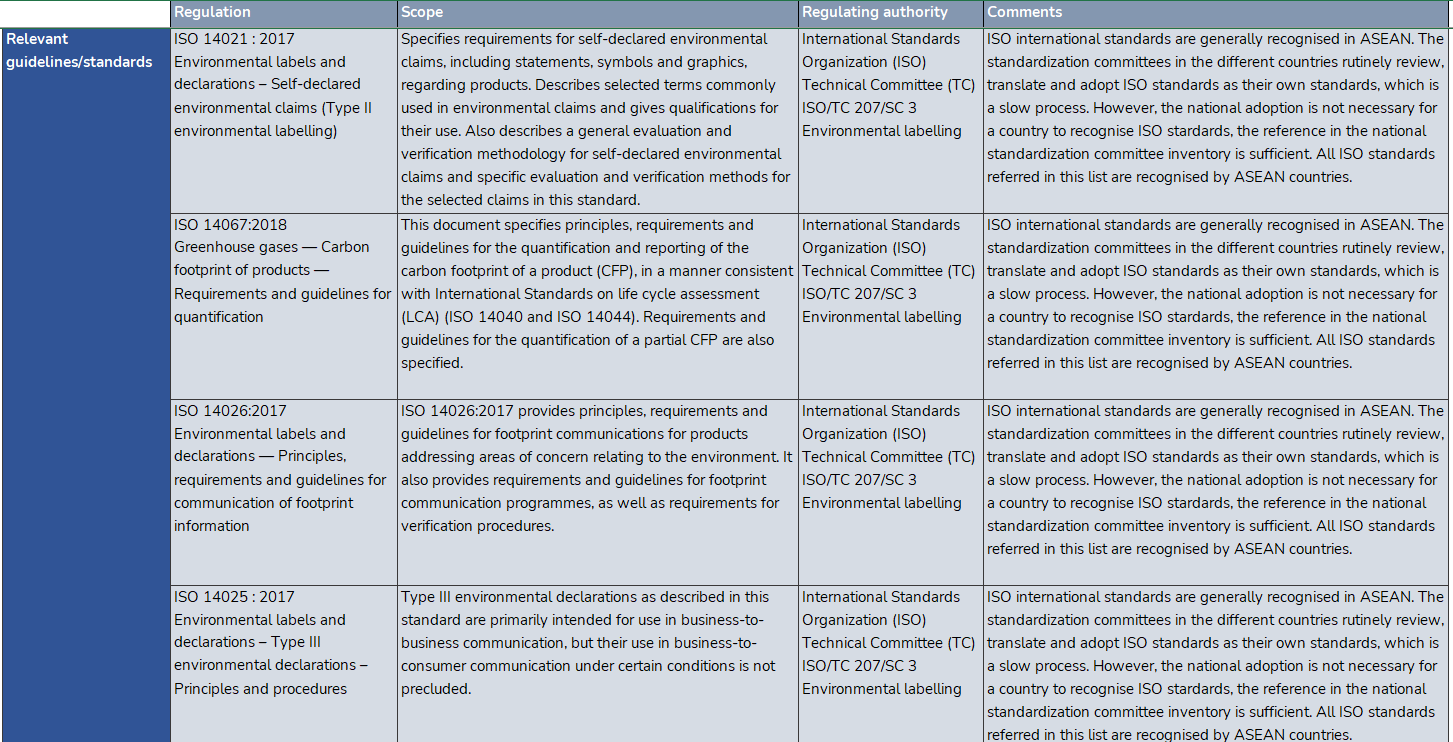
Advocacy Strategy
Advocacy at the ASEAN level is recommended, as many environmental policies are the result of joint efforts in the association's regulatory bodies. Through the ASEAN Regulatory Cooperation Project (ARCP) and the Responsible Care initiative, companies can advocate for environmental policy-making related to consumer goods. At a local level, the two most active industry associations in this topic are those of Singapore and Thailand.
3. Claim Support Standards
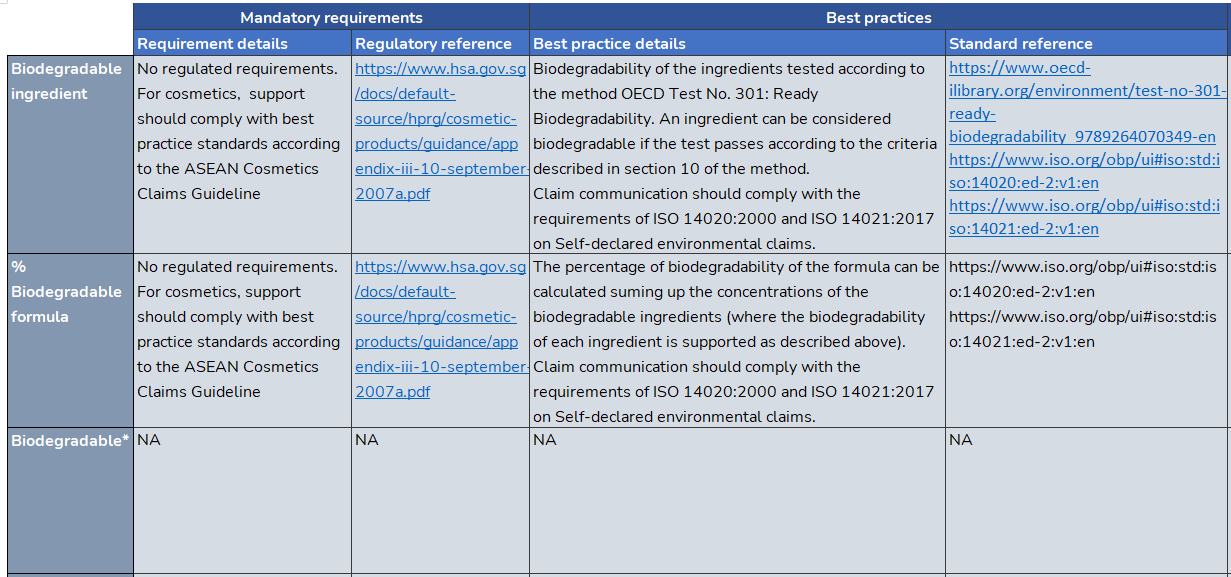
*The existing widely recognized tests for biodegradability measure the biodegradability of individual chemical substances, not mixtures. Therefore, a finished cosmetic product cannot be considered "Biodegradable" or not, as the biodegradability claim should be made with respect to its ingredients. The claim "Biodegradable" as such should therefore not be used, as it refers to the whole product.
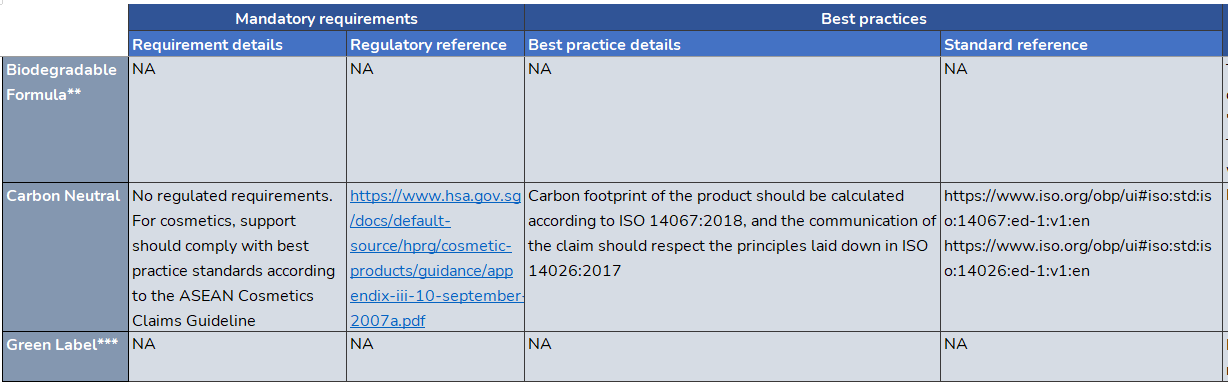 **The existing widely recognized tests for biodegradability measure the biodegradability of individual chemical substances, not mixtures. Therefore, a finished cosmetic product cannot be considered "Biodegradable" or not, as the biodegradability claim should be made with respect to its ingredients. The claim "Biodegradable formula" as such should therefore not be used, as it refers to the whole product.
***Each ASEAN country has its own Green Label scheme, please see the details in the corresponding report for each country. There is no Green Label shared scheme at the ASEAN level.
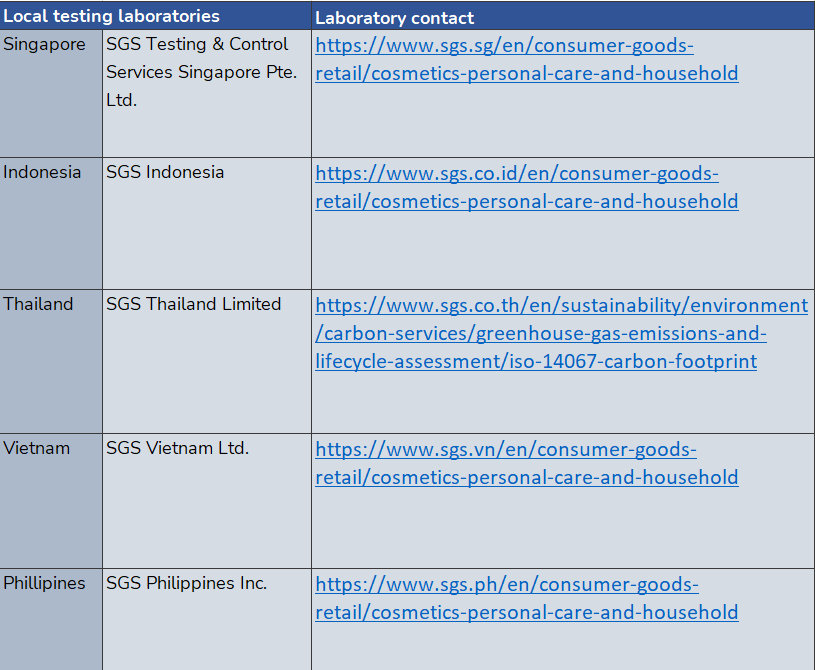
4. Testing
4.1 Biodegradable Ingredient
The testing method is published by the Organization for Economic Co-operation and Development (OECD).
Biodegradability of the ingredients is tested according to the method OECD Test No. 301: Ready Biodegradability. There are six method variants depending on the nature of the ingredient. An ingredient can be considered biodegradable if the test passes according to the criteria described in section 10 of the method.
Principles of the testing method:
a) A solution, or suspension, of the test substance in a mineral medium is inoculated and incubated under aerobic conditions in the dark or in diffuse light. The amount of DOC (Dissolved Organic Carbon) in the test solution due to the inoculum should be kept as low as possible compared with the amount of organic carbon due to the test substance. Allowance is made for the endogenous activity of the inoculum by running parallel blanks with the inoculum but without the test substance, although the endogenous activity of cells in the presence of a chemical will not exactly match that in the endogenous control. A reference compound is run in parallel to check the operation of the procedures.
b) In general, degradation is followed by the determination of parameters such as DOC, CO2 production, and oxygen uptake, and measurements are taken at sufficiently frequent intervals to allow the identification of the beginning and end of biodegradation. With automatic respirometers the measurement is continuous. DOC is sometimes measured in addition to another parameter but this is usually done only at the beginning and end of the test. Specific chemical analysis can also be used to assess the primary degradation of the test substance and to determine the concentration of any intermediate substances formed.
c) Normally, the test lasts for 28 days. Tests however may be ended before 28 days, i.e. as soon as the biodegradation curve has reached a plateau for at least three determinations. Tests may also be prolonged beyond 28 days when the curve shows that biodegradation has started but that the plateau has not been reached by day 28, in such cases, the chemical would not be classed as readily biodegradable.
4.2 % Biodegradable Formula
The percentage of biodegradability of the formula can be calculated by summing up the concentrations of the biodegradable ingredients (where the biodegradability of each ingredient is tested as described above).
4.3 Carbon Neutral
The testing method is published by the International Standards Organization (ISO).
ISO 14067:2018 specifies principles, requirements, and guidelines for the quantification and reporting of the carbon footprint of a product (Consumer Finished Product, CFP), in a manner consistent with International Standards on life cycle assessment (LCA) (ISO 14040 and ISO 14044). Requirements and guidelines for the quantification of a partial CFP are also specified.
ISO 14067:2018 is applicable to CFP studies, the results of which provide the basis for different applications. ISO 14067:2018 addresses only a single impact category: climate change. Carbon offsetting and communication of CFP or partial CFP information are outside the scope of this document. ISO 14067:2018 does not assess any social or economic aspects or impacts, or any other environmental aspects and related impacts potentially arising from the life cycle of a product.

Was this article helpful?