
3. Compositional Aspects
- 14 Mins to read
- DarkLight
3. Compositional Aspects
- 14 Mins to read
- DarkLight
Article summary
Did you find this summary helpful?
Thank you for your feedback
Beers, RTDs, Whisky
India

This section provides the compositional requirements for the food category and/or food products in scope and information on permitted nutrients, ingredients, and additives.
3.1 Composition Requirements
General Food
The general composition requirement of any food product is regulated to ensure safety and consistency. Requirements applying to all food are defined in the Indian legislation [1], and particular requirements apply per product.”
Besides FSSAI [1], food producers must adhere to Codex Alimentarius standards [3] for international trade. This includes regulations on additives, contaminants, and labeling, ensuring products meet the standards of importing countries.
Category
Alcoholic beverages
Alcoholic beverages may contain additives, enzymes, and processing aids as permitted under the Food Safety and Standards (Food Products Standards and Food Additives) Regulations, 2011. Alcoholic beverages shall be free from chloral hydrate, ammonium chloride, paraldehyde, pyridine, diazepam, or narcotic, psychotropic substances including caffeine except naturally occurring caffeine [2].
Product
1) Beer [3]
Raw Materials: Malt, hops, water, and yeast are the primary ingredients. Any additional additives must conform to FSSAI standards (e.g., stabilizers or permitted colors). [2]
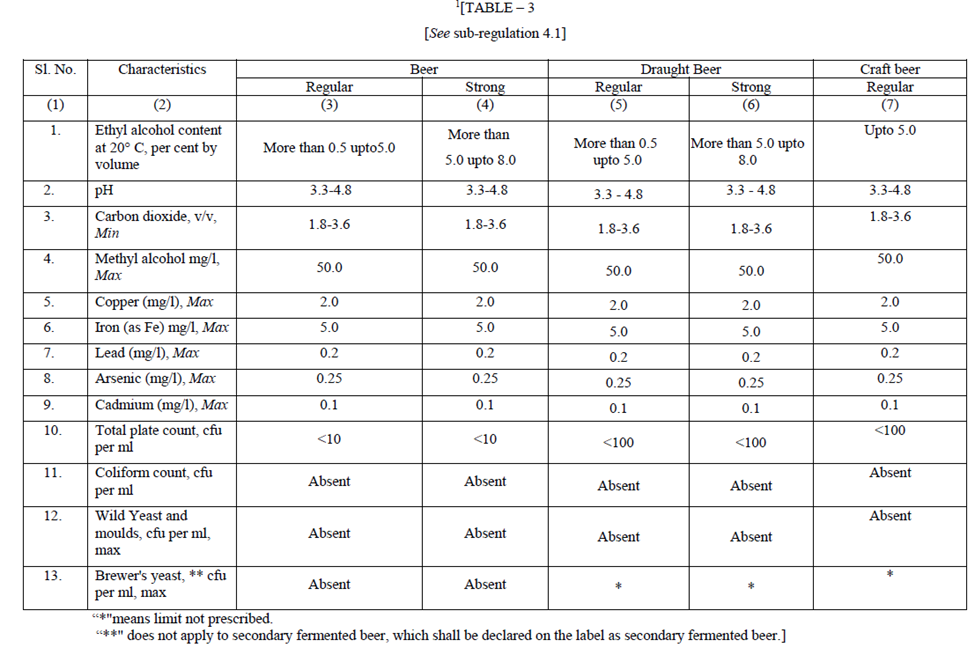
Depending upon the ethyl alcohol content, beer may be classified as under [2]:
- Regular or Mild–ABV more than 0.5 percent up to 5.0 percent.
- Strong – ABV more than 5.0 percent up to 8.0 percent.
- 1 [Alcohol-free beer- ABV 0.0 (for other parameters, alcohol-free beer shall comply with the limits specified for regular beer).]
Beer may also be of the following types based on the yeast used during fermentation [2]:
- 4.1.1 Lager: Lager beer is prepared by using bottom-fermenting yeast and matured at low temperatures. It can be found in colors from light to dark. Pilsner is a type of lager beer that is light in color and has a medium hop flavor.
- 4.1.2 Ale: Ale beer is prepared by using top-fermenting yeast and is usually lighter in color. It is prepared from pale malt and has a medium body.
- 4.1.2.1 Wheat beer: Wheat beer is brewed with a large proportion of wheat and may also contain a significant proportion of malted barley. Wheat beer is usually top-fermented. Wheat beer is sometimes hazy or cloudy with a touch of spicy notes.
- 4.1.2.2 Stout and porter: Stouts and porters are dark beers made using roasted malts or roasted barley and typically brewed with slow fermenting yeast.
- 4.2 Draught beer: Draught beer is a beer of all types i.e. lager, ale, stout porter, or wheat, and may or may not be pasteurized. It is served from a cask or keg.
- 1 [4.2 (1) Craft beer is made in a micro-brewery/ pub-brewery and may be aromatized with suitable food ingredients. It may or may not be filtered and pasteurized, and may be sold in casks, kegs, bottles, or cans.]
- 2 [4.2(2) Flavored Beer: Beer containing flavors as per the provisions of the Food Safety and Standards (Food Products Standards and Food Additives) Regulations, 2011 and such beer shall meet all the other requirements of the beer.]
In addition, the requirements defined in Table 3 [2] must be met:
2) Alcoholic ready-to-drink beverages
- Base Spirits: Derived from grains, fruits, or sugar, complying with BIS standards.
- Alcohol Content: see Section 2.2 of this guidebook. [5]
- Flavoring Agents: Only natural or nature-identical flavors are permitted by FSSAI. [6]
3) Whisky [3]
- Raw Materials: Grain-based alcohol, aged in oak barrels for at least three years. [2]
- Alcohol Content: No legal definition, market practice is within 36% to 50% ABV. [2]
- Blended Whisky: Mixing of grain spirits and malt whisky is permitted, adhering to defined ratios. [2]
3.2 Raw Material Requirements
General Food
Base Ingredients: Common raw materials for alcoholic beverages include grains (barley, rice, maize), fruits (grapes for wine, apples for ciders), and water. All materials must meet food safety standards regarding contaminants and pesticide residues, as per FSSAI and Codex Alimentarius guidelines [3].
Quality Control: Raw materials must be tested for pesticides, heavy metals, and microbiological safety before being processed. FSSAI ensures that no harmful substances exceed the prescribed levels.
Category
Alcoholic beverages
Same requirements as the products below.
Product
1) Beer [2]
Barley Malt:
- Primary ingredient, used for fermentation and flavor development.
- Must be free from fungal contamination (e.g., aflatoxins) and other harmful contaminants.
Hops:
- Added for bitterness, flavor, and as a preservative.
- Permitted in both natural and processed forms, adhering to FSSAI-approved additives.
Water:
- Must meet potable water quality standards as per BIS (Bureau of Indian Standards).
- It should be free from microbiological and chemical contamination.
Other Grains and Adjuncts (Optional):
- Rice, corn, wheat, and sorghum may be used as adjuncts, provided they meet FSSAI standards.
Yeast:
- Brewer’s yeast (Saccharomyces cerevisiae) is essential for fermentation.
Must be of food-grade quality and free from contaminants.
2) Alcoholic ready-to-drink beverages [2]
Alcohol Base:
- Can be derived from beer, wine, or distilled spirits (e.g., vodka, rum).
- The alcohol base must comply with the raw material standards of the respective beverage type.
Flavorings:
- Natural or artificial flavoring substances permitted under FSSAI guidelines (e.g., fruit flavors, botanical extracts).
Sweeteners:
- Both natural (e.g., sugar) and artificial sweeteners (e.g., aspartame, sucralose) may be used, within permissible limits.
Water:
- Potable water, free from microbiological contamination, is a key ingredient.
Carbonation (Optional): Food-grade carbon dioxide may be added for sparkling RTDs.
3) Whisky [2]
Grain Mash:
- Made from grains such as barley, corn, rye, or wheat.
- Grains must be free from harmful contaminants and meet compositional purity standards.
Water:
- Used in fermentation, distillation, and dilution to bottling strength.
- Must comply with potable water standards and be free from heavy metals and toxins.
Yeast:
- Food-grade yeast is used for fermentation to convert sugars into alcohol.
Oak Barrels (for Maturation):
- Whisky must be aged in wooden casks (typically oak).
- Barrels must not introduce any harmful chemicals or contaminants.
Additives (Optional):
- Caramel coloring (Class I) is permitted for standardizing appearance but must meet FSSAI limits.
3.3 Fortification
General Food
Food fortification is a public health strategy used to address widespread nutrient deficiencies without requiring significant changes in consumer behavior. FSSAI regulates the fortification of foods to ensure that the levels of added nutrients are safe and effective [6].
Category
Alcoholic beverages
Fortification in Alcoholic Beverages: Fortification may refer to the addition of vitamins, minerals, or alcohol to enhance the product's nutritional profile or strength. For instance, certain RTDs may be fortified with vitamin C or B-complex vitamins.
Regulations [6]: Fortified alcoholic products must clearly state the nutritional claim and comply with FSSAI’s fortification guidelines. Vitamin or mineral additions must be proven safe and substantiated by scientific data.
Product
1) Beer [6]
Beer is not traditionally subject to mandatory fortification under FSSAI regulations.
Optional Fortification:
- Vitamins and Minerals: Some global practices have experimented with adding vitamins (e.g., B-complex vitamins) to beer. However, in India, such fortification must comply with FSSAI approval for additives and fortificants.
- Dietary Fiber: Breweries may include cereal grains (e.g., oats or barley) that naturally increase the fiber content, aligning with trends for functional or "better-for-you" beers.
Regulatory Compliance:
- Any nutrient addition must align with compositional requirements and labeling standards.
- Fortified beer, if introduced, may require additional notification to FSSAI to clarify its category.
2) Alcoholic ready-to-drink beverages [6]
Fortification of RTD alcoholic beverages is not common or mandated by FSSAI.
Optional Fortification:
- Nutritional Enhancements: There is a potential to add functional ingredients such as antioxidants, vitamins (e.g., vitamin C), or electrolytes, especially in low-ABV (Alcohol by Volume) RTDs marketed as “healthier” options.
- Flavor-Driven Fortification: The addition of fruit juice concentrates or botanicals can provide natural enrichment while meeting consumer preferences.
Regulatory Considerations:
- Added nutrients must fall under FSSAI-permitted fortificants for beverages.
- Care must be taken to avoid misleading claims, particularly health claims, which are heavily regulated for alcoholic beverages. [25]
3) Whisky [6]
Whisky, as a distilled spirit, does not support fortification due to the production process and compositional purity requirements.
- The high alcohol content (~40-45% ABV) and distillation process render the addition of nutrients ineffective since most are degraded during production.
- Whisky’s classification under distilled spirits with strict ingredient controls makes fortification highly unlikely without reclassification as a fortified product.
FSSAI mandates stringent rules for labeling fortified products. Any claims about health or nutrition must be scientifically substantiated and comply with the Food Safety and Standards (Advertising and Claims) Regulations, 2018 [11].
3.4 Other Permitted Ingredients
General Food
None.
Category
Alcoholic beverages
- Sugars and Sweeteners: Ingredients like sucrose, glucose, or fructose are commonly used in the production of certain beverages like RTDs or sweet wines. FSSAI guidelines regulate the usage to ensure they are within permissible limits [6].
- Preservatives: Some alcoholic beverages (especially RTDs) may contain preservatives like sodium benzoate or potassium sorbate. These preservatives must comply with FSSAI standards for safety and quantity limits.
1) Beer [2]
- Malted Barley: The primary ingredient for fermentation.
- Water: Must meet potable water standards as per the Bureau of Indian Standards (BIS).
- Hops: Used for flavoring and natural preservation.
- Yeast: Brewer’s yeast (Saccharomyces cerevisiae) for fermentation.
Optional Ingredients:
- Cereal Grains and Adjuncts: Rice, corn, sorghum, wheat, and other grains can be used to supplement malted barley.
- Sugar: Added to adjust the fermentable sugar levels.
- Flavoring Substances: Permitted natural or artificial flavors like fruit extracts or spices (e.g., ginger, coriander).
- Carbon Dioxide (CO2): For carbonation.
2) Alcoholic ready-to-drink beverages [2]
Base Ingredients:
- Alcohol Base: Derived from distilled spirits (e.g., vodka, rum) or fermented beverages (e.g., beer or wine).
- Water: Used for dilution and mixing, meeting potable water standards.
Optional Ingredients:
- Flavors:
- Natural (e.g., citrus oils, fruit juices, botanical extracts).
- Artificial (e.g., permitted synthetic flavors approved under FSSAI regulations).
- Sweeteners:
- Natural sugars (e.g., sucrose, glucose).
- Artificial sweeteners (e.g., aspartame, sucralose) within permissible limits.
- Carbonation: Food-grade CO2 for sparkling RTDs.
- Acids: Permitted food acids like citric acid or malic acid for taste adjustment.
3) Whisky [2]
Core Ingredients:
- Grains: Barley, corn, rye, or wheat used for mash preparation.
- Water: Used in fermentation and for dilution to bottling strength.
- Yeast: Food-grade yeast for fermenting the grain mash.
Optional Ingredients:
- None are typically allowed except as detailed under "Additives" due to the strict compositional purity of whisky.
3.5 Permitted Additives
General Food
FSSAI has outlined specific standards and regulations regarding permitted food additives under the Food Safety and Standards (Food Products Standards and Food Additives) Regulations, 2011. These regulations define what additives are allowed in different categories of foods and establish the maximum permissible levels for each additive [6]. The composition of the food is confirmed by the Indian authority during the registration process (refer to Section 6 of this guidebook).
Category
Alcoholic beverages
- Stabilizers, Antioxidants, and Clarifying Agents: Additives like bentonite or gelatin may be used to clarify wine or beer. Antioxidants like ascorbic acid can prevent oxidation in wine or RTDs. [6]
- Regulation: All additives must meet FSSAI standards for safe usage. Some additives may have quantity restrictions or require specific labeling.
Product
1) Beer [6]
Additives Allowed:
- Stabilizers (e.g., gum Arabic).
- Preservatives (e.g., sulfur dioxide) within permissible limits.
- Food colors and processing aids approved by FSSAI.
2) Alcoholic ready-to-drink beverages [6]
Additives Allowed:
- Colors (natural and synthetic) approved by FSSAI.
- Preservatives such as potassium sorbate or sodium benzoate.
- Antioxidants to maintain flavor and freshness.
3) Whisky [6]
Additives Allowed:
- Caramel Coloring (Class I): Permitted to standardize color without altering flavor.
- Oak Barrels: Used in aging whisky; the interaction between the spirit and barrel adds natural flavors (e.g., vanilla, caramel).
- No artificial flavors, sweeteners, or non-approved additives are allowed.
3.6 Permitted Flavors and Colors
General Food
The Food Safety and Standards Authority of India (FSSAI) regulates the use of flavors and colors in food products to ensure their safety and quality. Flavors and colors play a crucial role in enhancing the sensory appeal of food, making it more attractive and palatable for consumers. However, the addition of these substances is strictly controlled to ensure they do not pose any health risks [6]. The composition of the food is confirmed by the Indian authority during the registration process (see Section 6 of this guidebook).
Category
Alcoholic beverages
- Flavors: Natural and nature-identical flavors are permitted, such as citrus or herbal flavors in RTDs. Artificial flavors are regulated under FSSAI guidelines [6], requiring approval for safe usage.
- Colors: FSSAI permits natural coloring agents like caramel or anthocyanins (from fruit). Artificial coloring agents are tightly regulated, with some specific colors being banned for use in alcoholic beverages.[6]
- Regulation: FSSAI’s Food Safety and Standards (Food Additives) Regulations, 2011 outlines specific color additives and flavoring agents permissible for alcoholic beverages.
Product
1) Beer [6]
Permitted Flavors:
- Natural Flavors:
- Derived from plant, fruit, herb, or spice extracts (e.g., orange peel, coriander, ginger, or clove).
- Artificial Flavors:
- Synthetic flavors permitted under FSSAI, such as fruit essence or botanical extracts.
Permitted Colors:
- Natural Colors:
- Caramel (Class I), annatto, or beetroot extract for appearance enhancement.
- Synthetic Colors:
- Tartrazine, sunset yellow, or brilliant blue, provided they meet FSSAI limits.
2) Alcoholic ready-to-drink beverages [6]
Permitted Flavors:
- Natural Flavors:
- Fruit-based flavors (e.g., lime, mango, mixed berries).
- Herbal flavors (e.g., mint, basil).
- Spice-derived flavors (e.g., cinnamon, cardamom).
- Artificial Flavors:
- Synthetic flavors replicating natural profiles, such as citrus or cola flavors.
Permitted Colors:
- Natural Colors:
- Anthocyanins (from grapes), turmeric (curcumin), or chlorophyll (green hues).
- Synthetic Colors:
- Synthetic dyes like allura red, brilliant blue, or ponceau 4R, used within FSSAI’s prescribed limits.
3) Whisky [2]
Permitted Flavors:
- Natural Flavors:
- Whisky is traditionally unflavored, with taste derived from natural aging processes (e.g., oak barrels imparting vanilla, caramel, or smoky notes).
- Artificial Flavors:
- Not permitted under FSSAI for whisky, as it is classified as a distilled spirit requiring compositional purity.
Permitted Colors:
- Natural Colors:
- Caramel Coloring (Class I): Allowed to standardize whisky appearance without altering flavor.
- Synthetic Colors:
- Not permitted for whisky in India due to its compositional standards.
3.7 Permitted Processing Aids
General food
Processing aids are substances used in food production to facilitate the manufacturing process, improve quality, or maintain safety. Unlike food additives, processing aids are typically not present in the final product or are present only in trace amounts. FSSAI regulates these substances to ensure they are safe, effective, and do not pose a health risk to consumers. FSSAI set safety standards for processing aids, ensuring they are non-toxic and have maximum residue limits (MRLs) in the final product [6].
Category
Alcoholic beverages
The use of processing aids in alcoholic beverages is regulated under the Food Safety and Standards (Alcoholic Beverages) Regulations, 2018 [2], and the Food Safety and Standards (Food Products Standards and Food Additives) Regulations, 2011 [6]. Processing aids are substances used in the manufacture of alcoholic beverages but are not intended to remain in the final product. All processing aids must be FSSAI-approved for use in alcoholic beverages. Processing aids are typically exempt from labeling requirements unless they significantly alter the product’s composition.
- Processing Aids: These include enzymes used in fermentation (e.g., amylase for beer) and fining agents for wine [18] and [19].
- Regulation: Processing aids must not remain in the final product, and their usage should comply with FSSAI guidelines for residue limits and safety. They must be food-grade and prove safe for consumption [11].
Product
1) Beer (References in alcoholic drinks above)
Fining Agents:
- Bentonite clay: Used for clarifying and stabilizing beer by removing proteins and haze-causing particles.
- Isinglass: A collagen-based fining agent derived from fish bladders, commonly used in traditional brewing.
- Gelatin: Helps clarify beer by binding to suspended particles.
- Silica Gel: Stabilizes beer by adsorbing haze-forming proteins.
Filtration Aids:
- Diatomaceous Earth (Kieselguhr): Used to filter suspended solids and clarify beer.
- Perlite: A volcanic glass often used as a filter medium.
Enzymes:
- Amylase: Breaks down starches into fermentable sugars during brewing.
- Protease: Reduces protein haze by breaking down proteins.
- Beta-glucanase: Improves filterability by breaking down beta-glucans barley.
Stabilizers:
- PVPP (Polyvinylpolypyrrolidone): Removes polyphenols to prevent haze formation.
- Carrageenan (Irish Moss): A seaweed-derived stabilizer that removes proteins during wort boiling.
2) Alcoholic ready-to-drink beverages (References in alcoholic drinks above)
Clarification Aids:
- Activated Carbon: Used to decolorize or deodorize the beverage base.
- Gelatin or Pectinase: Clarifies fruit-based RTDs by removing haze and solids.
Filtration Aids [3]:
- Diatomaceous Earth: Filters suspended particles in carbonated or clear RTDs.
- Silica Gel: Adsorbs unwanted compounds for improved clarity.
Stabilizers and Emulsifiers:
- Lecithin: Helps emulsify flavor oils in RTDs with added flavors.
- Gum Arabic: Stabilizes cloudiness in beverages with fruit pulp or flavorings.
- CMC (Carboxymethyl Cellulose): Prevents phase separation in flavored RTDs.
Enzymes:
- Pectinase: Reduces pectin content in fruit-based RTDs, improving clarity and stability
3) Whisky
Clarification Aids:
- Activated Carbon (Charcoal): Used in filtration for removing impurities and smoothing the whisky flavor.
- Gelatin: Occasionally used for clarity in post-distillation stages.
Aging and Flavoring Aids:
- Wood (Oak Barrels): Whisky matures in oak barrels, which act as a natural processing aid, imparting flavor and color.
Stabilizers:
- Whisky production typically avoids artificial stabilizers, relying on natural processes such as aging and filtration.
3.8 Additional Notes
Sustainability: Increasingly, sustainable practices are being encouraged, such as the use of organic ingredients or reducing packaging waste in the production of alcoholic beverages.
3.9 References
1. FSSAI Act 2006
https://fssai.gov.in/cms/food-safety-and-standards-act-2006.php
2. FSSAI Guidelines on Alcoholic Beverages
3. Alimentarius - Alcoholic Beverages Standards
https://www.fao.org/fao-who-codexalimentarius/en/
4. Alcoholic Beverages Standards Regulation, 2018, updated 28 08 2023
https://fssai.gov.in/upload/uploadfiles/files/Comp_Alcoholic_Beverages(III)_28_08_2023.pdf
5. Draft notification on Food Safety and Standards (Alcoholic Beverages) Amendment Regulations, 2023 related to standards of Mead (Honey wine), Craft Beer, Indian liquors and definition of Low Alcoholic Beverages/ RTD, wine-based Beverages and, Country Liquors, etc.
https://comments.fssai.gov.in/Bestviewwl.aspx?NOTIFICATION_ID=4345
6. FSSAI Food Additives Regulations (2011)
https://www.fssai.gov.in/upload/uploadfiles/files/Food_Additives_Regulations.pdf
7. FSSAI Packaging and Labelling Regulations, 2011
https://www.fssai.gov.in/upload/uploadfiles/files/Compendium_Labelling_Display_23_09_2021.pdf
8. FSSAI Food Safety and Standards Act, 2006 (Chapter 9 – Penalties and Offenses)
9. FSSAI Nutrition and Health Claims Regulations, 2018
https://fssai.gov.in/upload/uploadfiles/files/Gazette_Notification_Advertising_Claims_27_11_2018.pdf
10. FSSAI proposed standards Claims
https://fssai.gov.in/upload/uploadfiles/files/Notice_Comments_Alcoholic_Beverages.pdf
11. FSSAI Food Safety and Standards (Advertising and Claims) Regulations, 2018
12. BIS FMCS - Foreign Manufacturer Certification Scheme
https://www.bis.gov.in/fmcs/certification-process/products-under-fmcs/
13. Custom clearance process
14. Direct and Indirect Taxes
15. Pesticide residue FSSAI Pesticide and Contaminant Regulations (Food Safety and Standards (Contaminants, Toxins, and Residues) Regulations, 2011)
16. Consumer Protection Act, 2019 Specifies penalties for misleading advertisements, including alcohol-related campaigns
17. BIS standards for packaging materials (e.g., IS 15410 for food-grade plastics)
18. IS 3752 Specification for Beer
19. IS 6613: Standards for distilled beverages
https://www.services.bis.gov.in/tmp/rp_19122023_658141877ea41.pdf
20. Haryana Excise law
21. Delhi Excise Law
22. Advertising Standards Council of India (ASCI): ASCI oversees advertising content to ensure ethical practices, including compliance for surrogate advertising of alcoholic beverages. For detailed guidelines
https://www.ascionline.in/wp-content/uploads/2024/04/Code-Book_Codes_Webready.pdf
23. Cable Television Networks (Regulation) Act, 1995: This act prohibits direct advertising of alcohol on cable TV and sets conditions for surrogate advertising
Home | Ministry of Information and Broadcasting
24. Food Safety Mantra Blog on FSSAI Alcoholic Beverages Standards: A helpful summary of the FSSAI and excise-related guidelines for alcohol advertising
Alcoholic Beverages | FSSAI Guidelines | Food Safety Mantra Blog
25. Consumer Protection Act, 2019: Specifies penalties for misleading advertisements, including alcohol-related campaigns
Legislative Department | Legislative Department | India
26. Alcohol test
27. Food Safety and Standards (Approval for Non-Specified Food) Regulations, 2017
28. FSSAI Food Licensing and Registration System
https://foscos.fssai.gov.in/about-flrs
29. Food Import Clearance System
30. ReFoM portal
https://sites.fssai.gov.in/refom/
31. Food safety and standard (Import) Regulation, 2017
https://www.fssai.gov.in/upload/uploadfiles/files/Compendium_Food_Import_Regulations_05_06_2022.pdf
32. Microbiological standards
https://www.fssai.gov.in/upload/uploadfiles/files/20_%20Appendix%20B.pdf
33. Shipment declaration
34. ISO 5555: Standard for testing phenolic compounds in wines
35. ISO 15192: Standard for beer quality testing, including compounds like esters and aldehydes
Was this article helpful?