
3. Compositional Aspects
- 10 Mins to read
- DarkLight
3. Compositional Aspects
- 10 Mins to read
- DarkLight
Article summary
Did you find this summary helpful?
Thank you for your feedback
Beers, RTDs, Whisky
Mongolia

This section provides the compositional requirements for the food category and/or food products in scope and information on permitted nutrients, ingredients, and additives.
3.1 Composition Requirements
The “Law on Ensuring the Safety of Food Products” outlines the following general requirements for materials used in food:
- The safety of food raw materials is critical and must be ensured at all stages of the food chain, including production, processing, packaging, storage, and transportation, to prevent harm to human health when used as intended.
- If food raw materials or products pose a health risk, they must be immediately withdrawn from the market. The food business operator is obligated to report such withdrawals to the relevant authorities and maintain detailed records.
- Hazardous materials must be destroyed or recycled in accordance with government procedures.
- Food operators must maintain accurate records to trace food raw materials and products throughout the food chain, ensuring these records are kept for a minimum period after the product's expiration date [1].
In the case of alcoholic beverages, Article 2.1.6 of the Technical Regulation of the Beverage Industry MNTR 1:2008 aligns with these broader food safety measures. It mandates that alcoholic beverage producers conduct comprehensive analyses of both raw materials and finished products at least once per quarter in an accredited laboratory. This analysis is required when starting new production, resuming production after a long break, or introducing new raw materials. In all of these cases, a comprehensive analysis must be conducted by an accredited external laboratory, ensuring that raw materials are used in production under qualified conditions [2].
Mongolian regulations do not provide a positive list of permitted ingredients, except for the main ingredients essential for determining the product name and classification as specified in the product definition. The requirements for ingredients and components are generally outlined as follows:
Product
1) Beer, 4-7% Alcohol
The raw materials, auxiliary materials, and food additives for the production of beer shall meet the standards and technical requirements of Mongolia or of the country of preparation and supply when no specific criteria are laid down in Mongolian legislation [3].
Note: Mongolia follows the Codex General Standard for Food Additives CXS 192-1995. Compliance with CXS 192-1995 on the use of food additives is acceptable in Mongolia.
2) Alcoholic ready-to-drink beverages (mainly Chuhai), 3-9% Alcohol
Raw materials and auxiliary materials must meet the standards of Mongolia or of the supplier's country when no specific criteria are laid down in Mongolian legislation. Food additives must comply with "Food Additives" MNS CAC 192:2007, aligned with the Codex General Standard for Food Additives CXS 192-1995, and be approved by the relevant authority [5].
3) Whisky, around 45% Alcohol
Same as the alcoholic ready-to-drink beverages above.
3.2 Raw Material Requirements
Product
1) Beer, 4-7% Alcohol
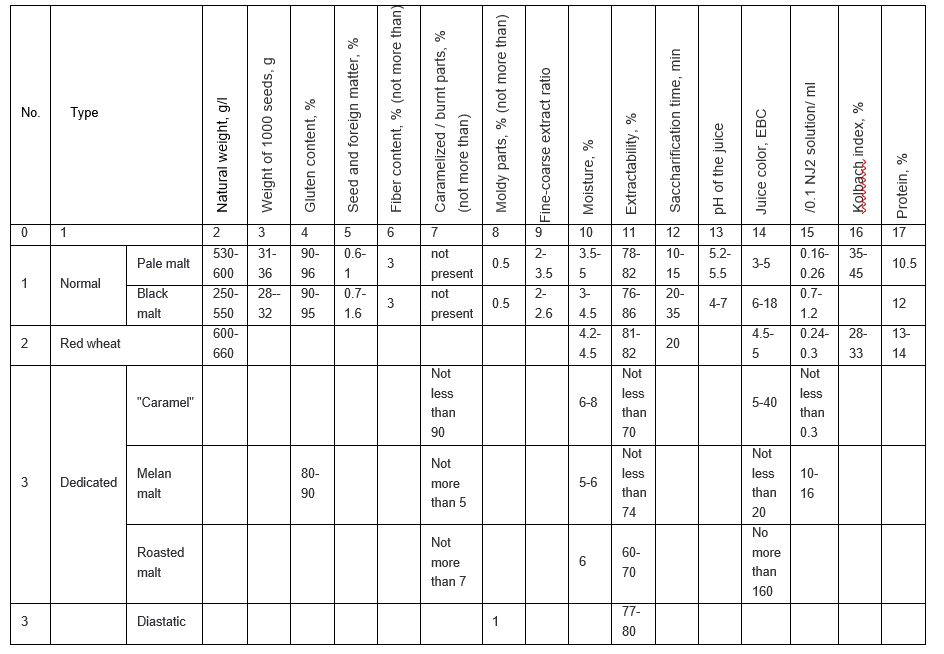
Malt, as the main raw material: all sensory, physical, chemical, and microbiological parameters specified in MNS 2108:2000 [4]
Table 1. Sensory parameters of malts, excerpted from MNS 2108:2000 [4]
| No. | Classification | Indicator | Appearance | Color | Taste | Smell |
| 1 | Normal | Pale malt | Dry, TOOC is free of dirt. The husk of the malt was as shiny as that of the barley. The beard and fangs are completely cleaned. It should not be hardened, glassy, or wrinkled. | Light yellow or uniform color. | Mild taste. Do not accompany. | Clean and must not be moldy, musty, and burnt. |
| Black malt | Yellow-greenish or dark glow. | |||||
| 2 | Dedicated | "Caramel" | Smooth surface without wrinkles. "Caramel" malt is glassy and bright. | Light yellow to brown intensity | The flavor of the juice is: Lightly sweet caramel, more pronounced caramel, almost bitter. | It has a distinctive aroma of malt. No external smell. |
| Melan malt | Saturated color of the melanoid formation reaction. | The flavor of the juice is divided into sweet taste. No bitter or sour taste. | It has a unique aroma of malt. | |||
| Roasted malt | When the sprout is cut, the embryo is dark brown in color. Burned seeds should not be more than 7%. | It is evenly dyed dark brown /not black/color. | Clean, coffee-flavored, not harsh or sharp. | It smells like barley coffee. |
Table 2. Chemical and physical parameters of malt, excerpted from MNS 2108:2000 [4]
2) Alcoholic ready-to-drink beverages (mainly Chuhai), 3-9% Alcohol
N/A.
3) Whisky, around 45% Alcohol
Same as Alcoholic ready-to-drink beverages.
3.3 Fortification
General Food
In Mongolia, food fortification regulations aim to address micronutrient deficiencies, with a focus on improving public health by adding essential nutrients to commonly consumed foods. Mandatory fortified foods in Mongolia include wheat flour and salt which serve as vehicles for adding nutrients like iron, vitamins group B, vitamin D, Zinc, and Iodine. For instance, wheat flour is fortified with folic acid to prevent neural tube defects, while salt is iodized.
Key regulations include:
- Law on Fortified Foods [7]
- List of Officially Fortified Foods [8]
- Law on Iodinated Salt and Prevention of Iodine Deficiency [9]
Apart from specific regulations on the addition of vitamins and minerals to flour and salt, Mongolia has not yet established a comprehensive list of nutrients permitted for addition to other foods.
Category
Alcohol
Alcoholic beverages are not explicitly addressed within the country's regulations on fortified foods.
3.4 Other Permitted Ingredients
Not specified by the regulations.
3.5 Permitted Additives
Article 2.2 of the 'Law on Ensuring the Safety of Food Products' establishes that international treaties to which Mongolia is a party take precedence over national legislation in cases of conflict. As a result, Mongolia’s food safety policies align with Codex standards, ensuring compliance with global norms, especially in the absence of a national list of approved food additives. This alignment facilitates Mongolia's integration into international food safety frameworks [1].
Article 17 of the same law assigns the central state administrative body the responsibility to establish safe levels and conditions for food additive use.
According to MNS CAC 192:2015, only food additives that have been evaluated and deemed safe by the Joint Expert Committee on Food Additives (JECFA) and the World Health Organization (WHO), and that meet the criteria for acceptable daily intake (ADI), are permitted for use in food. MNS CAC 192:2015 aligns with the Codex Standard CXS 192-1995 General Standard for Food Additives and references its latest official version in the event of any revisions. Therefore, the use of food additives in compliance with Codex standard CXS 192-1995 is considered consistent with Mongolia's regulatory requirements. [6, 10]
In applying Codex guidelines for alcoholic beverages, the use of food additives, including colors, within specified limits adheres to the provisions outlined in the Codex General Standard for Food Additives (CXS 192-1995), particularly in the following Codex food categories:
- 14.2 Alcoholic beverages, including alcohol-free and low-alcoholic counterparts
- 14.2.1 Beer and malt beverages
- 14.2.2 Cider and perry
- 14.2.3 Grape wines
- 14.2.3.1 Still grape wine
- 14.2.3.2 Sparkling and semi-sparkling grape wines
- 14.2.3.3 Fortified grape wine, grape liquor wine, and sweet grape wine
- 14.2.4 Wines (other than grapes)
- 14.2.5 Mead
- 14.2.6 Distilled spirituous beverages containing more than 15% alcohol
- 14.2.7 Aromatized alcoholic beverages (e.g. beer, wine, and spirituous cooler-type beverages, low-alcoholic refreshers)
3.6 Permitted Flavors and Colors
Colors
Similar to the content outlined for food additives in Section 3.5, Permitted Additives, above.
Flavors
Mongolia’s food safety legislation does not provide specific regulations for the use of flavors in food products. However, the Law on Ensuring Safety of Food Products requires that all food ingredients, including flavors, meet general safety guidelines. These guidelines mandate compliance with international food safety standards. In practice, in the absence of explicit national regulations on flavors, those that have been evaluated and approved by internationally recognized bodies—such as the Codex Alimentarius, the European Union (EU), and the U.S. Food and Drug Administration (FDA)—are commonly accepted in Mongolia.
3.7 Permitted Processing Aids
Mongolia does not have a dedicated positive list of processing aids in its national regulations. Instead, it aligns with international standards, primarily those from the Codex Alimentarius. Mongolia likely follows the Codex Standard CXG 75-2010 Codex Guidelines on Substances Used as Processing Aids, which provides advice on the safe use and regulation of processing aids in food production [10].
3.8 Additional Notes
Product
1) Beer, 4-7% Alcohol
The sensory parameters of beer are specified in Table 3 and the physical-chemical parameters in Table 4, respectively [3].
Table 3. Sensory parameters of beer excerpted from MNS 0181:2017 [3]
| No. | Indicator | Requirements |
| 1 | Taste | It has a unique taste suitable for the category. Does not contain foreign taste. Unfiltered, unsterilized beer may have a faint yeasty taste. |
| 2 | Fragrance | It has a unique fragrance suitable for the category. Does not contain external odor. |
| 3 | Clarity | Filtered beer is sparkling, clear, and free of foreign impurities, and during storage, unknown protein precipitates may form. Unfiltered beer is cloudy and has yeast sediment. The clarity of a unique beer is appropriate for its category. |
| 4 | Foam | The foam is homogeneous and dense. |
| 5 | Appearance | It has a specified amount of filling, the label is affixed correctly, it has a good appearance, and it has a strong filling. |
| Note: Top-fermented, unfiltered beers can change from light to dark, or dark to light, depending on the temperature. | ||
Table 4. Physical and chemical characteristics of beer excerpted from MNS 0181:2017 [3]
| No. | Classification | Initial density of the juice, % | Alcohol, % by volume | pH | Color | CO2 | Foam | |||
| 0.1 N iodine | by EBC-H unit | % | g/l | Thickness, mm | Stability, min | |||||
| 1 | Pale | 7-14 | 2-10 | 4.0 – 4.8 | 0.11-1.4 | 2-20 | 3.3-6.5 | >15 | 2 | |
| 2 | Dark | 11-18 | 2-10 | 4.0 – 4.8 | 1.5-6.1 | 21-60 | 3.3-6.5 | >15 | 2 | |
| 3 | Black | 6.3-13 | Not less than 61 | |||||||
| 4 | Unique | 7-30 | 0-25 | 3.0 – 5.2 | - | - | 3.3-6.5 | >15 | 2 | |
| The density and alcohol content of the original peony juice can vary by ±0.3%. | ||||||||||
2) Alcoholic ready-to-drink beverages (mainly Chuhai), 3-9% Alcohol
Ready-to-drink beverages meet the requirements specified in Table 5 for sensory characteristics and Table 6 for physico-chemical characteristics:
Table 5. Sensory parameters of ready-to-drink beverages, excerpted from MNS 5253:2003 and MNS 5984-2009 [5, 12]
| No. | Indicator | Carbonated | Non-Carbonated | Fruit, Fruit-Based Cocktails |
| 1 | Taste | 10-12 | 12-14 | The product has a distinctive taste and aroma based on its raw materials and food additives. The product has a unique taste and smell suitable for its category. No external/strange taste or smell |
| 2 | Aroma | 9-12 | 11-14 | |
| 3 | Color | 6-8 | 3-4 | The color depends on the raw materials; it should be clear but not completely transparent. The color matches the name of the product. |
| 4 | Carbonation | 3-4 | - | Carbonated low-alcohol beverages should be packaged under pressure. |
| 5 | Appearance | 4-6 | 6-8 | Should be free of sediment, evenly filled, with no floating particles, and properly sealed to prevent external contamination. It is filled to the prescribed level, the label is properly affixed, and the stopper is secure. Non-precipitated food additives can be dissolved or in physical form. |
| 6 | Total Score | 32-40 | 32-40 |
Table 6. Physico-chemical characteristics of ready-to-drink beverage, excerpted from MNS 5253:2023 and MNS 5984-2009 [5, 12]
| No. | Indicator, Measurement Unit | Acceptable Range |
| 1 | Ethanol Content, % by volume | 2.0 – 9.0 (MNS 5253:2023) 5.0 – 12 (MNS 5984:2009) The ethanol content may vary by ±0.2% from the stated amount. |
| 2 | Total Solids Content, % | 7.0 – 13.0 The dry matter content may vary by ±0.4%. |
| 3 | Acidity, g/L | 1.5 – 5.0 |
| 4 | Carbon Dioxide Content, % minimum (Applies to carbonated alcoholic soft drinks) | 0.25 |
| 5 | Amount of extract, g/100 cm³ | 0 – 10 |
| 6 | Amount of sugar, g/100 cm³ | 0 – 10 |
| 7 | Acidity, g/100cm³ (the amount of NaOH used to neutralize 100 ml of alcohol) | 0.2 – 0.7 |
Note: Test methods:
- Acidity, solid content, and alcohol content: "Analytical Methods for Various Types of Liquor" MNS 2117:89.
- Carbon dioxide content: "Various Beverages. General Technical Requirements" MNS 687:98.
3) Whisky, around 45% Alcohol
The sensory parameters of whisky meet the requirements specified in Table 7, physical-chemical parameters in Table 8, and permissible variation of physical and chemical parameters of alcohol in Table 9, respectively.
Table 7. Sensory parameters of whisky, excerpted from MNS 5984-2009 [5]
| No. | Indicator | Requirements |
| 1 | Taste and Fragrance | Product has a unique taste and smell suitable for its category. No external/strange taste or smell. |
| 2 | Color | The color matches the name of the product. |
| 3 | Appearance | It is filled to the prescribed level, the label is properly affixed, and the stopper is secure. Non-precipitated food additives can be dissolved or in physical form. |
Table 8. Physical and chemical parameters of whisky, excerpted from MNS 5984-2009 [5]
| Product | Food alcohol content and volume percentage | Amount of extract, g/100 cm³ | Amount of sugar, g/100 cm³ | Acidity, g/100cm³ (the amount of NaOH used to neutralize 100 ml of alcohol) |
| Whisky (Hard Liquor) | 35 | 25 | 25 | 0 – 0.5 |
Table 9. Permissible variation of physical and chemical parameters of liqueurs and liqueur-type alcohols excerpted from MNS 5984-2009 [5]
| No. | Indicator | Permissible variation (in the amount of extracts and sugars, g/100 cm³) | ||
Above 30 | 15-30 | Up to 15 | ||
| 1 | Food alcohol content and % by volume | ±0.5 | ±0.5 | ±0.5 |
| 2 | Content of extracts and sugars, g/100 cm³ | ±0.8 | ±0.6 | ±0.3 |
| 3 | Acidity, g/100cm³ (amount of NaOH used to neutralize alcohol). | ±0.03 | ±0.03 | ±0.03 |
Testing methods [5]:
- Alcohol content: "Analytical Methods for Various Types of Liquor" MNS 2117:89.
- Sensory parameters: "Method for Sensory Evaluation of Food-Grade Ethyl Alcohol, Spirits, and Wine Products" GOST R 52522:2006.
3.9 References
1. Law on Ensuring Safety of Food Products
https://legalinfo.mn/en/edtl/16959947951091
2. Decision of The Government of Mongolia on Technical Regulation for The Production of Alcoholic Beverages MNTR 1:2008
https://legalinfo.mn/mn/detail?lawId=4214
3. MNS 0181:2017 Various types of beer. General technical requirements
4. MNS 2108:2000 Malt - Technical general requirement
https://old.estandard.gov.mn/standard/v/4680
5. MNS 5984:2009 Alcoholic beverages. Liqueurs and liqueur-type alcohol. General technical requirements
https://old.estandard.gov.mn/standard/v/2351
6. MNS CAC 192: 2015 Food additives
7. Law on Fortified Foods
https://www.fao.org/faolex/results/details/en/c/LEX-FAOC185604
8. List of Officially Fortified Foods
https://legalinfo.mn/mn/detail?lawId=13839
9. Law on iodinated salt and prevention of iodine deficiency
https://faolex.fao.org/docs/pdf/mon185633.pdf
10. CXS 192-1995 General Standard for Food Additives
11. CXG 75-2010 Guidelines on Substances Used as Processing Aids
12. MNS 5253:2003 Alcoholic soft drink. Technical general requirements
https://old.estandard.gov.mn/standard/v/4716
Was this article helpful?