
3. Compositional Aspects
- 15 Mins to read
- DarkLight
3. Compositional Aspects
- 15 Mins to read
- DarkLight
Article summary
Did you find this summary helpful?
Thank you for your feedback
Beers, RTDs, Whisky
Thailand

This section provides the compositional requirements for the food category and/or food products in scope and information on permitted nutrients, ingredients, and additives.
3.1 Composition Requirements
Not all foods are subject to composition requirements. Only specific categories, such as controlled foods, foods with quality or standard specifications, and foods requiring labeling, are regulated with dedicated notifications and composition standards [1, 2].
For products like beer, alcoholic ready-to-drink beverages, and whisky, composition requirements are detailed in Section 2.2: Product & Definition of this guidebook.
3.2 Raw Material Requirements
General Food
Food ingredients must be safe, hygienic, and comply with the standards prescribed by the regulations to avoid being classified as impure, adulterated, or substandard. Additionally, the use of ingredients must be transparent, with no misleading claims regarding their quality or origin [1].
Thai FDA maintains positive and negative lists of ingredients as follows:
Commonly used food ingredients (Positive list 1)
The List of Ingredients Generally Allowed for Use in Food is currently published by the Thai FDA and is continuously updated on its website https://food.fda.moph.go.th/database-food/category/positivelists1.
Ingredients used in General Food may undergo basic processing, such as cutting, chopping, mincing, or grinding. However, this does not include extraction using solvents to obtain 'extracts.' 'Extracts' refer to substances derived from raw materials with a history of consumption, where active ingredients are separated from liquid or solid substances using solvents capable of dissolving the desired components.
Ingredients that can be used in food according to specific conditions (Positive list 2)
Ingredients Permitted for Use in Food Under Specified Conditions is maintained at link https://food.fda.moph.go.th/database-food/category/positivelists2
Detailed terms and conditions of use, including permitted parts and usage amounts are specifically mentioned in the documents available for download at this link.
Ingredients prohibited in food (Negative lists)
The list of ingredients prohibited in food including ingredients/groups of ingredients of plant and animal origin are being updated at the link: https://food.fda.moph.go.th/database-food/category/negativelists.
Category
Alcoholic beverages
Same raw material requirements as General Food above.
Product
1) Beer
Same as General Food.
2) Alcoholic ready-to-drink beverages (such as Chuhai)
Same as General Food.
3) Whisky
Same as General Food.
3.3 Fortification
3.3.1 Mandatory fortification
In Thailand, mandatory food fortification primarily focuses on iodizing salt to address iodine deficiency disorders. The Ministry of Public Health (MOPH) has implemented regulations requiring the addition of iodine to edible salt. Edible Salt shall have iodine content not less than 20 mg and not more than 40 mg per 1 kg of edible salt [2].
While the fortification of salt with iodine is mandatory in Thailand, MOPH Notification No.150 Re: Vitamin Fortified Rice does not require the mandatory fortification of all rice. Instead, it establishes regulations for the production and sale of vitamin-fortified rice, ensuring that such products comply with specific safety and labeling standards [3].
Aside from regulations on table salt, vitamin-fortified rice, and specialized nutritional products such as infant formula and follow-up formula, there are no mandatory requirements for fortifying general foods in Thailand.
3.3.2 Voluntary fortification
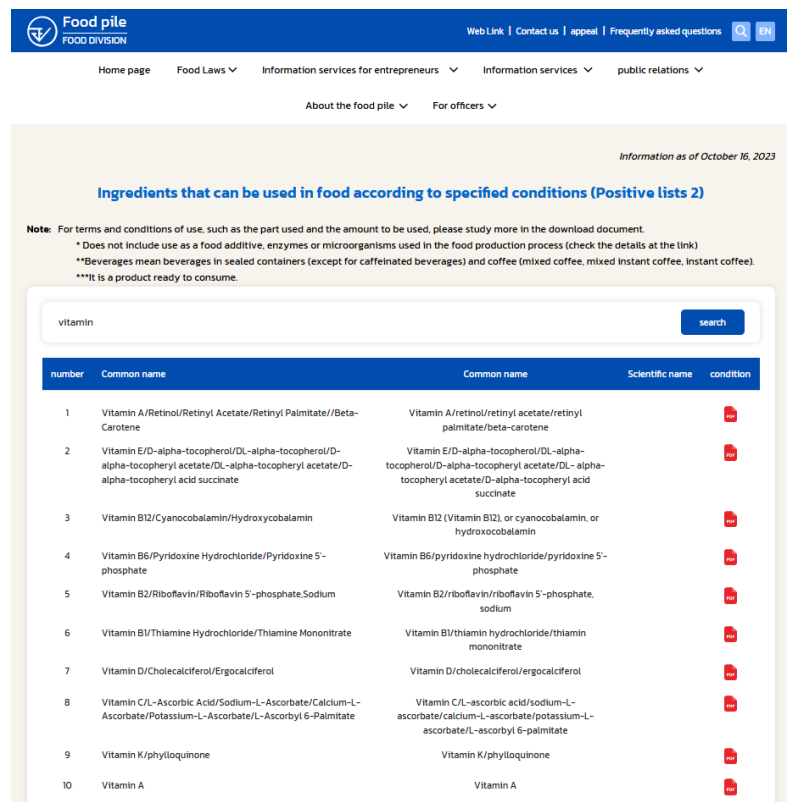
Vitamins and minerals may be voluntarily added to foods. The types and forms of nutrients permitted for use in food can be found in Positive List 2 - Ingredients Allowed for Use in Food Under Specified Conditions, accessible via the link https://food.fda.moph.go.th/database-food/category/positivelists2/. This list includes items such as vitamins, minerals, amino acids, plant extracts, etc. The terms and conditions for use, including permitted parts and usage limits, are detailed in downloadable documents available in the last column of the list. Refer to Figure 1 and Figure 2 below for examples of the representation of nutrients in Positive List 2.
If a nutrient substance is not included in Positive List 2 or is governed by another Thai MOPH regulation, consultation with the Thai FDA is required to determine its permissibility.
Although alcoholic beverages are not explicitly excluded from the fortification provisions, in practice, these products are not fortified.
Figure 1. Positive list 2 - Minerals that can be used in food according to specific condition
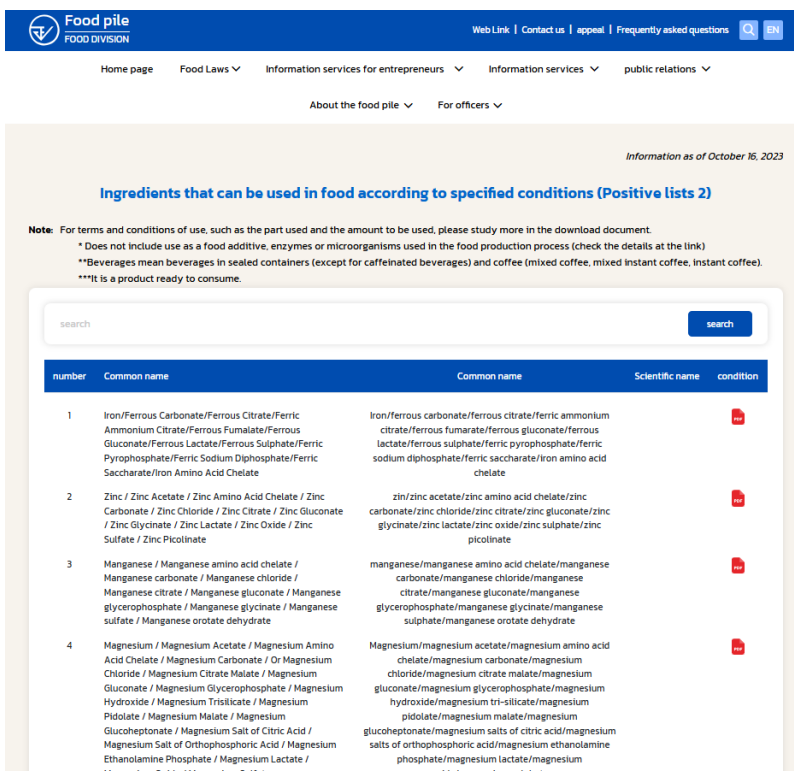
Figure 2. Positive list 2 - Vitamins that can be used in food according to specific condition
3.4 Other Permitted Ingredients
N/A.
3.5 Permitted Additives
General Food
The use of food additives must comply with the provisions of the MOPH Notification (No. 444) [1, 5].
Category
Alcoholic beverages
Under MOPH Notification No. 444 [5], food additives may be used in accordance with the regulations and permissible limits for the relevant food groups, including:
- 14.2 Alcoholic beverages - The alcohol-free and low-alcoholic counterparts are included in the same category as the alcoholic beverage.
- 14.2.1 Beer and malt beverages - Alcoholic beverages brewed from germinated barley (malt), hops, yeast, and water.
- 14.2.2 Cider and perry - Fruit wines made from apples (cider) and pears (perry). Includes carbonated cider and perry.
- 14.2.3 Grape wines - Alcoholic beverage obtained exclusively from the partial or complete alcoholic fermentation of fresh grapes, whether crushed or not, or of grape must (juice).
- 14.2.3.1 Still grape wine - Grape wine (white, red, rosé, or blush, dry or sweet) that may contain up to a maximum of 0.4g/100 ml (4000 mg/kg) carbon dioxide at 20 °C.
- 14.2.3.2 Sparkling and semi-sparkling grape wines - Grape wines in which carbonation is produced during the fermentation process, either by bottle fermentation or closed tank fermentation. Also includes carbonated wine whose carbon dioxide is partially or completely of exogenous origin.
- 14.2.3.3 Fortified grape wine, grape liquor wine, and sweet grape wine - Grape wines produced either by: (i) the fermentation of grape must (juice) of high sugar concentration; or (ii) by the blending of concentrated grape juice with wine; or (iii) the mixture of fermented must with alcohol.
- 14.2.4 Wines other than grapes - Includes wines made from fruit other than grapes, apples and pears. These wines may be still or sparkling.
- 14.2.5 Mead - Alcoholic liquor made from fermented honey, malt and spices, or just of honey.
- 14.2.6 Distilled spirituous beverages containing more than 15% alcohol - Includes all distilled spirituous beverages derived from grains (e.g. corn, barley, rye, wheat), tubes (e.g. potatoes), fruit (e.g. grapes, berries) or sugar cane that contain greater than 15% alcohol.
- 14.2.7 Aromatized alcoholic beverages - Includes all non-standardized alcoholic beverage products. Although most of these products contain less than 15% alcohol, some traditional non-standardized aromatized products may contain up to 24% alcohol.
Product
1) Beer
The use of food additives is permitted in accordance with MOPH Notification No. 444 applicable to group 14.2.1 Beer and malt beverages [5, 6].
2) Alcoholic ready-to-drink beverages
The use of food additives is permitted in accordance with MOPH Notification No. 444 applicable to group 14.2.7 Aromatized alcoholic beverages [5, 7].
3) Whisky
The use of food additives is permitted in accordance with MOPH Notification No. 444 applicable to group 14.2.6 Distilled spirituous beverages containing more than 15% alcohol [5, 7]
3.6 Permitted Flavors and Colors
General Food
Colorings
The use of food colorings must comply with the provisions of the MOPH Notification (No. 444) [1, 5].
Flavorings
In Thailand, the use of food flavorings is regulated by the Ministry of Public Health (MOPH) Notification No. 223 B.E. 2544 (2001) Re: Flavoring Agents [8]. This regulation classifies flavoring agents into three categories:
- Natural flavoring agents: agents for enhancing taste flavor which is physically derived from plants or animals normally used for human consumption.
- Imitation natural flavoring agents: flavoring agents derived from chemical extraction or synthesized flavoring agents in which the extracted substances or synthesized shall be of the same chemical properties as the natural products normally used for human consumption and shall mean to include imitate of the natural flavoring agents which contain natural flavoring agent content as well.
- Synthetic flavoring agents: flavoring agents which are not discovered in natural products normally used for human consumption and mean to include a synthesized flavoring agent which contains a natural flavoring agent or an imitate of a natural flavoring agent.
While there is no official notification explicitly referencing FEMA GRAS, current practices of the Thai FDA permit the use of food flavorings that comply with internationally recognized safety standards, such as those evaluated by the Flavor and Extract Manufacturers Association of the United States (FEMA) and designated as FEMA GRAS.
Category
Alcoholic beverages [4]
Colorings: The use of colors shall comply with the provision applicable for the specific food groups as mentioned for Category – Alcoholic Beverage of Section 3.5 above.
Flavorings: same as "General Food" above.
Product
1) Beer
Colorings: The use of colors shall comply with the provision applicable for the specific food group as mentioned for Product – Beer of Section 3.5 above.
Flavorings: same as "General Food" above.
2) Alcoholic ready-to-drink beverages
Colorings: The use of colors shall comply with the provision applicable for the specific food group as mentioned for Product – Alcoholic Ready to Drink beverage of Section 3.5 above.
Flavorings: same as "General Food" above.
3) Whisky
Colorings: The use of colors shall comply with the provision applicable for the specific food group as mentioned for Product – Whisky of Section 3.5 above.
Flavorings: same as "General Food" above.
3.7 Permitted Processing Aids
“Processing aid” means substances or any matters which are not for consumption in the manner of food compositions but are used in production of raw materials or food ingredients, by the used technology between qualities adjustment or processing, in which these substances or their derivatives may be unintentional or inevitable left over, in this regard not to include production equipment [9, 10]. Thailand does not maintain a specific positive list of food processing aids. Instead, the Thai FDA regulates these substances based on their functional subgroups, such as methyl alcohol used for specific products, cleaning and disinfecting agents [9, 10]. These regulations apply to food production in general, including alcoholic beverages.
Methyl alcohol as a processing aid
MOPH Notification 259 permits the use of methyl alcohol as a processing aid in specific foods, aligning with international Codex standards. Methyl alcohol may be used in producing calcium 5’-ribonucleotide, disodium 5’-ribonucleotide, and stevioside under strict conditions of quality and safety criteria mentioned in Articles 3 and 4 of MOPH Notification 259 [9].
Cleaning and disinfecting products used in food production
Permitted cleaning and disinfecting agents used in food production are regulated by MOPH Notification No. 412. Cleaning or sanitizing products for food is food additive used as processing aid to wash, clean, or reduce harmful materials in food (physical, biological, or chemical).
- Cleaning or sanitizing products for food are classified into three categories:
- Cleaning products
- Sanitizing products
- Combined cleaning and sanitizing products
- Active Ingredients for cleaning or sanitizing products for food must conform to at least one of the following:
- Latest version of FAO JECFA Monographs
- Latest version of Food Chemical Codex Monograph
- Latest version of Code of Federal Regulations Title 21 (USA)
- Approval by the Food and Drug Administration (FDA) under the Ministry of Public Health's Notification on food additives
- Requirements for other ingredients
- Food additives: Must comply with the Ministry's notification.
- Flavoring agents: Must be approved for food use.
- Water: Must meet the Ministry’s standards for drinking water in sealed containers.
- Contaminant limits for cleaning or sanitizing products
- Arsenic: ≤ 3 mg/kg
- Lead: ≤ 10 mg/kg
- Active ingredient usage must comply with the annex to MOPH Notification No. 412 regarding the following elements:
- Substances
- Food types
- Technological purposes
- Maximum use levels
- Residual limits in food
3.8 Additional Notes
3.8.1 Enzymes used in food processing
Enzymes used in food processing are regulated by MOPH Notification No. 443 [11].
Accordingly, enzymes used in food production are classified as food additives and designated as specifically controlled food. Enzymes must originate from approved plants, animals, or microbial sources listed in the notification or JECFA specifications. New enzyme sources require FDA approval based on safety assessments and detailed information. Applications must follow the conditions specified in the annexed schedules, JECFA standards, or other FDA-approved justifications.
Enzymes must meet the standards described in Table 3 below.
Table 3. Quality and safety standards of enzymes [11]
| Quality/Standard | Requirement |
| Enzyme activity | Must be at least 85% of the declared activity |
| Lead | Must not exceed 5 milligrams per kilogram |
| Salmonella | Must be absent in 25 grams |
| Coliforms | Must not exceed 30 per gram (MPN) |
| E. coli | Must be absent in 25 grams |
| Antibiotic activity (for microbial enzymes) | Must be absent |
| Mycotoxin (for fungal-source enzymes) | Must be absent |
| Genetically modified microorganism production strain | Must be absent in 1 gram of the enzyme |
| Other qualities or standards | As prescribed by the FDA based on risk assessment reports |
Enzyme preparations and immobilized enzymes must comply with approved lists or undergo FDA evaluation if unlisted. The use of enzymes in food production must adhere to the following:
- The conditions of use, including enzyme nomenclature, enzyme name, source, use conditions, and maximum use level, are specified in Schedule 1 annexed to MOPH Notification No. 443 [11].
- Functional uses outlined in the specifications of enzyme preparations according to the JECFA Combined Compendium of Food Additive Specifications.
- Conditions of use specified in MOPH Notification No. 444 on food additives.
For uses beyond these, approval from the Thai FDA is required, supported by technological justification. Producers or importers must submit the data outlined in Schedule 3 of MOPH Notification No. 443.
The use of food additives in enzyme preparations must comply with the conditions specified in Schedule 4 annexed to MOPH Notification No. 443. If a food additive not listed in Schedule 4 is intended for use, FDA approval must be obtained in accordance with MOPH Notification No. 444 on food additives [5,11].
The use of materials for immobilization or as supportive materials for immobilized enzymes must comply with the specifications in Schedule 5 annexed to MOPH Notification No. 443. If a material is not listed in Schedule 5, the Thai FDA may grant approval based on specifications approved in the country where the safety assessment has been conducted in accordance with international guidelines.
Requirements prescribed by MOPH Notification No. 443 exclude enzymes for nutrition, health benefits, food additives, processing aids, or those naturally occurring from fermentation [11].
Enzyme nomenclatures, enzyme names, sources of enzyme, maximum use level, and conditions of use in specific food categories, including alcoholic beverages, are specified in Schedule 1 annexed to MOPH Notification No. 443 regarding enzymes used in food production [11].
3.8.2 Microorganisms used in food production
Microorganisms used in food production are regulated by the MOPH Notification on Quality requirements or standards for microorganisms used in food production [12].
The regulation outlines quality standards for microorganisms used in food production, focusing on safety and functionality as per Table 4 below.
Table 4. Quality Requirements or Standards for Microorganisms Used in Food Production [12]
Category Microorganism Names | Characteristics | Specific Requirements |
| Fungi (Starter Culture) Penicillium candidum, Rhizopus oligosporus, R. oryzae, R. stolonifer | Non-toxic, available in liquid, semi-solid, or powder form; may include non-harmful substances to aid dispersion, prevent clumping, and assist in production. Function: Fermentation for food types in Appendix 1 to the notification | ≥85.0% of reported units |
| Lactobacillus Lactobacillus amylolyticus, L. amylovorus, L. alimentarius, L. buchneri, and others | Gram-positive, rod-shaped, non-spore forming, catalase-negative; converts sugars to lactic acid. Available in liquid, semi-solid, or powder form; may include non-harmful substances for production. Produces lactic acid for food types in Appendix 1 to the notification | ≥85.0% of reported units |
| Bifidobacterium Bifidobacterium thermophilum | Gram-positive, rod-shaped, non-spore forming, catalase-negative; converts sugars to citric or lactic acid. Available in liquid, semi-solid, or powder form; may include non-harmful substances for production. Function: Produces citric or lactic acid for food types in Appendix 1 to the notification | ≥85.0% of reported units |
| Propionibacterium Propionibacterium freudenreichii, P. acidopropinici, P. thoenii, P. jensenii | Gram-positive, rod-shaped, non-spore forming; produces propionic acid. Available in liquid, semi-solid, or powder form; may include non-harmful substances for production. Function: Produces propionic acid for food types in Appendix 1 to the notification | ≥85.0% of reported units |
| Leuconostoc Leuconostoc citreum, L. lactis, L. mesenteroides, L. pseudomesenteroides, and others | Gram-positive, round or oval, non-spore forming; digests sugar to lactic acid. Available in liquid, semi-solid, or powder form; may include non-harmful substances for production. Function: Produces lactic acid for food types in Appendix 1 to the notification | ≥85.0% of reported units |
| Pediococcus Pediococcus acidilactici, P. dextrinicus, P. pentosaceus | Gram-positive, spherical, non-spore forming; digests sugar to lactic acid. Available in liquid, semi-solid, or powder form; may include non-harmful substances for production. Function: Produces lactic acid for food types in Appendix 1 to the notification regulation | ≥85.0% of reported units |
| Acetobacter Acetobacter xylinum | Gram-negative, oval to slightly curved, non-spore forming. Available in liquid, semi-solid, or powder form; may include non-harmful substances for production. Function: Used in fermentation for food types in Appendix 1 to the notification | ≥85.0% of reported units |
Microorganisms must not be genetically modified unless explicitly approved by the FDA. Approval requires a safety assessment report per Ministry of Public Health guidelines on genetically modified food [12].
Contaminants limits applicable for microorganism mentioned in Table 4:
- Lead: ≤5 mg/kg
- Total coliforms: ≤30 cfu/g
- Salmonella spp.: Absent in 25 g
- E. coli: Absent in 25 g
- No harmful microbial toxins (per Table 5).
Table 5. Microbial Toxins in Natural Ingredients Used for Pure Culture Media [12]
| Natural Ingredients Used in Pure Culture Media | Microbial Toxins | Requirements |
| Almonds | Total aflatoxin | Not found |
| Brazil nuts | Total aflatoxin | Not found |
| Hazelnuts | Total aflatoxin | Not found |
| Peanuts | Total aflatoxin | Not found |
| Pistachios | Total aflatoxin | Not found |
| Dried figs | Total aflatoxin | Not found |
| Flour, meal, semolina, and flakes derived from wheat, maize, or barley | Deoxynivalenol Fumonisins* | Not found Not found |
| Cereal grains (wheat, maize, and barley) | Deoxynivalenol Ochratoxin A Fumonisins* | Not found Not found Not found |
| Milk | Aflatoxin M1 | Not found |
| Rye | Ochratoxin A | Not found |
| Apple juice | Patulin | Not found |
Note:
- Total aflatoxin: Includes the sum of aflatoxins B1, B2, G1, and G2.
- Fumonisins: Includes the sum of Fumonisins B1 and B2.
3.8.3 Requirements for fresh yeast from Saccharomyces cerevisiae [13]
Quality and safety requirements for yeast are regulated by the MOHP Notification on Quality requirements or standards for fresh yeast from yeast Saccharomyces cerevisiae [13]. The standard applicable to yeast used in food production is summarized in Table 6 below.
Table 6. Standards for Fresh Yeast from Saccharomyces cerevisiae [13].
| Category | Details |
| Yeast Name | Fresh yeast, Saccharomyces cerevisiae |
| Characteristics | • Light brown color with a distinctive yeasty smell. • Produced under controlled fermentation processes. |
| Forms: • Liquid Form: Total solid content of 15-21% by weight. • Compressed Form: Dehydrated yeast formed into blocks with a total solid content of 30-37% by weight. | |
| Specifications | • Carbon Dioxide Production: When 5 grams of fresh yeast are added to 50 ml of a 10% sugar solution at 35-40°C, carbon dioxide production begins within 1-4 hours. • Protein Content: Not less than 41%. • Total Ash Content: Not exceeding 8%. |
| Contaminants Limits | Heavy Metals: • Liquid yeast: ≤ 15 mg/kg. • Compressed yeast: ≤ 30 mg/kg |
| Arsenic: • Liquid yeast: ≤ 1.5 mg/kg. • Compressed yeast: ≤ 3 mg/kg. | |
| Microbial Contamination: • Coliforms: ≤ 1,000 cfu/g • Escherichia coli: ≤ 100 cfu/g • Salmonella spp.: Not detected in 25 g • Staphylococcus aureus: ≤ 10 cfu/g • Listeria monocytogenes: Not detected in 25 g |
3.9 References
1. Food Act B.E. 2522 (1979)
https://food.fda.moph.go.th/media.php?id=536782813802930176&name=law_act_EN.pdf
2. Notification of the Ministry of Public Health Re: Edible Salt
https://food.fda.moph.go.th/media.php?id=509369278236073984&name=No.%20333%20Edible%20Salt.pdf
3. Notification of the Ministry of Public Health Re: Vitaminized rice
https://food.fda.moph.go.th/media.php?id=509277907219259392&name=No.150-36%20Vitaminized%20Rice.pdf
4. MOPH Notification (No. 445) B.E. 2566 (2023) Re: Nutrition Labeling
https://food.fda.moph.go.th/media.php?id=689363893683888128&name=P445_EN.pdf
5. MOPH Notification (No. 444) B.E. 2566 Re: prescribing the principle, conditions, methods and proportion of food additives (No. 3)
https://food.fda.moph.go.th/media.php?id=575225582770593792&name=P444_EN.pdf
6. TIS 2090-2021 beer
https://service.tisi.go.th/tisi-standard-shop/item/tis/5620
7. TIS 2088-2021 Distilled liquor
https://service.tisi.go.th/tisi-standard-shop/item/tis/5566
8. Ministry of Public Health (MOPH) Notification No. 223 B.E. 2544 (2001) Re: Flavouring Agents.
https://food.fda.moph.go.th/media.php?id=509304818947465216&name=P223.pdf
[English] https://faolex.fao.org/docs/pdf/tha160621.pdf
9. MOPH Notification (No. 259) B.E. 2545, regarding the use of methyl alcohol as a processing aid for certain types of food.
10. MOPH Notification (No. 412) 2019 regarding cleaning or disinfecting products used for food
https://exfood.fda.moph.go.th/law/data/announ_moph/P412_E.pdf
11. MOPH Notification (No. 443) B.E. 2566 regarding enzymes for use in food production
https://en.fda.moph.go.th/media.php?id=575145142210666496&name=Notification%20443.pdf
12. Quality requirements or standards for microorganisms used in food production
https://food.fda.moph.go.th/media.php?id=510458995014770688&name=61_microorganism.pdf
13. Quality requirements or standards for fresh yeast from yeast Saccharomyces cerevisiae
https://food.fda.moph.go.th/media.php?id=510458994800861184&name=yeast.pdf
Was this article helpful?