
2. Product Categories
- 4 Mins to read
- DarkLight
2. Product Categories
- 4 Mins to read
- DarkLight
Article summary
Did you find this summary helpful?
Thank you for your feedback
Beers, RTDs, Whisky
India

This section provides the regulatory definition of the food category in scope, or the appropriate food category for the product in scope. Additionally, it provides the food products that belong to this food category along with the definition and specific information on each of these types of food products.
2.1 Category Name & Definition
General Food
Alcoholic beverages are part of the definition of food as per the FSSAI Act 2006 [1]: “Food” means any substance, whether processed, partially processed or unprocessed, which is intended for human consumption and includes primary food to the extent defined in clause (zk), genetically modified or engineered food or food containing such ingredients, infant food, packaged drinking water, alcoholic drink, chewing gum, and any substance, including water used into the food during its manufacture, preparation or treatment but does not include any animal feed, live animals unless they are prepared or processed for placing on the market for human consumption, plants, before harvesting, drugs and medicinal products, cosmetics, narcotic, or psychotropic substances.
Category Name
Alcoholic Beverages
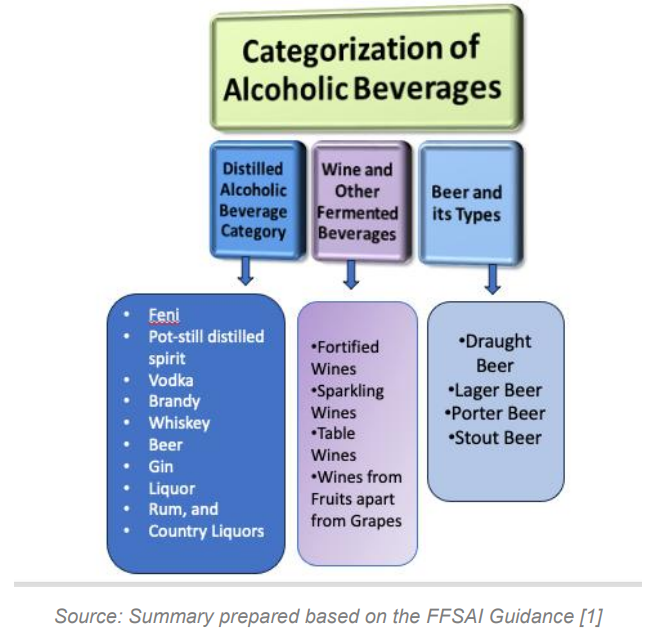
The food regulatory body, FSSAI, has mapped out the Alcoholic Beverages Standards Regulation, 2018 [4]: Alcoholic beverages are brews containing more than 0.5 percent. abv. The ethanol used in the production of alcoholic beverages shall be of agricultural origin; [Provided that this limit shall be zero in the case of Alcohol-free beer.]
Under the regulatory framework in India, alcoholic beverages fall under the "Alcoholic Beverages and Non-Alcoholic Beverages" category within General Food products.
2.2 Product & Definition
1) Beer
Definition
Beer is a fermented alcoholic beverage typically made from malted barley, hops, yeast, and water. The fermentation process converts sugars in the barley into alcohol, creating distinctive alcoholic content. There are various types of beer, including lagers, ales, stouts, and pilsners, each with unique flavors based on the ingredients and brewing techniques used [4].
Specifications/Target Age
Alcohol content is defined in Table 3 [2]. The legal drinking age varies across Indian states but generally ranges from 18 to 25 years.
Additional Information
N/A.
2) Alcoholic Ready-to-drink beverages
Ready-to–drink/ Low alcoholic beverages, shall be low alcoholic, flavored beverages having more than 0.5 to 8.0% alcohol ABV, made from the spirit or the mixture of spirit or any alcoholic beverage other than wine and beer as a base by adding natural / nature identical/artificial flavors and/or food additives permitted under the FSS (FPS&FA) Regulations 2011; and/or fruit/vegetable juice with or without added sugar/ salt and with or without carbonation. [5]
In the case of carbonated ready-to-drink (RTD) / low alcoholic beverages, they shall be carbonated with carbon dioxide. However, the carbonated RTD /low alcoholic beverages shall have a minimum of one volume of carbon dioxide. On the Indian market, the alcohol content in such RTDs generally ranges from 3% to 9% ABV. Common examples include alcoholic sodas, coolers, and cocktail-in-a-can products. [5]
Note the above definitions of RTDs [5] are a future amendment, currently under Public Consultation, and are expected to be officially adopted in the upcoming revision of the Food Safety and Standards (Food Products Standards and Food Additives) Regulations, 2011.
Specifications/Target Age
No alcohol content defined yet will be included in future amendments [5]. The legal drinking age for RTDs is generally consistent with that for other alcoholic beverages, varying by state in India. This can range from 18 to 25 years.
Additional Information
N/A.
3) Whisky
Definition
Whisky (or whiskey, depending on the region) is a distilled alcoholic beverage made from fermented grain mash. The grains used can include barley, corn, rye, and wheat. The production process involves distilling the grain mash, aging it in oak barrels, and typically filtering or adding flavoring agents to enhance its character [4].
Specifications/Target Age
On the Indian market, the alcohol content of whisky generally ranges between 36% and 50% ABV (Alcohol by Volume), but not a mandatory parameter. The legal drinking age for whisky in India typically follows the same guidelines as other alcoholic beverages and ranges from 18 to 25 years.
Additional Information
N/A.
2.3 References
1. FSSAI Act 2006
https://fssai.gov.in/cms/food-safety-and-standards-act-2006.php
2. FSSAI Guidelines on Alcoholic Beverages
3. Alimentarius - Alcoholic Beverages Standards
https://www.fao.org/fao-who-codexalimentarius/en/
4. Alcoholic Beverages Standards Regulation, 2018, updated 28 08 2023
https://fssai.gov.in/upload/uploadfiles/files/Comp_Alcoholic_Beverages(III)_28_08_2023.pdf
5. Draft notification on Food Safety and Standards (Alcoholic Beverages) Amendment Regulations, 2023 related to standards of Mead (Honey wine), Craft Beer, Indian liquors and definition of Low Alcoholic Beverages/ RTD, wine-based Beverages and, Country Liquors, etc.
https://comments.fssai.gov.in/Bestviewwl.aspx?NOTIFICATION_ID=4345
6. FSSAI Food Additives Regulations (2011)
https://www.fssai.gov.in/upload/uploadfiles/files/Food_Additives_Regulations.pdf
7. FSSAI Packaging and Labelling Regulations, 2011
https://www.fssai.gov.in/upload/uploadfiles/files/Compendium_Labelling_Display_23_09_2021.pdf
8. FSSAI Food Safety and Standards Act, 2006 (Chapter 9 – Penalties and Offenses)
9. FSSAI Nutrition and Health Claims Regulations, 2018
https://fssai.gov.in/upload/uploadfiles/files/Gazette_Notification_Advertising_Claims_27_11_2018.pdf
10. FSSAI proposed standards Claims
https://fssai.gov.in/upload/uploadfiles/files/Notice_Comments_Alcoholic_Beverages.pdf
11. FSSAI Food Safety and Standards (Advertising and Claims) Regulations, 2018
12. BIS FMCS - Foreign Manufacturer Certification Scheme
https://www.bis.gov.in/fmcs/certification-process/products-under-fmcs/
13. Custom clearance process
14. Direct and Indirect Taxes
15. Pesticide residue FSSAI Pesticide and Contaminant Regulations (Food Safety and Standards (Contaminants, Toxins, and Residues) Regulations, 2011)
16. Consumer Protection Act, 2019 Specifies penalties for misleading advertisements, including alcohol-related campaigns
17. BIS standards for packaging materials (e.g., IS 15410 for food-grade plastics)
18. IS 3752 Specification for Beer
19. IS 6613: Standards for distilled beverages
https://www.services.bis.gov.in/tmp/rp_19122023_658141877ea41.pdf
20. Haryana Excise law
21. Delhi Excise Law
22. Advertising Standards Council of India (ASCI): ASCI oversees advertising content to ensure ethical practices, including compliance for surrogate advertising of alcoholic beverages. For detailed guidelines
https://www.ascionline.in/wp-content/uploads/2024/04/Code-Book_Codes_Webready.pdf
23. Cable Television Networks (Regulation) Act, 1995: This act prohibits direct advertising of alcohol on cable TV and sets conditions for surrogate advertising
Home | Ministry of Information and Broadcasting
24. Food Safety Mantra Blog on FSSAI Alcoholic Beverages Standards: A helpful summary of the FSSAI and excise-related guidelines for alcohol advertising
Alcoholic Beverages | FSSAI Guidelines | Food Safety Mantra Blog
25. Consumer Protection Act, 2019: Specifies penalties for misleading advertisements, including alcohol-related campaigns
Legislative Department | Legislative Department | India
26. Alcohol test
27. Food Safety and Standards (Approval for Non-Specified Food) Regulations, 2017
28. FSSAI Food Licensing and Registration System
https://foscos.fssai.gov.in/about-flrs
29. Food Import Clearance System
30. ReFoM portal
https://sites.fssai.gov.in/refom/
31. Food safety and standard (Import) Regulation, 2017
https://www.fssai.gov.in/upload/uploadfiles/files/Compendium_Food_Import_Regulations_05_06_2022.pdf
32. Microbiological standards
https://www.fssai.gov.in/upload/uploadfiles/files/20_%20Appendix%20B.pdf
33. Shipment declaration
34. ISO 5555: Standard for testing phenolic compounds in wines
35. ISO 15192: Standard for beer quality testing, including compounds like esters and aldehydes
Was this article helpful?