
Regulatory Status for Food Supplements
- 4 Mins to read
- DarkLight
Regulatory Status for Food Supplements
- 4 Mins to read
- DarkLight
Article summary
Did you find this summary helpful?
Thank you for your feedback
Ashwagandha
Spain

This section provides a regulatory assessment for the use of Ashwagandha in Food Supplements in Spain.
1. Regulatory Background on Food Supplements in Spain
In Spain, the Spanish Agency for Food Safety and Nutrition (AESAN) is an autonomous body attached to the Ministry of Consumer Affairs in charge of verifying the quality, safety, and innocuousness of food supplements, which are defined and classified under food legislation. The specific regulatory framework for the category is described in:
- Royal Decree No 1487/2009 [1] Food Supplements, transposing EU Directive 2002/46/EC [2], which lays down a positive list of permitted vitamins and minerals; and
- Its amendments in Royal Decree No 130/2018 [3], transposing Regulation (EC) No 1170/2009 [4], which includes a positive list of other permitted substances with nutritional or physiological roles that can be added to food supplements
Royal Decree No 1487/2009 provides the following definition for food supplement:
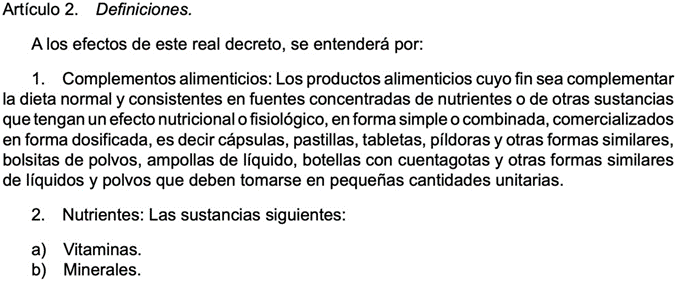
Figure 1. Excerpt from Article 2 of the Royal Decree No 1487/2009
English translation:
Article 2. Definitions.
For the purposes of this royal decree, it shall be understood as:
- Food supplements: Food products whose purpose is to supplement the normal diet and consisting of concentrated sources of nutrients or other substances that have a nutritional or physiological effect, in simple or combined form, marketed in dose form that is capsules, pills, tablets and other similar forms, powder sachets, ampoules of liquid, dropper bottles, and other similar forms of liquids and powders to be taken in small unit amounts.
- Nutrients: The following substances:
- Vitamins
- Minerals
It is worth noting that the above-mentioned regulations do not include a positive list of botanicals to be used in food supplements. Thus, AESAN has issued the Guide for official control of the labelling and composition of food supplements [5], stating that a food supplement will be considered safe if it contains ingredients for which, without being expressly and legally authorized, there is sufficient scientific information to conclude that the food supplement does not pose a risk to the health of the people who consume it. In particular, according to the Guide, ingredients contained, among other references, in the "List of Suitable Substances for Food Supplements in other EU Member States" may be considered safe, as the product is considered safe in other EU Member States.

Figure 2. Excerpt from Guide for the official control of the labeling and composition of food supplements
English translation:
In the absence of a Spanish regulation for ingredients other than vitamins and minerals, as well as for other substances with a nutritional or physiological effect, the principles of mutual recognition will apply, and the marketing of a food supplement legally marketed in another Member State cannot be hindered, unless it is substantiated and expressly justified through the procedure established in Regulation (EC) No 764/2008 and that established in articles 11 and 12 of Directive 2002/46/EC.
2. Permitted Use of Ashwagandha as an Active Ingredient in Food Supplements
Ashwagandha (scientific name:Withania Somnifera) is described in the “Italian list of other substances with nutritional and physiological effects that can be used in food supplements” [6] (see Figure 3). Thus, Ashwagandha can be used in food supplements to be marketed in Spain as well.
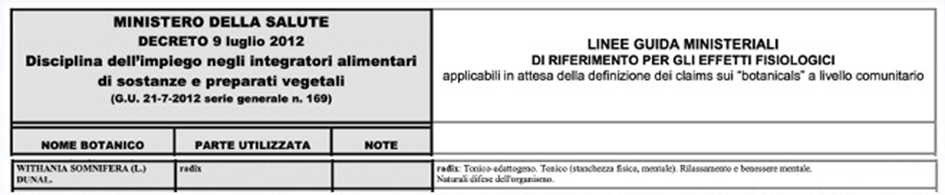
Figure 3. Excerpt from Italian list of other substances with nutritional and
physiological effect that can be used in food supplementsEnglish translation:
Ministry of Health Decree 9 July 2012 Regulation of use in food supplements of plant substances and preparations (OJ 21-7-2012 general series n. 169) | Ministerial Guidelines Reference for Physiological Effects Applicable pending the definition of claims on “botanicals” at community level | ||
Botanical name | Part used | Note |
|
Withania Somnifera (L.) Dunal. | Radix (root) |
| Radix: Tonic-adaptogen, Tonic (physical, mental fatigue), Relaxation, and mental well-being. Natural defense of organisms |
In the absence of a maximum limit stated in national or EU-level regulations (such as the above Italian list), the manufacturer is responsible to ensure the amount of Ashwagandha in food supplements is safe and has no pharmacological effects.
2.1 Applicable Specifications for Ashwagandha (Local and/or International Standards)
No national or EU-level specifications for Ashwagandha are identified. Therefore it is our best understanding that this plant species and its extracts must comply with the quality, safety, and food safety criteria applicable to food in general, in compliance with Regulation (EC) No 178/2002 [7] and Regulation (EC) No 1925/2006 [8].
In addition, the manufacturer should refer to the applicable specifications (contaminants, residual solvent, etc.) for botanical substances at the EU level.
Conclusion
- In Spain, the food supplement regulation does not include a positive list of botanicals but botanicals authorized in other EU Member States may be used.
- Ashwagandha (Withania Somnifera) is listed in Italy as a permitted botanical substance for use in food supplements. Hence, it is also permitted in food supplements in Spain.
- Currently, there is no maximum limit nor specifications for Ashwagandha (Withania Somnifera) in Spanish regulations. Manufacturer should at minimum refer to relevant provisions laid down in EU legislation regarding solvents, contaminants, and pesticides.
3. References
1. Royal Decree No 1487/2009 – Regulation for Food Supplements
https://www.boe.es/boe/dias/2009/10/09/pdfs/BOE-A-2009-16109.pdf
2. Directive 2002/46/EC – Approximation of the laws of the Member States relating to food supplements
https://eur-lex.europa.eu/legal-content/EN/TXT/?uri=CELEX%3A02002L0046-20220930
3. Royal Decree No 130/2018 – Amendment of Royal Decree No 1487/2009.
https://www.boe.es/boe/dias/2018/03/27/pdfs/BOE-A-2018-4245.pdf
4. Commission Regulation (EC) No 1170/2009 - Lists of vitamin and minerals and their forms that can be added to foods, including food supplements
https://eur-lex.europa.eu/legal-content/EN/ALL/?uri=CELEX%3A32009R1170
5. Guide for the official control of the labelling and composition of food supplements
6. Italian list of other substances with nutritional and physiological effect that can be used in food supplements
https://www.trovanorme.salute.gov.it/norme/dettaglioAtto?id=48636
7. Regulation (EC) No 178/2002 – Laying down the general principles and requirements of food law, establishing the European Food Safety Authority and laying down procedures in matters of food safety
https://eur-lex.europa.eu/legal-content/EN/TXT/?uri=CELEX%3A02002R0178-20220701
8. Regulation (EC) No 1925/2006 on the addition of vitamins and minerals and of certain other substances to foods
https://eur-lex.europa.eu/legal-content/EN/TXT/?uri=CELEX%3A02006R1925-20221221
Was this article helpful?