
Regulatory Status for Use in Food Supplements
- 3 Mins to read
- DarkLight
Regulatory Status for Use in Food Supplements
- 3 Mins to read
- DarkLight
Article summary
Did you find this summary helpful?
Thank you for your feedback
Regulatory Assessment for Melatonin
Thailand

This section provides a regulatory assessment for the use of Melatonin in Food Supplements in Thailand.
1. Authorized Usage in Food Supplements
Food supplements are classified as “Controlled Foods” following the standard notifications issued by the Thai FDA and are defined as follows:

Figure 2a. Definition of Controlled Food in Section 4 of Food Act B.E. 2522 [2]
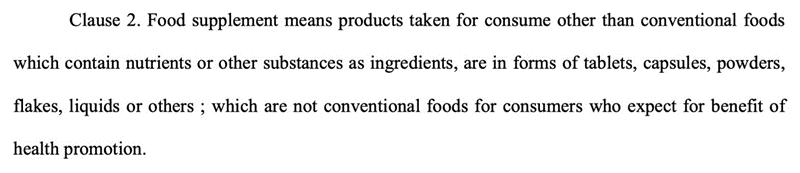
Figure 2b. Definition of Food Supplement in Clause 2 of MOPH Notification
No. 293 B.E.2548 (2005) Re. Food Supplement [3]
As shown in the Annex below in Section 2.5, the Thai FDA considers food supplements mixed with melatonin as illegal and thus, it is not permitted for use in food supplements either. Currently, melatonin is classified as a pharmaceutical product which is regulated under the drug law in Thailand.
A search on the Thai FDA database for drug registration [4] shows the following example of a drug containing melatonin as an active ingredient and classified as a “dangerous drug”:
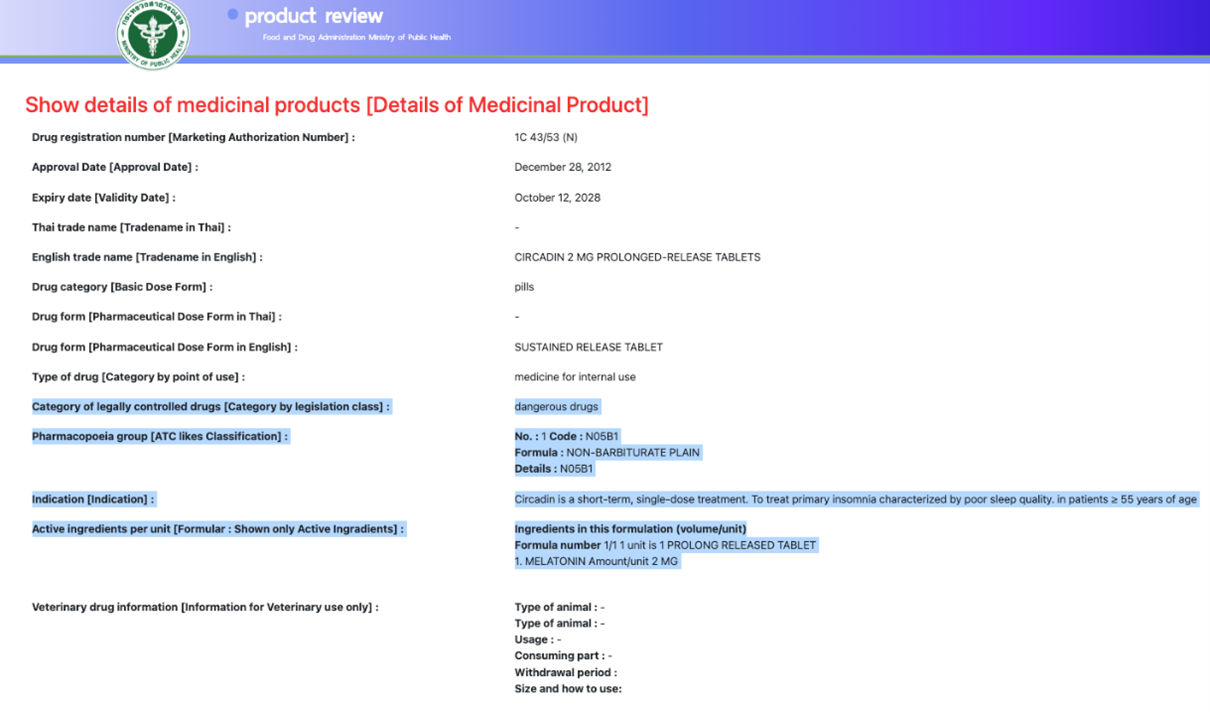
Figure 3. A medicinal product with the active ingredient melatonin which has been registered with the FDA and classified as a "dangerous drug"
2. Applicable Specifications (Local and/or international standards)
Currently, Thailand does not have applicable specifications for Melatonin as a food or food ingredient. The use of melatonin for drugs will be regulated by the Drugs Act B.E. 2510 (1967) [5].
3. Permitted Claims for Melatonin in Food Supplements
No claims are allowed for melatonin in food and food supplements because it is not authorized for use in foods [1, 2].
4. References
1. Thai FDA Press Release No 128, 2020: “Dietary supplements mixed with melatonin are illegal. The FDA warns that long-term use is dangerous”
https://food.fda.moph.go.th/law/data/act/E_FoodAct2522.pdf
3. MOPH Notification No. 293 B.E.2548 (2005) Re. Food Supplement
https://food.fda.moph.go.th/law/data/announ_moph/V.English/No.293-48%20Food%20Supplement.pdf
4. Thai FDA Drug registration information of the melatonin-containing product
5. Drugs Act B.E. 2510 (1967)
5. Annex
Excerpt from Thai FDA Press Release No 128, 2020 on 18 September 2020
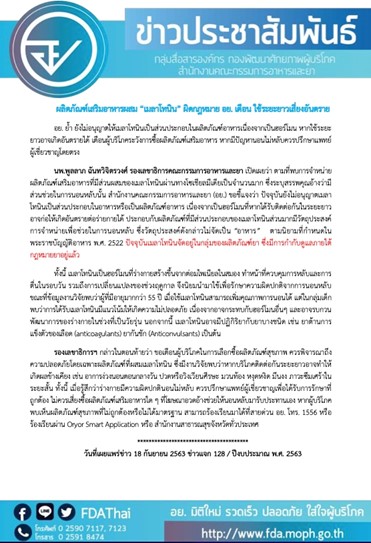
English translation:
Food supplements mixed with "melatonin" are illegal.
The FDA warns that long-term use is dangerous.
The Food and Drug Administration (FDA) emphasizes that melatonin is not allowed as an ingredient in food products because it is a hormone. With long-term use, it can be dangerous. Remind consumers to be careful when buying nutritional supplements. If you have trouble sleeping, you should consult a doctor.
Dr. Poonlarp Chanthawichitwong, Deputy Secretary-General of the Food and Drug Administration, revealed a large number of food supplements containing melatonin being sold through social media which state properties claiming to help sleep. The FDA would like to clarify that melatonin is currently not permitted as an ingredient in food or as a food product. Because it is a hormone that, if received in the long term, can cause harm to the body. In addition, most melatonin-containing products are marketed as sleep aid, of which such purpose is not classified as “food” as defined in the Food Act B.E. 2522. Currently, melatonin is classified as a pharmaceutical product that is regulated under the drug law.
Melatonin is a hormone that the body produces from the pineal gland in the brain. It controls sleep and wake cycles throughout the day, including seasonal changes. Therefore, it is popular to use water to treat sleep disorders. While research data showed that people over 55 years old when using melatonin can improve sleep quality, in the group of children it was found that exposure to melatonin is likely to be unsafe, as it may affect other hormones and may interfere with the development of the body during adolescence. In addition, melatonin may interact with certain drugs such as anticoagulants, anticonvulsants, etc.
The Deputy Secretary-General said to warn consumers when buying health products to take into account safety, especially for products containing melatonin. Research has shown that if consumed continuously for a long time, it may cause side effects such as drowsiness during the day, pain or dizziness, abdominal distension, irritability, dizziness, and short-term depression. Consult with a medical professional for proper treatment. Do not take the risk of taking any dietary supplements claiming to help you sleep. If consumers come across incorrect or substandard health products, complaints can be made at the FDA hotline 1556 or via Oryor Smart Application or the Provincial Public Health Offices across the country.
Was this article helpful?