
Regulatory Status for Use in Food
- 4 Mins to read
- DarkLight
Regulatory Status for Use in Food
- 4 Mins to read
- DarkLight
Article summary
Did you find this summary helpful?
Thank you for your feedback
Chondroitin Sulfate Sodium
Japan

This section provides a regulatory assessment for the use of Chondroitin Sulfate Sodium in Food in Japan.
1.1 Authorized Usage in Food
Regulatory background on additive and ingredient legislation
Under the current Japanese regulatory system, substances intentionally consumed by humans (excluding drugs) are divided into 2 categories: “food ingredients” and “food additives”. In general, food ingredients are defined as providing a nutritional purpose whereas food additives are typically used to provide a technical effect.
Food additives are regulated by a positive list system under which any new additives and/or new intended uses of additives are subject to a pre-market authorization by the Ministry of Health, Labour and Welfare (“MHLW”), the competent authority responsible for food hygiene and safety. On the other hand, there is no such authorization system for food ingredients. If a product is a food ingredient and conforms to the requirements set by the Food Sanitation Act (Act No. 233 of 1947) [1] and its subordinate regulatory documents, the product can be used in Japan with no specific restriction for use. The exact regulatory requirements can vary depending on the nature and type of food ingredient.
Chondroitin Sulfate Sodium
Chondroitin sulfate sodium is authorized as a food additive (humectant) [2] in a limited number of food categories [3] as shown below:


Since sodium chondroitin sulfate is classified as a food additive, its use as a food ingredient is not permitted.
Note: chondroitin sulfate, as an extract from animal soft bone that is not in a sodium salt form, is permitted as a food ingredient with no restriction for use [4] when it conforms to the requirements set out by the Food Sanitation Act (Act No. 233 of 1947) [1].
1.2 Applicable Specifications (including mandatory quality requirements, if any)
As a Food Additive
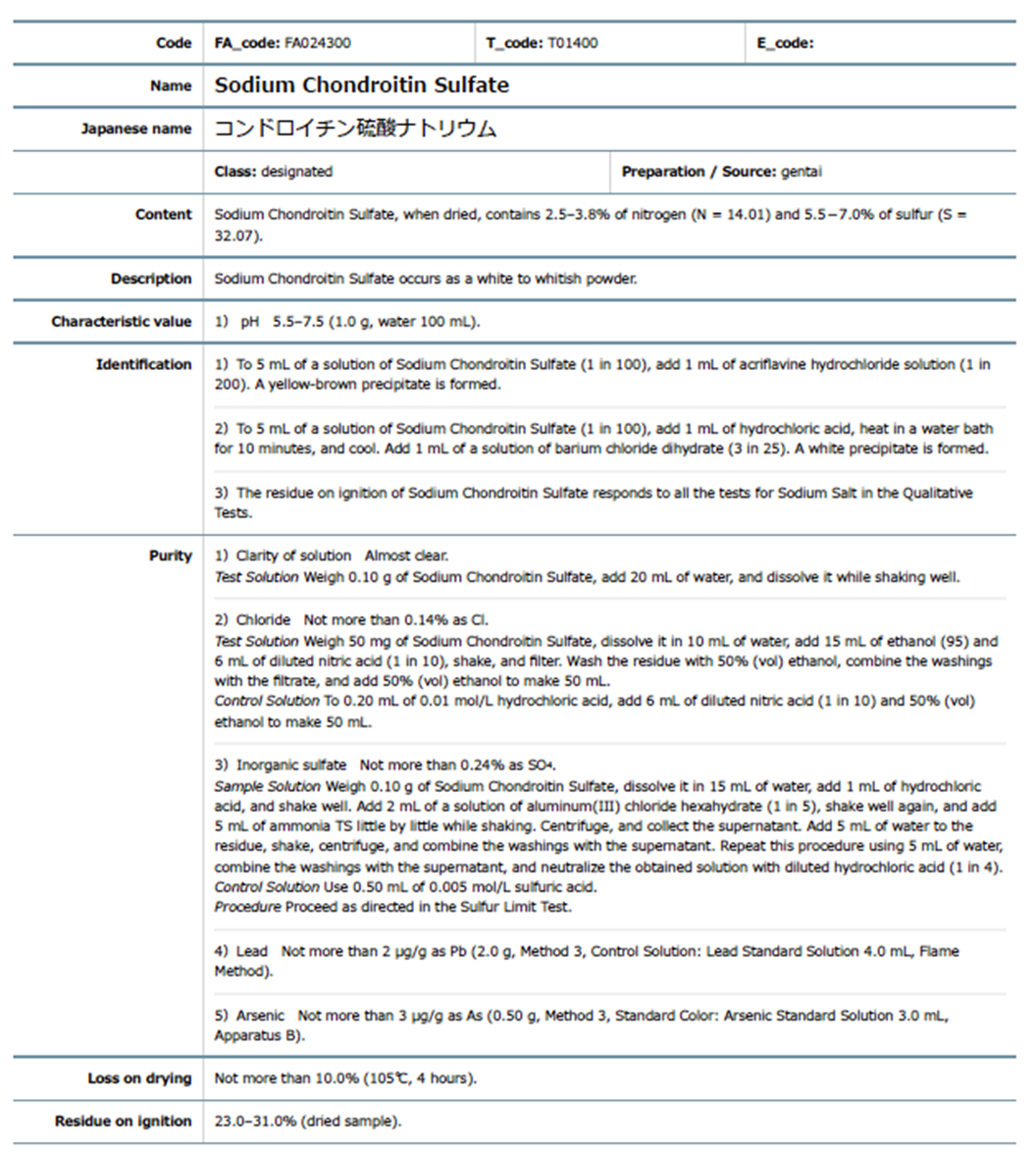
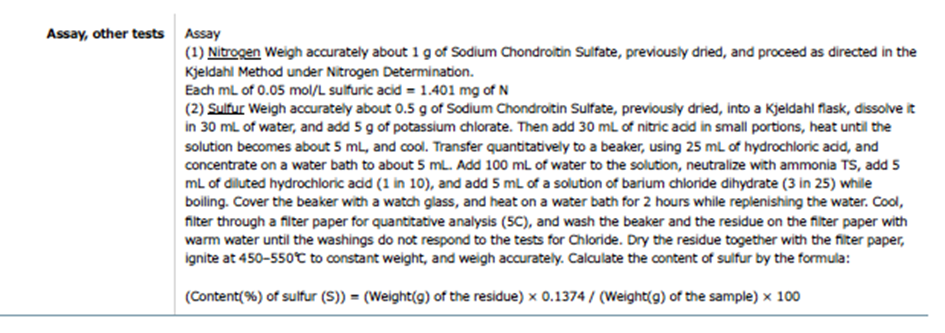
For chondroitin sulfate sodium as a food additive, there is a specification established by the MHLW (See section 1.5 - ANNEX - below), and it is included in Japan’s Specifications and Standards of Food Additives (“JSFA”) 9th edition [4]. In order to use the manufacturer’s product in Japan as a food additive, it must conform to this specification. Specific analysis methods and details of regents etc. are found in English on the webpage of the National Institute of Health Sciences [5].
Note: the specification established by the MHLW does not mention the production method. Therefore, the chondroitin sulfate sodium under consideration would be allowed for use if it conforms with the additive specification even if it is produced by microbial fermentation.
1.3 Registration Requirements
As a Food Additive
If the product does not conform to the JSFA specification and/or if the manufacturers wish to use their product in the currently permitted food categories (i.e., fish sausage, mayonnaise, and dressing), they will need to file an application that requests the MHLW to revise the JSFA specification of chondroitin sulfate sodium in the way that the specification covers the product. Similarly, if a manufacturer wishes to use the product in new food categories, they will need to file an application that requests the MHLW to revise the use standards of chondroitin sulfate sodium.
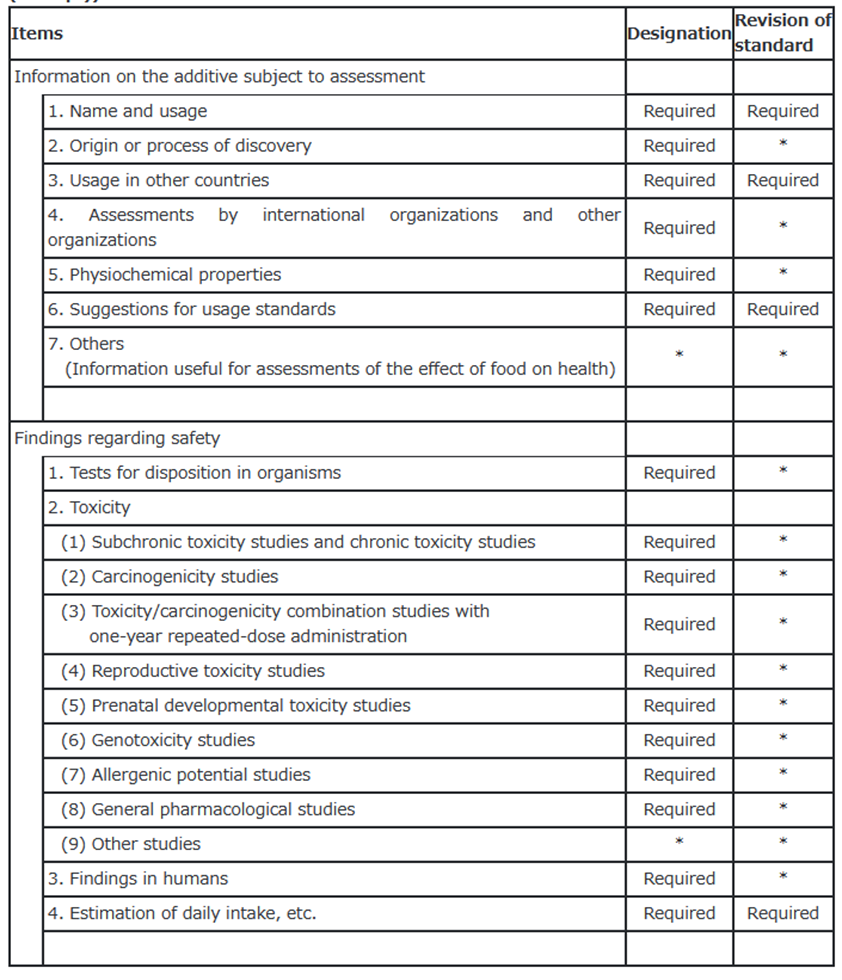
An overview of such a process to request a revision to the MHLW is presented in Figure 1. An overview of data requirements is also presented in Table 2 (See the “revision of standard” column). The timeline from formal receipt of an application by the MHLW until authorization is a minimum of 2 to 3 years. There is a preliminary review step before the MHLW’s formal receipt which requires a minimum of 1 to 2 years.
Figure 1. Process of the Pre-market Evaluation and Authorization of Food Additives [6] |
|
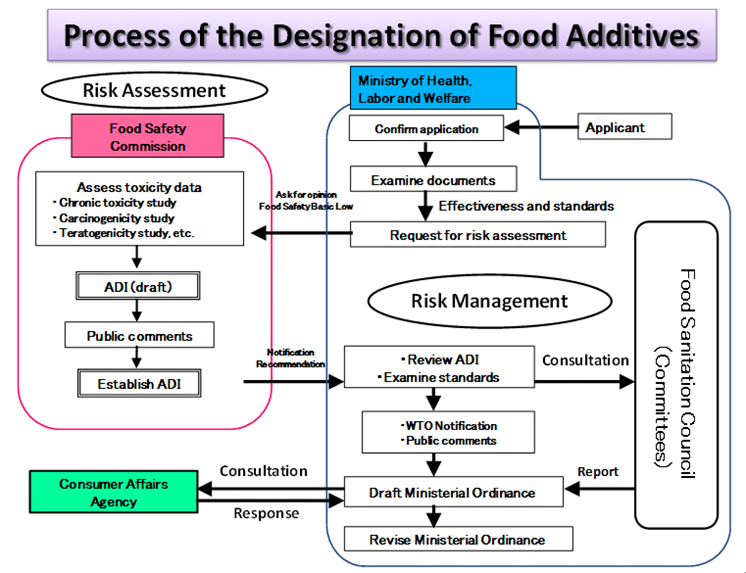
Table 2. Overview of Data Requirements for Pre-market Evaluation of Food Additives [6]
|
Note 1. When requesting a division of usage standards for a food additive for which an assessment of the effect of the food on health has already been carried out by FSCJ, the materials required for “Revision of standard” should be submitted. When requesting a division of usage standards for a food additive for which assessment of the effect of the food on health has not been carried out by FSCJ, documents required for designation should be submitted, in principle.
Note 2. Materials marked “Required” should be submitted whenever applicable. Materials marked with an asterisk (*) should be submitted as necessary (when there is a new finding, for example).
Note 3. When a combination test for chronic toxicity and carcinogenicity is carried out using one rodent species, a chronic toxicity test and carcinogenicity test on another rodent species can be omitted. |
1.4 References
1. Food Sanitation Act (Act No. 233 of 1947) (in English)
https://www.japaneselawtranslation.go.jp/ja/laws/view/3687
2. List of Designated Additives (in English)
https://www.ffcr.or.jp/en/tenka/list-of-designated-additives/list-of-designated-additives.html
3. Standards for Use of Food Additives (in English)
4. Section D Monographs in the Japan’s Specifications and Standards of Food Additives (JSFA) 9th edition (in English)
https://dfa25.nihs.go.jp/jssfa/list.php
5. Section B General Tests in the Japan’s Specifications and Standards of Food Additives (JSFA) 9th edition (in English)
6. “Food Additives” on the webpage of the MHLW (in English)
https://www.mhlw.go.jp/stf/seisakunitsuite/bunya/kenkou_iryou/shokuhin/syokuten/index_00012.html
1.5 Annex
Sodium chondroitin sulfate specifications from Japan’s Specifications and Standards of Food Additives (“JSFA”) 9th edition
Was this article helpful?